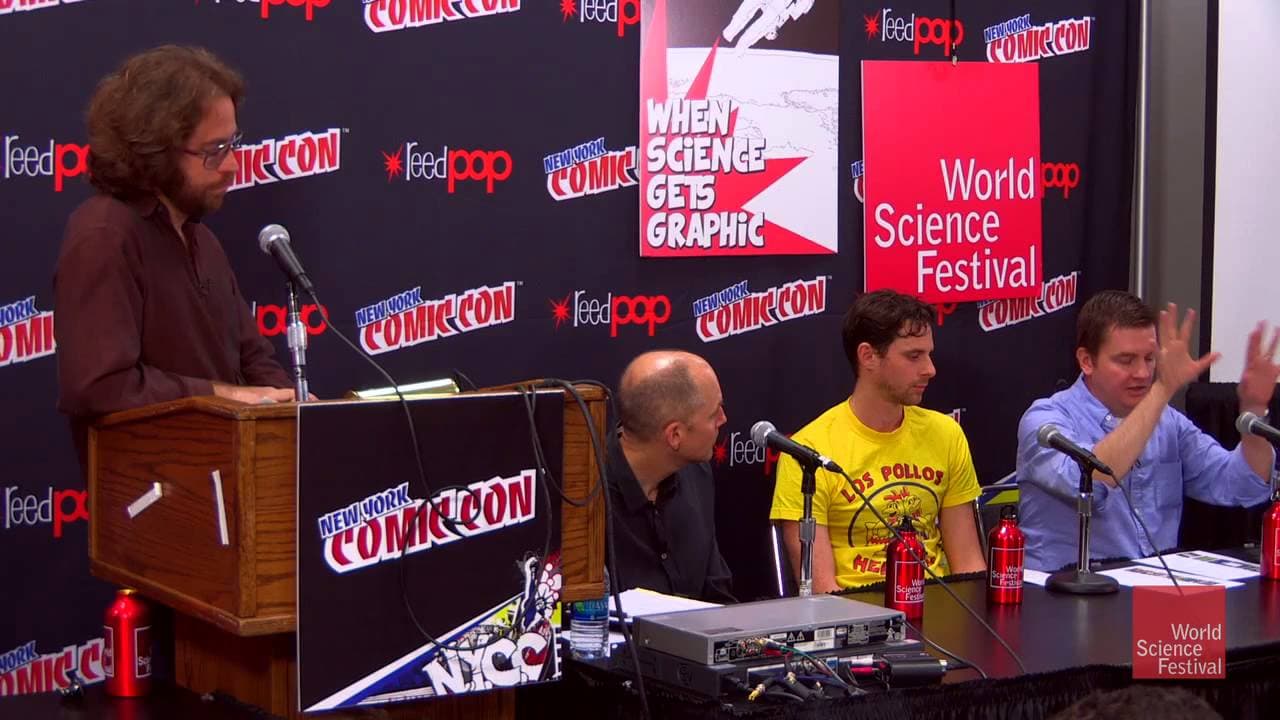
When Science Gets Graphic: How did you do the research?
TL;DR
Authors discuss the process of integrating complex scientific concepts and compelling narratives in graphic novels.
Transcript
foreign it occurs to me that you guys are you guys are tackling some some sort of complex and and deep subjects and you know in particular Charles I'm interested in your process when you when you say all right I'm going to write graphic novel about complexity Theory yeah you know how how do you even start to uh to research that and unpack that and ... Read More
Key Insights
- 👨🔬 Researching through books and expert consultation is crucial for accurately depicting complex scientific concepts in graphic novels.
- ⚖️ Balancing scientific accuracy and storytelling is essential to maintain reader engagement and understanding.
- 💡 Introducing concepts through a relatable character can help readers grasp complex ideas more easily.
- 🤩 Finding a balance between narrative and scientific detail is key in creating an engaging and informative graphic novel.
- 💁 Incorporating real-world examples, like extreme life forms, can make scientific concepts more relatable and interesting to readers.
- ❓ Using a "layman's approach" in explaining complex concepts can make them more accessible to a wider audience.
- 🏑 Collaborating with friends or experts in the field can help authors incorporate accurate scientific details while maintaining a compelling narrative.
Install to Summarize YouTube Videos and Get Transcripts
Explore YouTube Video Summarizer or Get YouTube Transcript Extractor
Questions & Answers
Q: How do authors approach researching complex scientific concepts for graphic novels?
Authors start by reading books, consulting experts, and ensuring they have a grasp of the subject matter to effectively integrate it into their storytelling.
Q: What role does narrative play in explaining intricate scientific ideas to readers?
The narrative in graphic novels helps in simplifying complex scientific concepts by presenting them through engaging story arcs and relatable characters.
Q: How do authors strike a balance between science and storytelling in their graphic novels?
Authors balance precise scientific accuracy with entertaining storytelling, ensuring that readers can learn about complex concepts while enjoying a compelling narrative.
Q: Why is it important to introduce scientific concepts through a relatable character like a young apprentice?
Using characters like a young apprentice helps in introducing complex scientific ideas in a digestible manner, as readers learn alongside the character.
Summary & Key Takeaways
-
Authors start by researching, reading books, and consulting experts smarter in the field.
-
They aim to find a balance between precise scientific details and an engaging storyline.
-
Introducing concepts through a young apprentice character helps readers understand complex ideas.
Read in Other Languages (beta)
Share This Summary 📚
Summarize YouTube Videos and Get Video Transcripts with 1-Click
Try YouTube Summary with ChatGPT & Claude or YouTube Transcript Generator
Explore More Summaries from World Science Festival 📚



Summarize YouTube Videos and Get Video Transcripts with 1-Click
Try YouTube Summary with ChatGPT & Claude or YouTube Transcript Generator