Asynchronous counters | Mod 6 and Mod 10 | STLD | Lec-136
TL;DR
Explanation of how to design mod 6 and mod 10 asynchronous counters using flip flops.
Transcript
hi everyone in this video I'm going to explain about the designing of mod 6 and mod 10 asynchronous counter so first we will see design of mod 6 asynchronous counter asynchronous counter synchronous counter these are two different counters that we can design using flip flops so asynchronous counter is having the output of first fpop is acting as cl... Read More
Key Insights
- 🔄 An asynchronous counter's outputs are interconnected as clock inputs for the subsequent flip flops, enabling sequential counting.
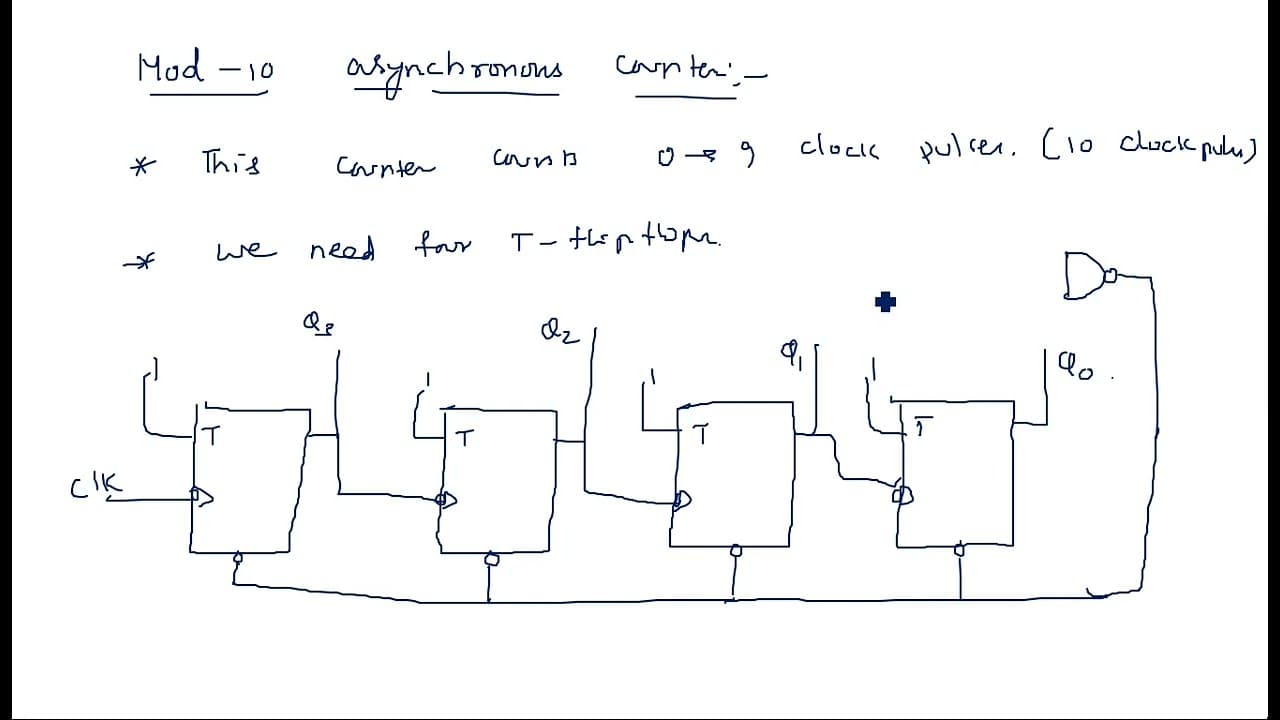
- 📳 For mod 6, three T flip flops are sufficient, while four are necessary for mod 10, reflecting binary representation needs.
- 🎨 The truth table is a crucial tool for understanding the state transitions of the counter operations, simplifying design processes.
- 🔄 Reset mechanisms, primarily controlled by NAND gates, ensure counters behave predictably, returning to zero after reaching their maximum count.
- ✋ Differences in designs highlight operational scaling; how more flip flops are needed for higher mod values demonstrates increased complexity.
- 🔄 A clear understanding of the roles of clock pulses, outputs, and reset signals within the designs is critical to developing functional counters.
- 🛟 Logic diagrams serve as essential blueprints for implementation, detailing how the circuit components interact and ensuring accurate design.
Install to Summarize YouTube Videos and Get Transcripts
Explore YouTube Video Summarizer or Get YouTube Transcript Extractor
Questions & Answers
Q: What is a mod 6 asynchronous counter, and how does it function?
A mod 6 asynchronous counter is a counting device that counts from 0 to 5. It utilizes flip flops where the output of one serves as the clock input for the next. Upon receiving the sixth clock pulse, it resets back to zero, effectively cycling through a sequence of states defined by its structure.
Q: How many flip flops are needed for a mod 6 counter, and why?
A mod 6 counter requires three T flip flops. This is because the highest count, which is 5, can be represented in binary as 101, necessitating three bits. Since each flip flop can store one bit, three flip flops are needed to achieve this representation.
Q: What role do the truth tables play in designing these counters?
Truth tables outline the state of the counter outputs (Q2, Q1, Q0) in relation to the clock pulses. They provide a clear description of how the counter progresses through its counts and when the reset pin is activated, allowing for better visualization and planning of the counter's operation.
Q: Can you explain the reset mechanism of the mod 6 asynchronous counter?
The reset mechanism activates when the output of the second and first flip flops read as '1', feeding into a NAND gate. When both inputs to the NAND gate are high (1), its output goes low (0), which triggers the reset pin to clear the outputs of all flip flops back to zero.
Q: How does a mod 10 counter differ from a mod 6 counter in design?
A mod 10 counter differs primarily in the number of flip flops used; it requires four T flip flops instead of three. This is because it counts from 0 to 9, necessitating four bits to represent the counts accurately, which illustrates how the design expands in complexity with increasing mod values.
Q: What is the function of a NAND gate in these counter designs?
In the counter designs, the NAND gate processes the output states of certain flip flops to control the reset mechanism. When specific conditions are met—typically when two flip flops both output '1'—the NAND gate triggers a reset signal, ensuring the counter returns to its initial state.
Q: How is the clock pulse applied in these asynchronous counters?
The clock pulse for asynchronous counters is applied to the first flip flop directly. Each subsequent flip flop receives its clock input from the output of the previous flip flop. This chain reaction results in staggered toggling, characteristic of asynchronous counter operation.
Q: What does a logic diagram represent in the context of these counters?
A logic diagram visually represents how flip flops and logic gates are connected to implement the counting logic. It provides a roadmap for the electrical connections necessary to build the counter, illustrating how the signals flow through the system to achieve the desired counting behavior.
Summary & Key Takeaways
-
The video covers the design process of mod 6 and mod 10 asynchronous counters, explaining their fundamental differences and functionalities.
-
It emphasizes the use of T flip flops for building these counters, detailing the necessary number of flip flops and their binary representations.
-
The speaker describes truth tables and logic diagrams to illustrate the reset mechanisms and clock pulse operations involved in these counting systems.
Read in Other Languages (beta)
Share This Summary 📚
Summarize YouTube Videos and Get Video Transcripts with 1-Click
Try YouTube Summary with ChatGPT & Claude or YouTube Transcript Generator