How to Get Used to Indonesian Words
TL;DR
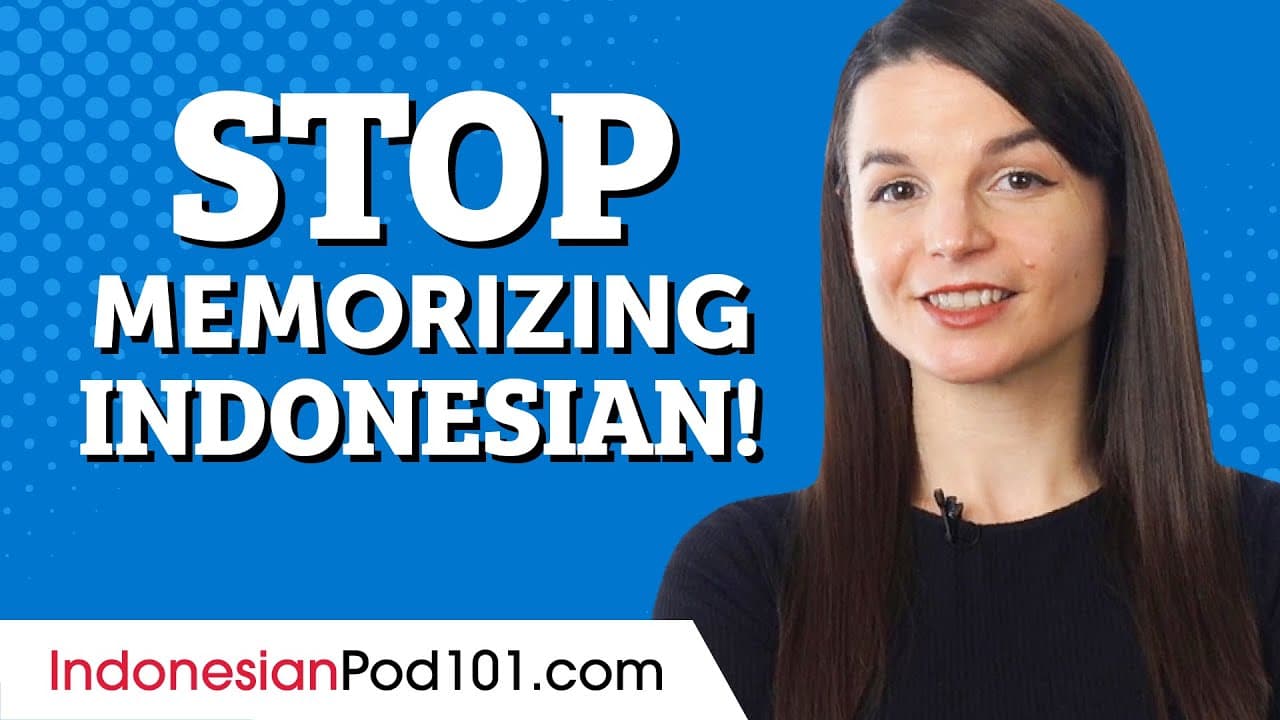
Learn a language by listening and reading, not memorizing.
Transcript
want to learn more words there's an easy way to boost your vocabulary and speak more of your target language and it doesn't involve memorization in fact all you need to do is press play and listen along as often as possible and get used to the language what does this mean exactly stick around how to get used to words so you can learn fast and skip ... Read More
Key Insights
- Listening to a language repeatedly helps you get used to it naturally, similar to learning to ride a bike or use a new device.
- The provided language learning system offers a structured pathway of lessons that include conversations, translations, and explanations to enhance understanding.
- Re-listening to dialogues without translations can immerse you in the language and reinforce vocabulary learning.
- The vocabulary slideshow tool allows for repetitive listening of words, aiding in memorization through audio-visual exposure.
- Extensive reading emphasizes quantity over quality, encouraging reading without pausing over unknown words to build vocabulary through context.
- The learning system offers extensive reading materials at various difficulty levels to cater to different learners' needs.
- Space repetition flashcards are available to help cement words into long-term memory through regular review.
- A personal vocabulary collection can be created using the word bank feature, allowing for customized study sheets and vocabulary review.
Install to Summarize YouTube Videos and Get Transcripts
Explore YouTube Video Summarizer or Get YouTube Transcript Extractor
Questions & Answers
Q: How does listening help in language learning?
Listening helps in language learning by providing repeated exposure to the language, allowing learners to naturally get used to words and grammar rules. This method mimics how people learn their native language, where frequent exposure leads to familiarity and understanding without the need for conscious memorization.
Q: What is the role of extensive reading in language acquisition?
Extensive reading plays a crucial role in language acquisition by exposing learners to a large volume of text, encouraging them to understand the language in context. This method prioritizes quantity over quality, allowing learners to read without focusing on unknown words, thereby enhancing vocabulary through context and repeated exposure.
Q: What tools are available in the language learning system?
The language learning system offers various tools, including structured lessons with conversations and translations, vocabulary slideshow tools for repetitive listening, space repetition flashcards for long-term memory retention, and a word bank feature for personalized vocabulary collection and review. These tools collectively enhance the learning experience by providing diverse methods of exposure and practice.
Q: How do space repetition flashcards aid in learning?
Space repetition flashcards aid in learning by systematically reviewing vocabulary at increasing intervals, helping to cement words into long-term memory. This method leverages the psychological spacing effect, where information is more easily recalled when reviewed over spaced intervals, thus reinforcing retention and recall of vocabulary.
Q: What is the benefit of using the vocabulary slideshow tool?
The vocabulary slideshow tool benefits learners by providing a repetitive audio-visual exposure to words. By listening to words on repeat while simultaneously reading them on the screen, learners can enhance their memorization and recall abilities, making it easier to internalize vocabulary through consistent practice and exposure.
Q: Why is it important to have a structured learning pathway?
A structured learning pathway is important because it provides a clear, step-by-step approach to language acquisition, ensuring that learners systematically build on their knowledge. It helps in organizing lessons in a coherent manner, gradually increasing complexity and reinforcing previous learning, which enhances overall comprehension and retention.
Q: How does re-listening to dialogues without translations help?
Re-listening to dialogues without translations helps by immersing learners in the language, encouraging them to focus on the sounds, rhythms, and patterns of the language. This practice aids in developing listening comprehension skills and reinforces vocabulary and grammar understanding through repeated exposure, without relying on translation.
Q: What levels of extensive reading materials are available?
The extensive reading materials in the learning system are available at various levels, including absolute beginner, beginner, and intermediate. These materials are designed to match the learner's proficiency level, providing appropriate challenges without overwhelming them, and allowing for gradual improvement through consistent reading practice.
Summary & Key Takeaways
-
The content emphasizes learning a language through exposure rather than memorization. By listening to conversations and reading extensively, learners can naturally acquire vocabulary and grammar. The language system provides structured lessons, dialogues, and tools like flashcards and slideshows to aid in the learning process.
-
Listening repeatedly to language dialogues helps learners get used to vocabulary and grammar naturally. The system offers a step-by-step learning pathway, with lessons that include conversations, translations, and grammar explanations, reinforcing learning through repetition and exposure.
-
Extensive reading is highlighted as a method to boost vocabulary by focusing on reading large quantities without worrying about unknown words. The learning system provides reading materials at various levels, encouraging learners to understand contextually and improve their language skills through consistent practice.
Read in Other Languages (beta)
Share This Summary 📚
Summarize YouTube Videos and Get Video Transcripts with 1-Click
Try YouTube Summary with ChatGPT & Claude or YouTube Transcript Generator
Explore More Summaries from Learn Indonesian with IndonesianPod101.com 📚



Summarize YouTube Videos and Get Video Transcripts with 1-Click
Try YouTube Summary with ChatGPT & Claude or YouTube Transcript Generator