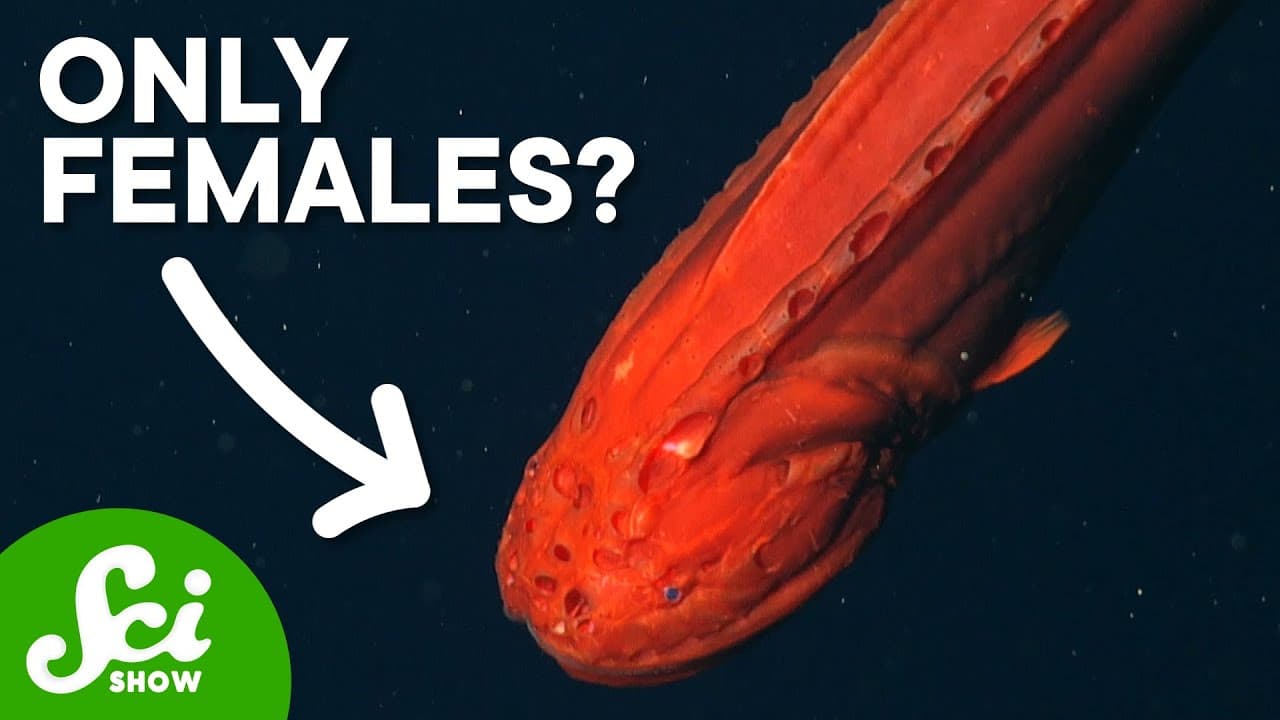
Why Are There No Male Whalefish?
TL;DR
Scientists unravel mysteries of deep-sea fish families through DNA analysis, revealing unique adaptations and life strategies.
Transcript
Thanks to the Monterey Bay Aquarium and their research and technology partner MBARI for partnering with us on this episode of SciShow. They are super excited for folks to learn about the deep sea. [♪ INTRO] Even though they live in Earth’s largest habitat, we just don’t know a whole lot about the extraordinary creatures found in the deep sea. So we... Read More
Key Insights
- 🤢 Deep-sea fish families are often studied through trawl nets and video recordings due to the challenges of their habitat.
- 👪 The discovery that three distinct fish families actually belong to one Cetomimidae family highlights the importance of DNA analysis in taxonomy.
- 🕵️♀️ Male and female fish in the Cetomimidae family display extreme sexual dimorphism and unique adaptations for survival in the deep sea.
- 🤢 DNA analysis plays a crucial role in unraveling mysteries and connecting seemingly unrelated fish families in the deep sea.
- 🕵️♀️ The Cetomimidae family showcases unique life strategies and adaptations for males and females to survive in the extreme conditions of the deep sea.
- 👪 Further genetic analysis is needed to fully understand the diversity and life stages of the Cetomimidae family.
- 👨🔬 The collaboration between research institutions like the Monterey Bay Aquarium and MBARI enables scientific discoveries and advancements in deep-sea exploration.
Install to Summarize YouTube Videos and Get Transcripts
Explore YouTube Video Summarizer or Get YouTube Transcript Extractor
Questions & Answers
Q: How do researchers study deep-sea fish, and why are they often left with more questions than answers?
Researchers study deep-sea fish through trawl nets and video recordings, but the elusive nature of these creatures leaves gaps in understanding due to limited data availability.
Q: What led scientists to discover that three different fish families were actually part of one Cetomimidae family?
DNA analysis revealed close genetic similarities between specimens from supposed different families, ultimately leading to the consolidation of Whalefish, Bignose, and Tapetail fish into one family.
Q: What unique adaptations do male and female fish in the Cetomimidae family exhibit?
Male fish stop eating as adults, relying on stored energy from their giant liver for reproduction, while females continue to grow larger and consume larger prey with elongated jaws.
Q: What challenges remain in fully understanding the Cetomimidae family?
While over 20 species are known, matching different life stages and understanding the full extent of genetic diversity require further genetic analysis.
Summary & Key Takeaways
-
Deep-sea creatures remain largely unknown, leading researchers to study fish through trawl nets and video recordings.
-
Three enigmatic fish families, originally thought to be separate, were discovered to belong to one Cetomimidae family through DNA analysis.
-
Male and female fish within the Cetomimidae family display extreme sexual dimorphism and unique adaptations for survival in the deep sea.
Read in Other Languages (beta)
Share This Summary 📚
Summarize YouTube Videos and Get Video Transcripts with 1-Click
Try YouTube Summary with ChatGPT & Claude or YouTube Transcript Generator
Explore More Summaries from SciShow 📚


Summarize YouTube Videos and Get Video Transcripts with 1-Click
Try YouTube Summary with ChatGPT & Claude or YouTube Transcript Generator