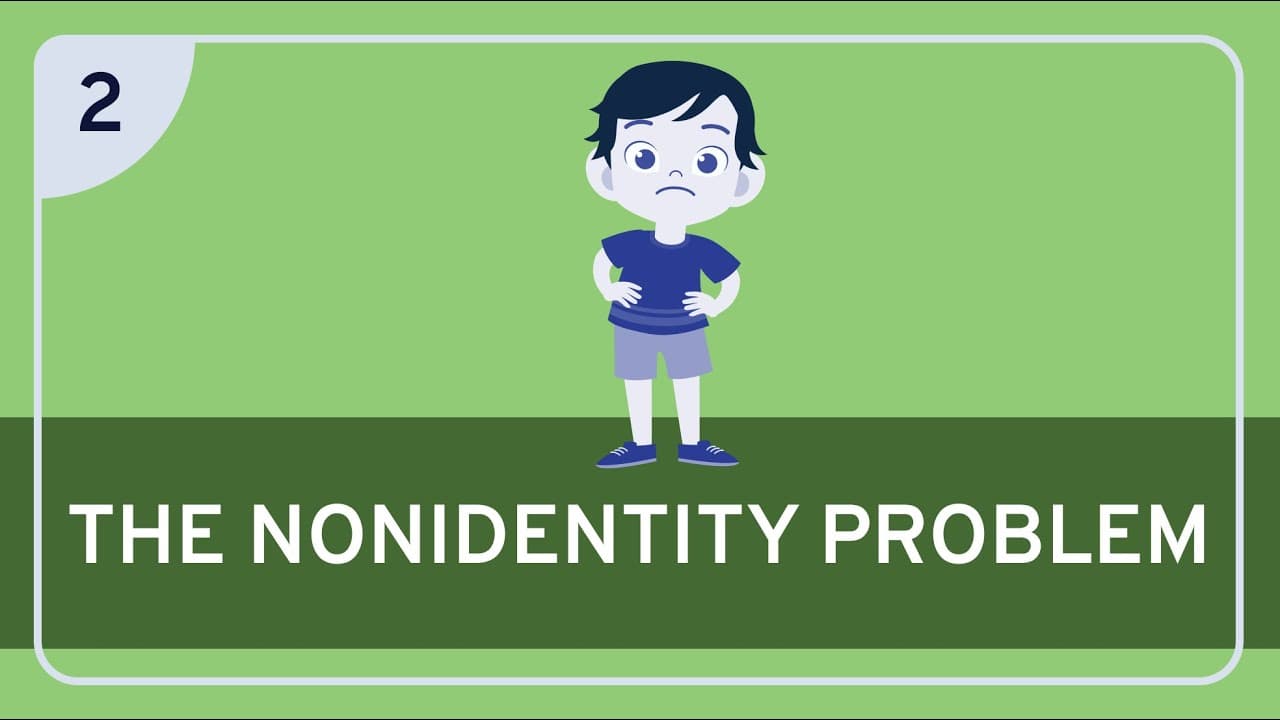
The Nonidentity Problem #2 - Ethics | WIRELESS PHILOSOPHY
TL;DR
Exploration of philosophical strategies to address the nonidentity problem.
Transcript
hello again my name is Molly Gardner and I am now an assistant professor in the philosophy department at Bowling Green State University in Bowling Green Ohio this is the second in a two-part series on the non-identity problem in this video I will survey some of the ways that philosophers have attempted to solve the problem recall from the previous ... Read More
Key Insights
- The nonidentity problem involves four inconsistent claims that need resolution by rejecting at least one. These claims revolve around the idea of wronging without harming.
- The wronging without harming strategy suggests that wronging can occur without causing harm, illustrated by rights violations or unfair treatment.
- Casper Hare proposes a reconstruction of the problem using de dicto and de re senses, suggesting that Barbara's child could be considered worse off in a de dicto sense.
- The biting the bullet strategy, supported by David Boonin, argues that Barbara does not wrong her child, as no other solution successfully rejects the other claims.
- The harm-based strategy posits that harm can occur without making someone worse off, as shown in hypothetical scenarios like Andy the Assassin.
- Maximizing act utilitarianism suggests Barbara's wrongdoing lies in not maximizing well-being by having a healthier child, though this view has controversial implications.
- David Benatar's perspective argues all acts of procreation are harmful, as existence inherently involves disadvantages over non-existence.
- Philosophers continue to explore various solutions to the nonidentity problem, each with unique challenges and implications for ethics.
Install to Summarize YouTube Videos and Get Transcripts
Explore YouTube Video Summarizer or Get YouTube Transcript Extractor
Questions & Answers
Q: What is the nonidentity problem?
The nonidentity problem is a philosophical issue that arises when an individual's existence depends on an action that seems to wrong them. It involves four inconsistent claims, and philosophers attempt to resolve it by rejecting one of these claims. The problem challenges our understanding of harm, rights, and moral wrongdoing.
Q: What is the wronging without harming strategy?
The wronging without harming strategy suggests that an individual can be wronged without being harmed. This approach argues that wrongdoing can occur through rights violations, unfair treatment, or disrespect, rather than direct harm. It challenges traditional views that equate wrongdoing with harm, offering a broader perspective on moral principles.
Q: How does Casper Hare's approach address the nonidentity problem?
Casper Hare's approach involves reinterpreting the problem using de dicto and de re senses. He suggests that Barbara's child is worse off in a de dicto sense, meaning that if Barbara hadn't had Billy, she would have had a different child, Timmy, who would have been healthier. This perspective offers a new way to view the problem's claims.
Q: What is the biting the bullet strategy?
The biting the bullet strategy, advocated by David Boonin, argues that Barbara does not wrong her child. Boonin contends that no other solution satisfactorily rejects the other claims, so the logical conclusion is that Barbara's actions are not wrong. This strategy involves accepting the implications of the problem without trying to resolve the inconsistency.
Q: What is the harm-based strategy?
The harm-based strategy posits that harm can occur without making someone worse off. It uses hypothetical scenarios, like Andy the Assassin, to illustrate that harm can be inflicted even if the individual's situation does not worsen. This approach challenges the notion that harm is solely about worsening conditions and seeks to redefine the concept of harm.
Q: How does maximizing act utilitarianism relate to the nonidentity problem?
Maximizing act utilitarianism suggests that Barbara's wrongdoing lies in not maximizing well-being by having a healthier child. This view holds that actions are morally wrong unless they result in the greatest aggregated well-being. However, it has controversial implications, such as preferring the existence of many individuals with minimal well-being over fewer individuals with higher well-being.
Q: What is David Benatar's perspective on procreation?
David Benatar argues that all acts of procreation are harmful because existence inherently involves disadvantages compared to non-existence. He claims that the harms experienced in life, including death, outweigh any potential benefits. Benatar concludes that it is better never to have existed, offering a radical perspective on the ethics of procreation.
Q: Why is the nonidentity problem significant in philosophy?
The nonidentity problem is significant because it challenges conventional views on harm, rights, and moral responsibility. It raises complex ethical questions about the nature of wrongdoing and the implications of bringing individuals into existence. Philosophers continue to explore various solutions, each with unique challenges, offering insights into broader ethical and metaphysical issues.
Summary & Key Takeaways
-
Molly Gardner discusses the nonidentity problem, focusing on four inconsistent claims that philosophers attempt to resolve by rejecting one. Strategies include wronging without harming, which involves rights violations and unfair treatment, rather than direct harm.
-
Casper Hare's approach involves reinterpreting the problem using de dicto and de re senses, suggesting that Barbara's child is worse off in a de dicto sense. David Boonin's biting the bullet strategy argues Barbara does not wrong her child, as no other solution is satisfactory.
-
The harm-based strategy suggests harm can occur without making someone worse off, while maximizing act utilitarianism and David Benatar's views offer alternative perspectives on procreation and its ethical implications. Philosophers continue to explore these complex issues.
Read in Other Languages (beta)
Share This Summary 📚
Summarize YouTube Videos and Get Video Transcripts with 1-Click
Try YouTube Summary with ChatGPT & Claude or YouTube Transcript Generator
Explore More Summaries from Wireless Philosophy 📚
Summarize YouTube Videos and Get Video Transcripts with 1-Click
Try YouTube Summary with ChatGPT & Claude or YouTube Transcript Generator