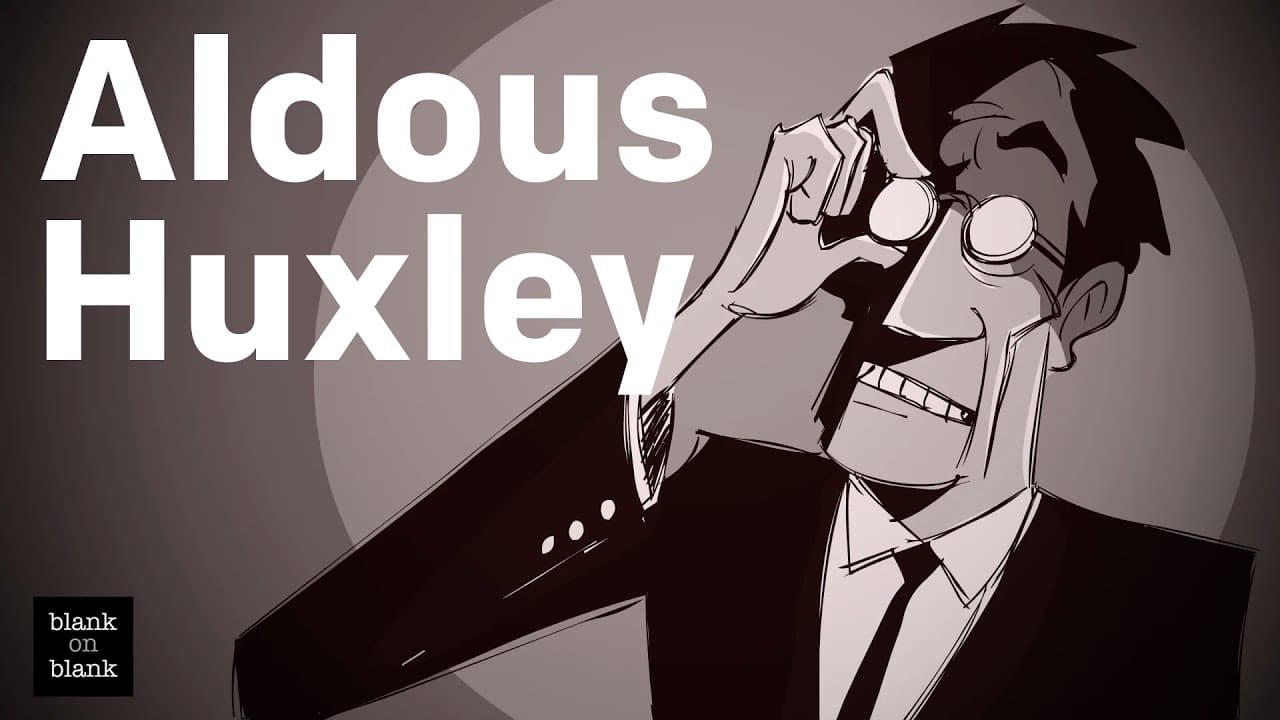
Aldous Huxley on Technodictators
TL;DR
Aldous Huxley warns of a future dictatorship predicted in his novel "Brave New World," discussing the influence of overpopulation, technology, and propaganda on the loss of individual freedoms.
Transcript
- It's a question of education, to teach people to be on their guard against the sort of verbal booby traps into which they're always being led, to analyze the kind of things that are said to them. I think it's terribly important to insist on individual values, that every human being is unique. And it is of course on this genetical basis that the w... Read More
Key Insights
- 🥺 Overpopulation leads to social unrest, increased government intervention, and a potential shift towards totalitarian regimes.
- 📻 Communication devices, like radios and television, can be powerful tools for propaganda and indoctrination.
- 😒 The responsible use of drugs may have the potential to alter mental states without causing harm.
Install to Summarize YouTube Videos and Get Transcripts
Explore YouTube Video Summarizer or Get YouTube Transcript Extractor
Questions & Answers
Q: How does overpopulation contribute to the loss of individual freedoms and the rise of totalitarian regimes?
Huxley argues that overpopulation leads to social unrest, which necessitates increased government control to maintain stability. This, in turn, creates a pattern that pushes towards a totalitarian regime, limiting individual freedoms.
Q: How was communication technology, particularly the radio, used by Hitler to impose his will on people?
Hitler effectively used radio propaganda to influence and control the masses, even highly educated individuals in Germany. Huxley warns that technology, such as television, can similarly be used for indoctrination if not used responsibly.
Q: How does Huxley view the idea of using drugs to control mental states?
Huxley suggests that drugs have the potential to profoundly alter mental states. However, he envisions a future where drugs can be used beneficially without harming individuals, unlike the fictional substance soma from his novel.
Q: How does Huxley criticize the merchandising and marketing of political candidates?
Huxley points out the danger of depending solely on a candidate's personality, as if they were a commercial product. He believes that democracy should rely on individual voters making rational choices based on their own enlightened self-interest.
Key Insights:
- Overpopulation leads to social unrest, increased government intervention, and a potential shift towards totalitarian regimes.
- Communication devices, like radios and television, can be powerful tools for propaganda and indoctrination.
- The responsible use of drugs may have the potential to alter mental states without causing harm.
- The merchandising and marketing of political candidates hinders the democratic process by bypassing rational decision-making.
Summary & Key Takeaways
-
Aldous Huxley believes that the world is heading towards a society controlled by a totalitarian regime due to overpopulation, which leads to social unrest and increased government intervention.
-
Huxley emphasizes the power of communication devices, such as Hitler's use of radio propaganda, and warns against being caught off guard by advancing technology, like television.
-
In his book "Brave New World," Huxley introduces the concept of a versatile drug called soma and speculates about the potential future impact of drugs on individuals' mental states.
Read in Other Languages (beta)
Share This Summary 📚
Summarize YouTube Videos and Get Video Transcripts with 1-Click
Try YouTube Summary with ChatGPT & Claude or YouTube Transcript Generator
Explore More Summaries from Blank on Blank 📚
Summarize YouTube Videos and Get Video Transcripts with 1-Click
Try YouTube Summary with ChatGPT & Claude or YouTube Transcript Generator