Exponential sweep circuit | Transmission & Displacement Error | Part-2/2 | PDC | Lec-73
TL;DR
The video analyzes displacement error in RC circuits and its relationship with sweep and transmission errors.
Transcript
hi everyone so in this video I am just continuing the previous calculation the third parameter which is nothing but displacement error Ed so we have taken just I am recollecting what we have discussed in the previous video we have taken one circuit like resistance and capacitance which provides a time constant which is that as it provides a time co... Read More
Key Insights
- 🤭 Displacement error (Ed), sweep error (Es), and transmission error (Et) are crucial parameters in analyzing RC circuits.
- 📈 The relationship among these parameters illustrates the proportional impact of circuit component values on performance metrics.
- ⌛ Time constants govern the charging and discharging behavior of capacitors, influencing the overall circuit's response to signals.
- ❓ Mathematical derivations highlight the importance of accurate calculations in predicting circuit behavior under specific conditions.
- 🎮 The video reinforces foundational concepts in electronics, crucial for both academic and practical applications.
- 🌍 The formulas derived serve as fundamental tools for electrical engineers tackling real-world circuit design challenges.
- ❓ A thorough understanding of these errors enables better troubleshooting and optimization in complex electronic systems.
Install to Summarize YouTube Videos and Get Transcripts
Explore YouTube Video Summarizer or Get YouTube Transcript Extractor
Questions & Answers
Q: What is the primary focus of the video?
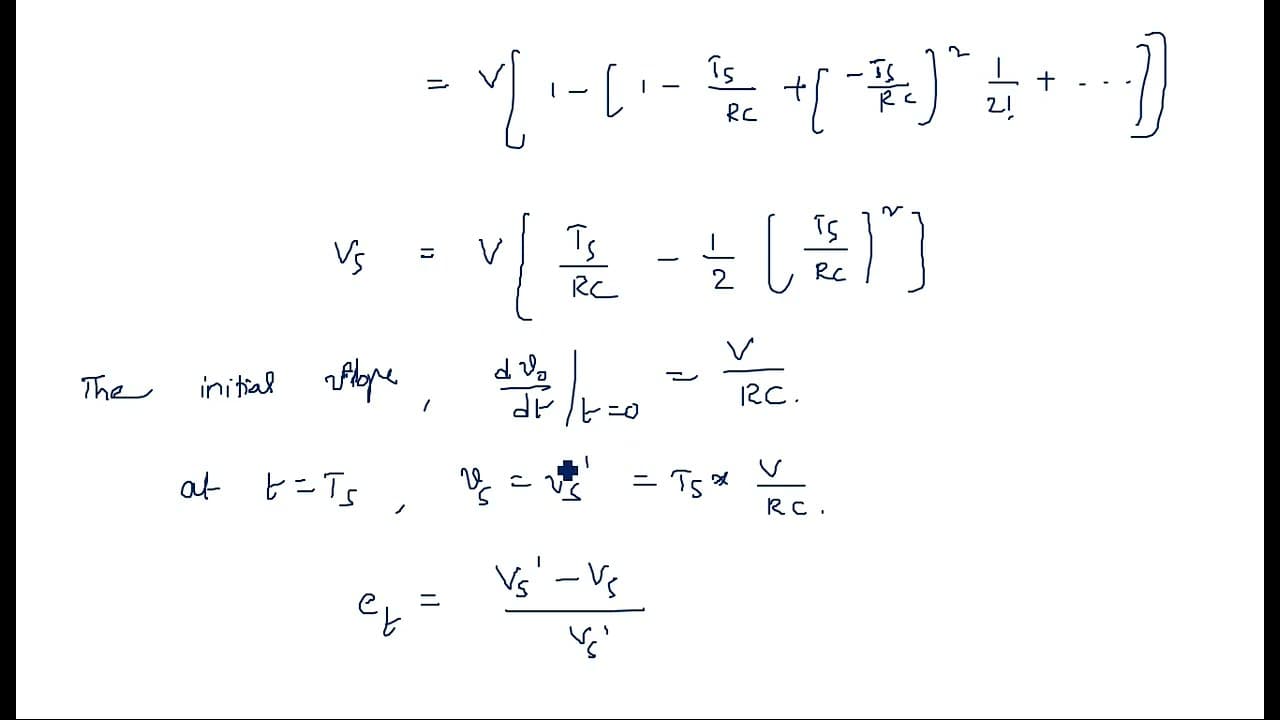
The main focus is on calculating the displacement error (Ed) in RC circuits and how it relates to other parameters like sweep error (Es) and transmission error (Et). The video walks through the mathematical derivations and offers insights into circuit behavior when subject to specific conditions.
Q: How is the time constant in an RC circuit defined?
The time constant (Tau) in an RC circuit is defined as the product of resistance (R) and capacitance (C), represented as Tau = R * C. This time constant characterizes the exponential charge and discharge rates of the capacitor, directly impacting the resistance-capacitance dynamics in the output waveform.
Q: What is the formula used for calculating displacement error?
The displacement error (Ed) is calculated using the formula Ed = (Vs - Vs') / Vs, where Vs is the actual sweep and Vs' is the linear sweep at specific time intervals. By analyzing the output waveforms, this difference gives insights into the positional accuracy of the system under evaluation.
Q: What relationship exists among sweep error, transmission error, and displacement error?
The video explains that the relationship among these errors is characterized by specific proportionalities: Es is equal to twice the transmission error (Et), whereas the displacement error (Ed) is one-eighth of Es. This reveals a structured framework to understand circuit performance under varying conditions.
Q: How does the capacitor behave in the circuit discussed in the video?
In the circuit, when the switch is open, the capacitor charges according to an exponential rate defined by the time constant (Tau), resulting in a voltage rise described by the formula V = V0(1 - e^(-t / RC)). Conversely, when the switch closes, it discharges, which is crucial in analyzing transient responses in the circuit.
Q: What practical applications could arise from understanding these circuit errors?
Understanding these circuit errors is critical for designing accurate timing circuits, amplifiers, and signal processors, which can significantly affect performance in communication and electronic systems. Such knowledge is instrumental for engineers working in fields that depend on precise electrical signal management.
Summary & Key Takeaways
-
The video focuses on calculating displacement error in RC circuits, detailing the circuit setup, including resistors and capacitors that define time constants.
-
Key parameters discussed include displacement error (Ed), sweep error (Es), and transmission error (Et), which are derived using specific formulas and circuit configurations.
-
The relationship among these errors is highlighted, with Ed being one-eighth of Es, illustrating the mathematical interconnection critical for understanding circuit performance.
Read in Other Languages (beta)
Share This Summary 📚
Summarize YouTube Videos and Get Video Transcripts with 1-Click
Try YouTube Summary with ChatGPT & Claude or YouTube Transcript Generator