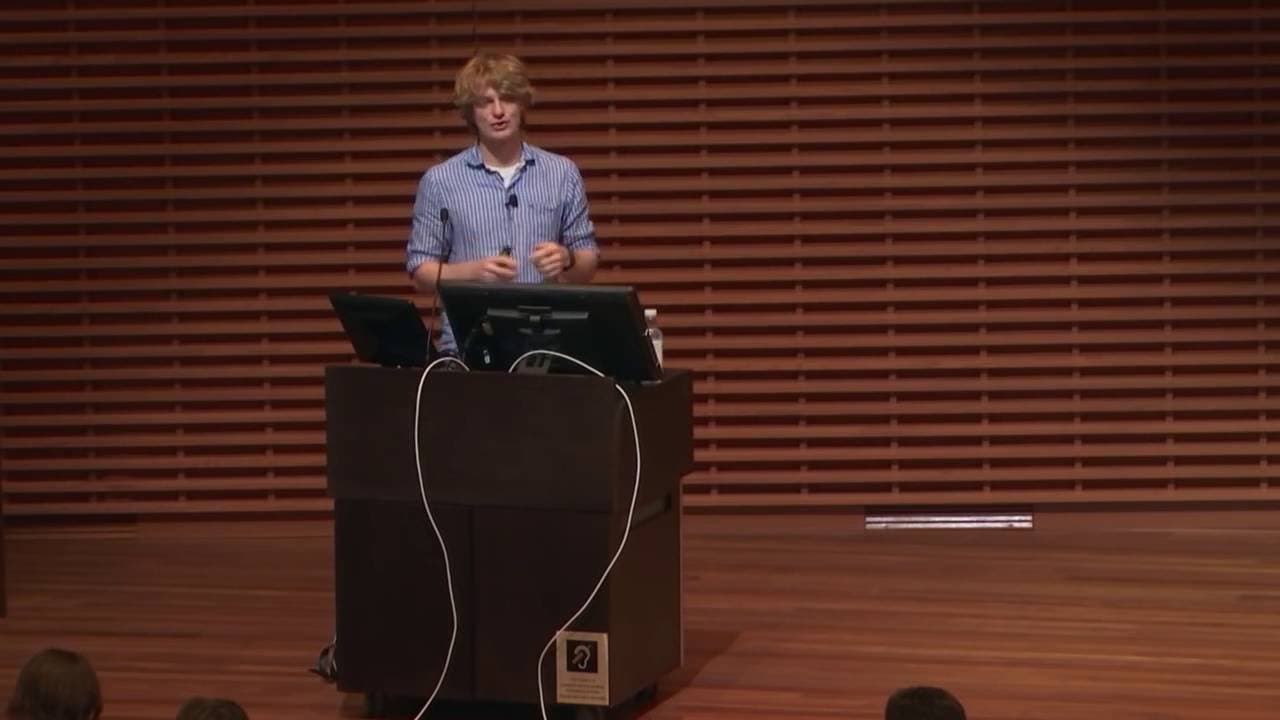
Deep Learning for Natural Language Processing (Richard Socher, Salesforce)
TL;DR
A comprehensive analysis of deep learning models for Natural Language Processing tasks, focusing on the Dynamic Memory Network architecture.
Transcript
thank you everybody thanks for coming back very soon after lunch I'll try to make it entertaining to avoid some post food coma so I actually have a lot - OH - being here - Andrew and Chris and my PhD at Stanford here it's it's really it's always fun to be back I figured there's a going to be a broad range of capabilities in the room so I'm sorry I ... Read More
Key Insights
- ❓ The intersection of deep learning and NLP tackles diverse language understanding tasks.
- 💁 Word vectors and recurrent neural networks form fundamental building blocks for advanced NLP models.
- ⁉️ Dynamic Memory Networks offer a flexible architecture for complex question answering tasks.
- ❓ Deep learning advancements in NLP address challenges like ambiguity and coreference resolution.
- 🥰 Proper training and architecture play crucial roles in achieving state-of-the-art results in NLP tasks.
- 🌍 Real-world NLP applications benefit from dynamic memory structures and multiple passes over input.
- ❓ Effective attention mechanisms and episodic memory modules enhance the performance of NLP models.
Install to Summarize YouTube Videos and Get Transcripts
Explore YouTube Video Summarizer or Get YouTube Transcript Extractor
Questions & Answers
Q: What is the goal of Natural Language Processing?
The goal of NLP is for computers to process and understand natural language to perform useful tasks like question answering, but complete language understanding remains elusive due to complex nuances.
Q: How has deep learning improved NLP tasks like speech recognition and syntax?
Deep learning has advanced NLP by skipping some linguistic levels and directly focusing on semantics, enabling significant progress in tasks like speech recognition and syntax analysis.
Q: Why is NLP challenging?
NLP is challenging due to complexities in representing and learning from linguistic, situational, and visual knowledge, leading to issues like coreference resolution and ambiguity in language meanings.
Q: How can word vectors and sequence models enhance NLP performance?
Word vectors capture word meanings, while sequence models like recurrent neural networks can model context and dependencies, improving NLP tasks like sentiment analysis and machine translation.
Summary & Key Takeaways
-
Introduction to deep learning in NLP, focusing on the intersection of computer science, AI, and linguistics.
-
Explanation of Natural Language Processing goals, challenges, and levels of language understanding.
-
Detailed discussion on word vectors, recurrent neural networks, and the Dynamic Memory Network architecture for question answering tasks.
Read in Other Languages (beta)
Share This Summary 📚
Summarize YouTube Videos and Get Video Transcripts with 1-Click
Try YouTube Summary with ChatGPT & Claude or YouTube Transcript Generator
Explore More Summaries from Lex Fridman 📚





Summarize YouTube Videos and Get Video Transcripts with 1-Click
Try YouTube Summary with ChatGPT & Claude or YouTube Transcript Generator