Products
Features
YouTube Video Summarizer
Summarize YouTube videos
Web & PDF Highlighter
Highlight web pages & PDFs
Chat with PDF
Ask any PDF questions with AI
Ask AI Clone
Chat with your highlights & memories
Audio Transcriber
Transcribe audio files to text
Glasp Reader
Read and highlight articles
Kindle Highlight Export
Export your Kindle highlights
Idea Hatch
Hatch ideas from your highlights
Integrations
Obsidian Plugin
Notion Integration
Pocket Integration
Instapaper Integration
Medium Integration
Readwise Integration
Snipd Integration
Hypothesis Integration
Apps & Extensions
Chrome Extension
Safari Extension
Edge Add-ons
Firefox Add-ons
iOS App
Android App
Discover
Discover
Ideas
Discover new ideas and insights
Articles
Curated articles and insights
Books
Book recommendations by great minds
Posts
Essays and notes from readers
Quotes
Inspiring quotes collection
Videos
Curated videos and summaries
Explore Glasp
Glasp Newsletter
Weekly insights and updates
Glasp Talk
Interview series with great minds
Glasp Blog
Latest news and articles
Glasp Use Cases
Learn how others use Glasp
Build & Support
Glasp API
Access Glasp's API for developers
MCP Connector
Connect Glasp to Claude & ChatGPT
Community
Glasp Reddit Community
Students
Student discount and benefits
FAQs
Frequently Asked Questions
AboutPricing
DashboardLog inSign up

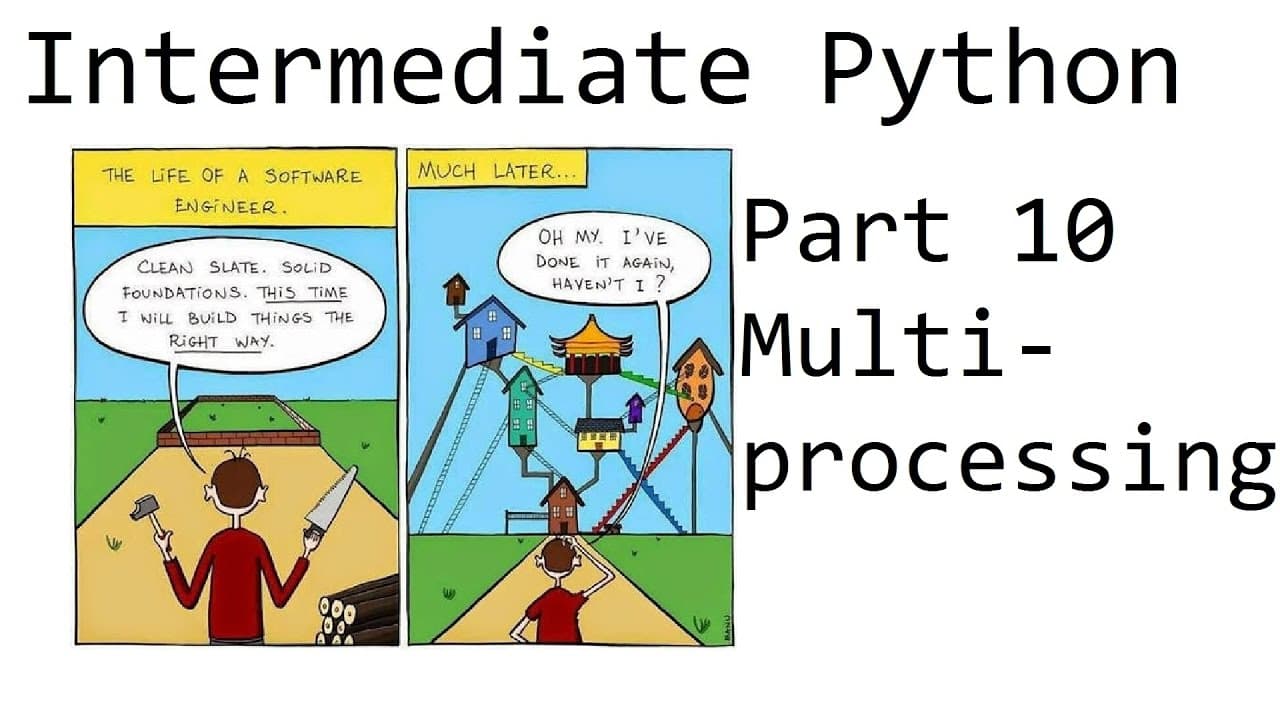
Multiprocessing - Intermediate Python Programming p.10
64.0K views
•
November 14, 2016
by
sentdex
YouTube video player
Multiprocessing - Intermediate Python Programming p.10

TL;DR

Utilize Python's multiprocessing library to overcome GIL limitations and maximize CPU utilization.

Transcript

what is going on everybody welcome to another Python fundamentals that aren't the basics tutorial series in this video what we're gonna be talking about is multi-processing so first let's talk real briefly about why we have to use a library to do such a thing so you may have noticed that when you run a Python program even if you say threading your ... Read More

Key Insights

  • ❓ GIL restricts Python programs to utilize only 16% of CPU.
  • 📚 Multiprocessing library facilitates spawning independent Python processes.
  • ❓ Shared databases and pipes enable communication between multiple processes.
  • 👻 Multi-processing allows for optimal CPU utilization for parallel processing tasks.
  • 🎮 Process spawning and joining functions control parallel execution.
  • 🧭 Arguments can be passed to processes, enhancing flexibility and functionality.
  • 💯 Utilizing multiprocessing results in efficient utilization of multiple CPU cores.

Install to Summarize YouTube Videos and Get Transcripts

Explore YouTube Video Summarizer or Get YouTube Transcript Extractor

Questions & Answers

Q: What is the Global Interpreter Lock (GIL) in Python?

The Global Interpreter Lock in Python limits concurrent execution of threads by allowing only one thread to execute at a time to ensure memory management safety.

Q: How does the multiprocessing library in Python overcome GIL limitations?

By spawning separate Python processes, the multiprocessing library allows utilizing multiple CPU cores independently, maximizing CPU utilization compared to threading.

Q: How can multiple Python processes communicate with each other?

Multiple Python processes can communicate via shared databases, pipes, or shared variables without the need to be directly linked, enhancing parallel processing capabilities.

Q: Why is multiprocessing essential for CPU-intensive tasks in Python?

Multiprocessing enables distributing computation across multiple CPU cores, boosting performance for CPU-intensive tasks that require parallel processing without GIL limitations.

Summary & Key Takeaways

  • Python's Global Interpreter Lock (GIL) limits CPU utilization to 16%.

  • Multiprocessing library enables launching separate Python processes.

  • Easily spawn and communicate between multiple processes for efficient CPU usage.


Read in Other Languages (beta)

English

Share This Summary 📚

Summarize YouTube Videos and Get Video Transcripts with 1-Click

Download browser extensions on:

Try YouTube Summary with ChatGPT & Claude or YouTube Transcript Generator

Explore More Summaries from sentdex 📚
Python: How to Program the Chaikin Money Flow Trading Indicator thumbnail
Python: How to Program the Chaikin Money Flow Trading Indicator
sentdex
Python: How to Graph the Chaikin Money Flow Trading Indicator in Matplotlib thumbnail
Python: How to Graph the Chaikin Money Flow Trading Indicator in Matplotlib
sentdex
Parsing XML - Go Lang Practical Programming Tutorial p.11 thumbnail
Parsing XML - Go Lang Practical Programming Tutorial p.11
sentdex
How to Parse Twitter for Twitter Analysis: Part 1 thumbnail
How to Parse Twitter for Twitter Analysis: Part 1
sentdex
How to Train a Chatbot Using TensorFlow and Python thumbnail
How to Train a Chatbot Using TensorFlow and Python
sentdex
Python Generator Functions for massive Performance Improvements with Lists thumbnail
Python Generator Functions for massive Performance Improvements with Lists
sentdex

Summarize YouTube Videos and Get Video Transcripts with 1-Click

Download browser extensions on:

Try YouTube Summary with ChatGPT & Claude or YouTube Transcript Generator

Apps & Extensions

  • Chrome Extension
  • Safari Extension
  • Edge Add-ons
  • Firefox Add-ons
  • iOS App
  • Android App

Key Features

  • YouTube Video Summarizer
  • Web & PDF Summarizer
  • Web & PDF Highlighter
  • Chat with PDF
  • Ask AI Clone
  • Audio Transcriber
  • Glasp Reader
  • Kindle Highlight Export
  • Idea Hatch

Integrations

  • Obsidian Plugin
  • Notion Integration
  • Pocket Integration
  • Instapaper Integration
  • Medium Integration
  • Readwise Integration
  • Snipd Integration
  • Hypothesis Integration

More Features

  • APIs
  • MCP Connector
  • Blog & Post
  • Embed Links
  • Image Highlight
  • Personality Test
  • Quote Shots

Company

  • About us
  • Blog
  • Community
  • FAQs
  • Job Board
  • Newsletter
  • Pricing
Terms

•

Privacy

•

Guidelines

© 2026 Glasp Inc. All rights reserved.