What Is the 3-4-7 Miracle and How Does It Work?
TL;DR
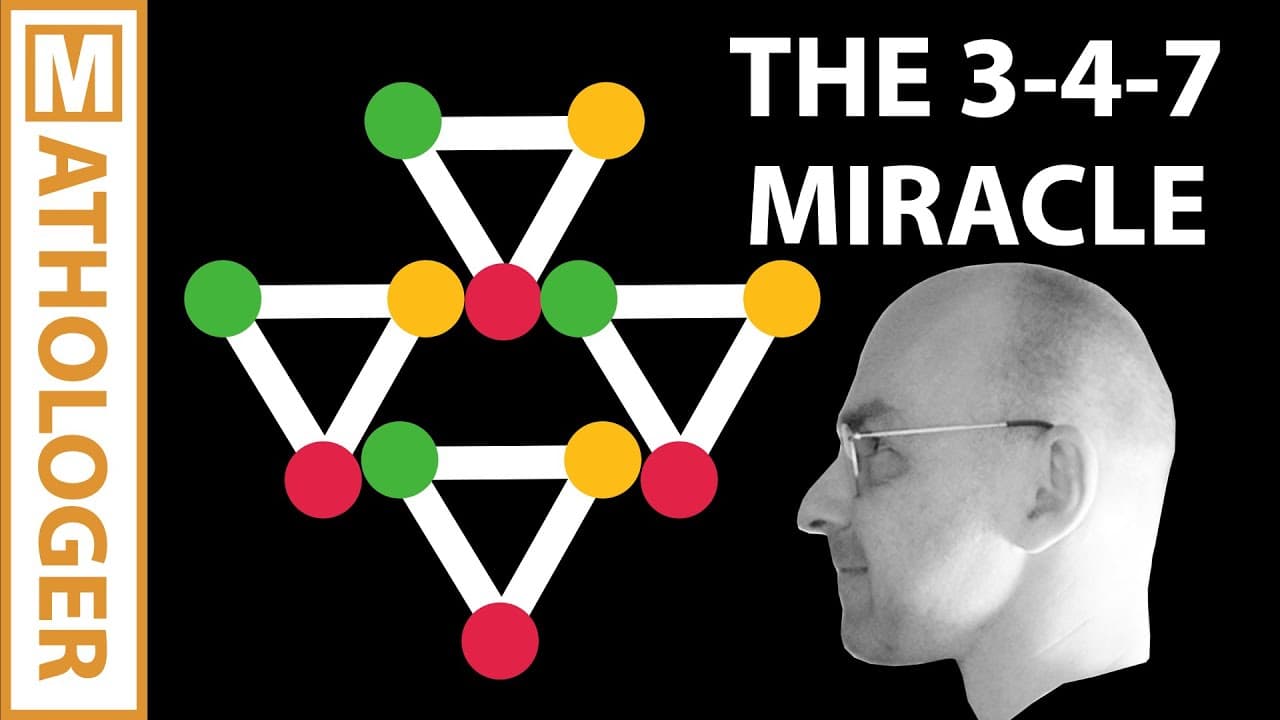
The 3-4-7 miracle involves points moving in geometric patterns, forming equilateral triangles, squares, and a seven-pointed star through the principles of circle rolling and the coin rotation paradox. This phenomenon showcases how spirographs and mathematical curves can create visually stunning animations while highlighting surprising rotations that challenge intuition.
Transcript
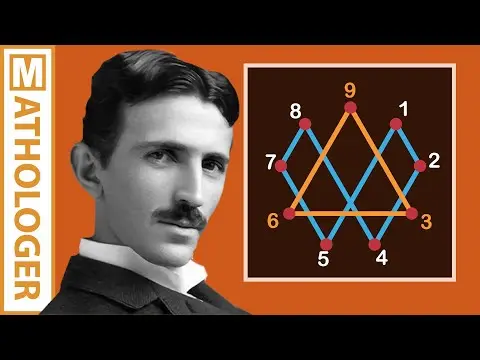
welcome to another mathologer video recently while browsing maths on the web and working on a hardcore video i got sidetracked by a very puzzling animation have a look there are 12 points performing a strange dance in certain groups of three the points are waltzing in equilateral triangles at the same time in certain groups of four they're performi... Read More
Key Insights
- ⭕ Points moving along straight lines and circles simultaneously can be explained using the concept of circle rolling.
- 🤣 Spirographs, generated by rolling circles, can create a variety of mathematical curves and geometric patterns.
- 🪙 The coin rotation paradox helps explain the counterintuitive number of rotations observed when one coin rolls around another.
Install to Summarize YouTube Videos and Get Transcripts
Explore YouTube Video Summarizer or Get YouTube Transcript Extractor
Questions & Answers
Q: How are the points in the animation able to move in both straight lines and circles simultaneously?
This phenomenon can be explained by the concept of circle rolling, where a smaller circle rolls inside a larger one, causing points on its perimeter to trace out various shapes.
Q: What are hypertrochoids, and how are they related to the animation?
Hypertrochoids are curves formed by tracing a point on a rolling circle as it moves inside a larger circle. In the animation, the points create the shapes of equilateral triangles and other geometric figures.
Q: Why does the animation feature a star made up of straight line segments instead of curved lines?
The animation cheats a bit by replacing a curved star with a star consisting of straight lines. This simplification allows for easier visualization of the dancing points' movements.
Q: How does the coin rotation paradox explain the number of rotations observed in the animation?
The coin rotation paradox demonstrates that when a smaller coin rolls around a larger one, the number of rotations is determined by the ratio of their circumferences. This principle can be applied to understand the number of rotations in the animation.
Summary & Key Takeaways
-
The video explores a puzzling animation of points dancing in different geometric patterns, including equilateral triangles and squares.
-
The phenomena observed in the animation can be understood by applying the principles of circle rolling and the coin rotation paradox.
-
Spirographs, mathematical curves generated by rolling circles, are used to create the patterns observed in the animation.
Read in Other Languages (beta)
Share This Summary 📚
Summarize YouTube Videos and Get Video Transcripts with 1-Click
Try YouTube Summary with ChatGPT & Claude or YouTube Transcript Generator
Explore More Summaries from Mathologer 📚
Summarize YouTube Videos and Get Video Transcripts with 1-Click
Try YouTube Summary with ChatGPT & Claude or YouTube Transcript Generator