Bar graph | Sales of Phones & Laptops | DI | Reasoning | Part - 19 | Bharath Kumar
TL;DR
The session teaches how to analyze bar graphs of mobile phones and laptops sold by various companies.
Transcript
hi everyone welcome to this session in this session I'm continuing bar graph data interpretation first of all we need to read the information carefully and then we need to solve the questions according to the given information here the information is about a number of mobile phones and laptops sold by six different companies in a month here the inf... Read More
Key Insights
- ❓ Accurate data interpretation involves meticulous attention to detail and systematic calculations.
- 🥳 Average, percentage increases, and ratios are fundamental concepts in analyzing sales data.
- 🎁 Each company's sales figures must be correctly understood in their context, often presented in thousands for consistency.
- 📈 Understanding bar graphs allows for quick comparisons between different entities and their performance metrics.
- 🥳 Clarity in definitions, such as "more than" or "ratio," ensures that interpretations are both accurate and meaningful.
- ❓ Problem-solving requires not just the ability to do arithmetic but also the clear communication of results.
- 💁 Knowing how to convert fractions into percentage form is a valuable skill in data analysis.
Install to Summarize YouTube Videos and Get Transcripts
Explore YouTube Video Summarizer or Get YouTube Transcript Extractor
Questions & Answers
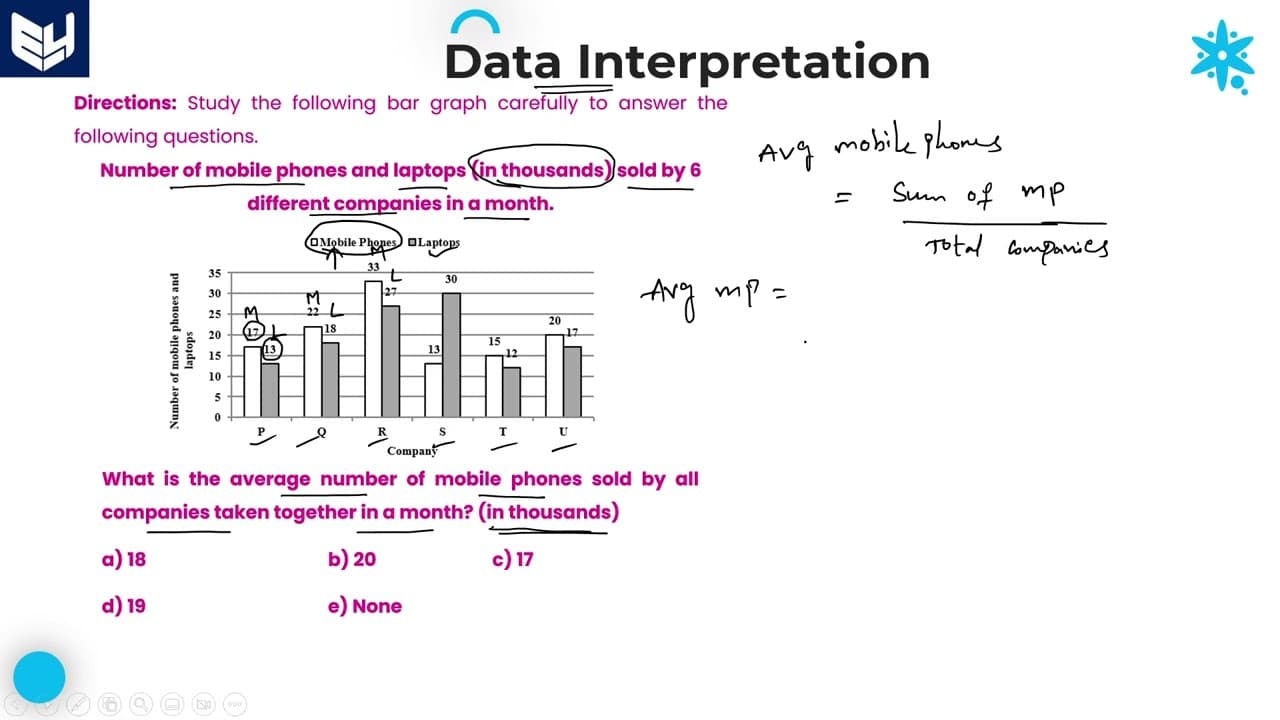
Q: What is the average number of mobile phones sold by all companies?
The average number of mobile phones sold by all six companies is calculated by summing the mobile sales figures for each company and dividing by the total number of companies. The total sold is 120,000 units, so the average is 20,000 mobile phones.
Q: How is the percentage of mobile phones sold by company U compared to company T determined?
To find the percentage that company U's sales exceed those of company T, you subtract T's figure from U's (20,000 - 15,000), yielding a difference of 5,000. You then divide this difference by the lesser value (15,000) and multiply by 100, resulting in a percentage increase of 33.33%.
Q: What is the average number of laptops sold by companies P, R, and T?
To find the average laptops sold by companies P, R, and T, you add the sales figures for these companies (13,000 for P, 27,000 for R, and 12,000 for T) to get a total of 52,000 laptops. Dividing by the three companies gives an average of approximately 17,333 laptops sold.
Q: How do you calculate the ratio of mobile phones sold by company T to laptops sold by company Q?
The ratio of mobile phones sold by company T, which is 15,000 units, to laptops sold by company Q, which is 18,000 units, is expressed as 15:18. This ratio simplifies to 5:6 when both numbers are divided by their greatest common divisor.
Q: How is the ratio between laptops sold by companies Q and R established?
To establish the ratio of laptops sold by companies Q (18,000) to R (27,000), you set it up as 18:27. Simplifying this gives you 2:3, which represents the relationship between the number of laptops sold by each company.
Summary & Key Takeaways
-
The session focuses on interpreting a bar graph that illustrates the sales of mobile phones and laptops by six companies, designated as P, Q, R, S, T, and U.
-
It provides step-by-step calculations for questions related to averages and percentage differences in sales figures, emphasizing clarity in data representation.
-
Key examples are worked through, including finding averages, percentages, and ratios, demonstrating effective problem-solving strategies in data interpretation.
Read in Other Languages (beta)
Share This Summary 📚
Summarize YouTube Videos and Get Video Transcripts with 1-Click
Try YouTube Summary with ChatGPT & Claude or YouTube Transcript Generator