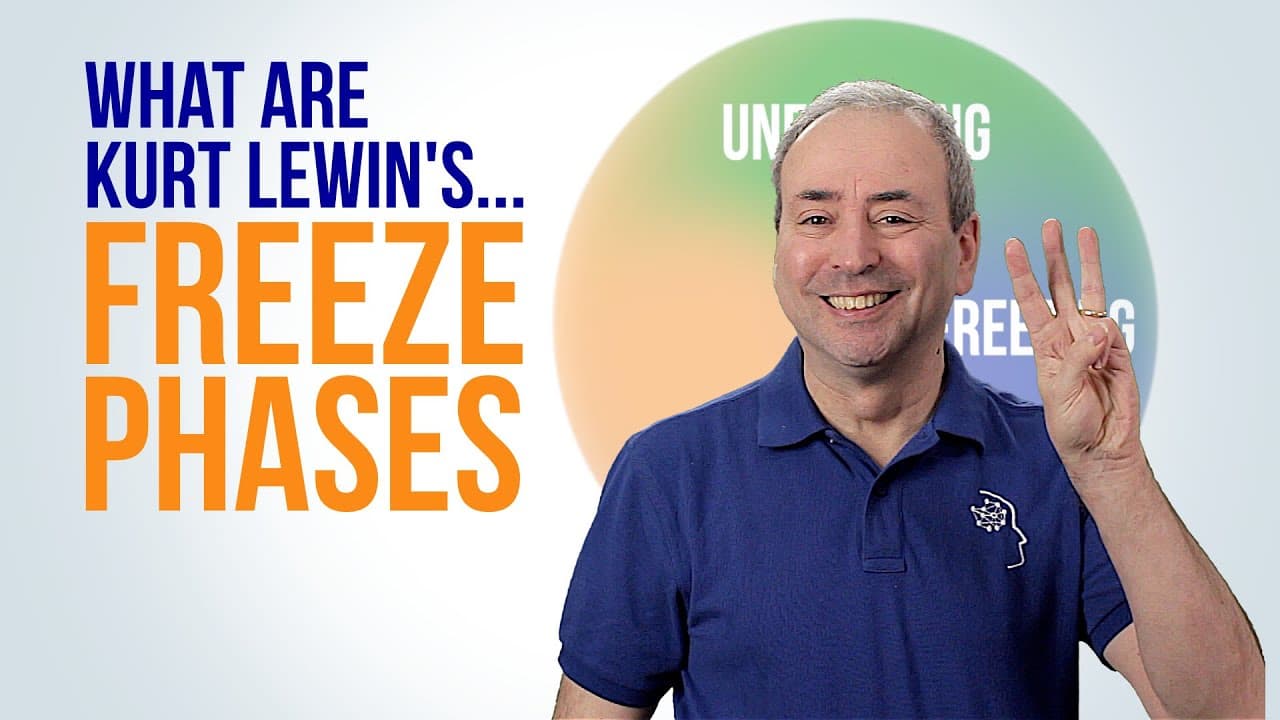
What are Kurt Lewin's Freeze Phases?
TL;DR
Kurt Lewin's Freeze Phases model explains the process of change, involving unfreezing from established patterns, implementing change, and re-freezing into a new normal.
Transcript
kurt lewin's freeze phases is one of the models that every change agent and project manager needs to be aware of lewin was one of the first people to systematically study how change works yet his model remains valid so a good understanding of lewin's freeze phases is important for every project manager whose project is likely to create organization... Read More
Key Insights
- 💱 Understanding Kurt Lewin's Freeze Phases model is essential for project managers and change agents dealing with organizational or cultural change.
- 🪡 Lewin's model emphasizes the need to challenge established beliefs and recognize alternatives to overcome resistance.
- 🦮 Effective leadership is vital during the changing phase to guide individuals through commitment fluctuations.
- 👶 Re-freezing involves individuals adopting new ways of working and settling into the new normal, but some may choose to pursue bigger changes.
- 💱 Lewin's Freeze Phases model has influenced other change management models, such as William Bridges' three-stage model in his books on personal and organizational change.
- 💱 The model's simplicity and relevance continue to make it valuable for understanding and facilitating the process of organizational change.
- 👻 Lewin's model serves as a continuum rather than static stages, allowing for a fluid transition between phases.
Install to Summarize YouTube Videos and Get Transcripts
Explore YouTube Video Summarizer or Get YouTube Transcript Extractor
Questions & Answers
Q: What does Kurt Lewin's Freeze Phases model entail?
Kurt Lewin's Freeze Phases model consists of three stages: unfreezing, changing, and re-freezing. Unfreezing involves challenging established beliefs and recognizing alternatives to overcome resistance. Changing is a period of uncertainty and commitment fluctuations. Re-freezing occurs when individuals adopt new ways of working and settle into the new normal.
Q: Why do people resist change?
People often resist change due to the comfort they feel in their existing situation and the fear of the unknown. Resistance can also stem from conformity to societal norms or organizational expectations.
Q: How does leadership impact the changing phase?
Strong leadership is crucial during the changing phase as people's commitment levels fluctuate, and resistance may set in. Weak leadership makes individuals susceptible to other influences, such as rumors and misinformation.
Q: What happens during the re-freezing phase?
In the re-freezing phase, individuals start understanding and embracing the new ways of working. They seek ways to take advantage of the changes and settle into the new status quo. However, for some, the changes may not be suitable, leading them to seek more significant and radical changes.
Summary & Key Takeaways
-
Kurt Lewin's Freeze Phases model provides a three-stage understanding of change, including unfreezing, changing, and re-freezing.
-
Unfreezing involves challenging established beliefs and recognizing alternative possibilities, overcoming resistance to change.
-
Changing is a time of uncertainty, requiring strong leadership to guide people through commitment fluctuations and resistance.
-
Re-freezing occurs when individuals start adopting new ways of working and settle into the new status quo, but some may choose to leave or seek bigger changes.
Read in Other Languages (beta)
Share This Summary 📚
Summarize YouTube Videos and Get Video Transcripts with 1-Click
Try YouTube Summary with ChatGPT & Claude or YouTube Transcript Generator
Explore More Summaries from Online PM Courses - Mike Clayton 📚



Summarize YouTube Videos and Get Video Transcripts with 1-Click
Try YouTube Summary with ChatGPT & Claude or YouTube Transcript Generator