Can Science Explain All Aspects of Reality?
TL;DR
Science excels at describing many aspects of the physical world, but it may not explain everything. The 'Knowledge Argument' suggests some experiences, like seeing color for the first time, cannot be fully captured by scientific language. This implies that there are nonphysical aspects of reality that science cannot describe.
Transcript
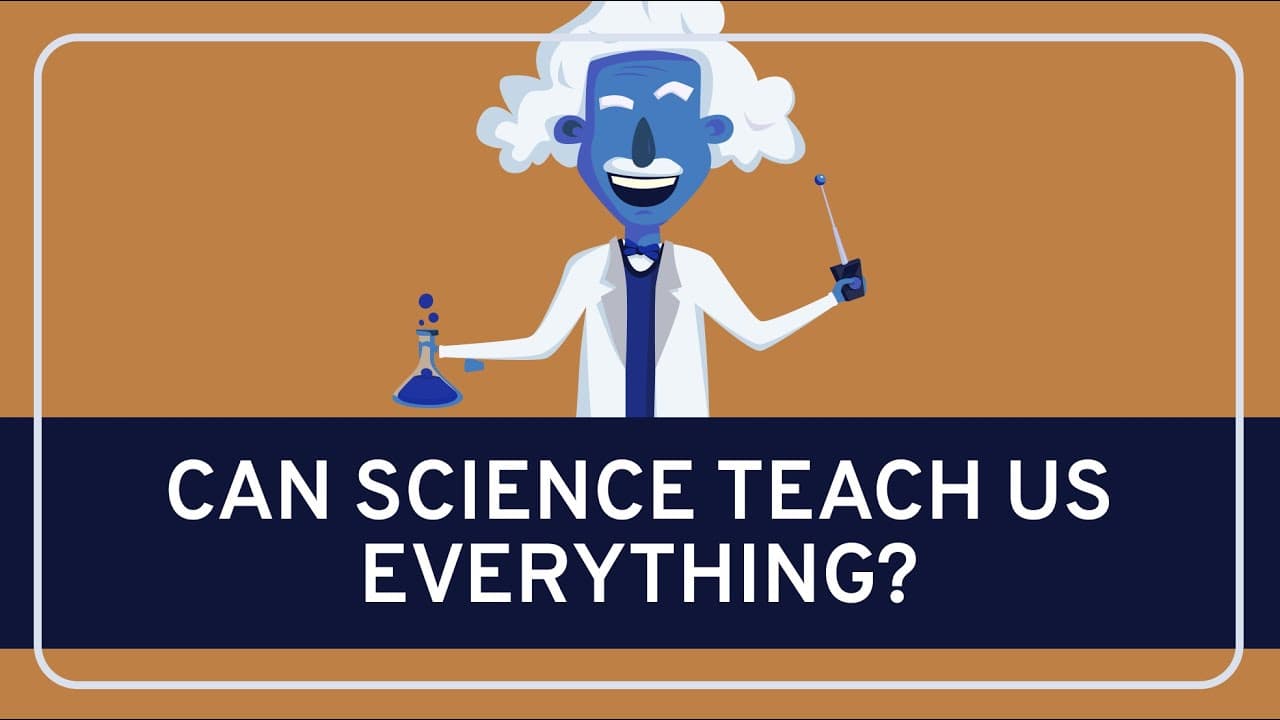
(intro music) Hi, my name is Caspar Hare. I'm a professor at MIT, the Massachusetts Institute of Technology. Today we're going to talk about science. Can it teach us everything[br]there is to know about reality? Science is an impressive thing. Scientists have, for hundreds[br]of years, been able to predict the movements of comets,[br]the eclipses, ... Read More
Key Insights
- Science is capable of predicting and explaining many phenomena in the physical world.
- The completeness of scientific descriptions of reality is debated.
- The 'Knowledge Argument' suggests some experiences are beyond scientific explanation.
- Mary's thought experiment illustrates the limits of scientific knowledge about subjective experiences.
- Knowing all scientific facts about color doesn't equate to experiencing color.
- Experiences like seeing red or tasting coffee involve knowledge beyond scientific facts.
- The argument challenges the notion that science can offer a complete description of reality.
- Nonphysical aspects of reality may exist beyond the scope of natural sciences.
Install to Summarize YouTube Videos and Get Transcripts
Explore YouTube Video Summarizer or Get YouTube Transcript Extractor
Questions & Answers
Q: What is the 'Knowledge Argument' in philosophy?
The 'Knowledge Argument' suggests that there are aspects of reality, particularly subjective experiences, that cannot be fully explained by science. It uses the thought experiment of Mary, who knows all scientific facts about color but learns something new upon seeing color for the first time, to illustrate that experiential knowledge exists beyond scientific description.
Q: How does the Mary thought experiment challenge scientific completeness?
The Mary thought experiment challenges scientific completeness by showing that even with complete scientific knowledge about color, Mary gains new understanding when she experiences color firsthand. This implies that some knowledge is experiential and not captured by scientific facts, suggesting limits to science's ability to fully describe reality.
Q: Why is the 'Knowledge Argument' significant in philosophy?
The 'Knowledge Argument' is significant because it questions the ability of science to fully describe reality, highlighting the potential existence of nonphysical aspects of reality. It suggests that subjective experiences cannot be entirely captured by scientific language, sparking debate about the scope and limits of scientific knowledge.
Q: Can science describe subjective experiences?
Science struggles to describe subjective experiences fully, as these experiences often involve personal, qualitative knowledge that is not easily captured by objective scientific facts. The 'Knowledge Argument' illustrates this by showing that experiential knowledge, like seeing color, provides insights beyond what scientific descriptions can offer.
Q: What does the 'Mary Argument' reveal about nonphysical aspects of reality?
The 'Mary Argument' reveals that there may be nonphysical aspects of reality that science cannot describe. It suggests that subjective experiences, such as seeing color for the first time, involve knowledge that is not purely scientific, indicating the existence of elements of reality beyond the physical and measurable.
Q: How does the 'Knowledge Argument' relate to epistemology?
The 'Knowledge Argument' relates to epistemology by exploring the nature and limits of knowledge. It questions whether scientific knowledge can encompass all aspects of reality, highlighting the distinction between objective scientific facts and subjective experiential knowledge, thus contributing to discussions on the scope of human understanding.
Q: What are the implications of the 'Knowledge Argument' for science?
The implications of the 'Knowledge Argument' for science are that it may not be able to provide a complete description of reality. It suggests that some knowledge, particularly experiential knowledge, is beyond scientific reach, prompting reconsideration of the boundaries of scientific inquiry and the existence of nonphysical realities.
Q: Why can't science explain what it's like to see red?
Science can't explain what it's like to see red because subjective experiences involve personal, qualitative insights that go beyond objective scientific facts. The 'Knowledge Argument' illustrates that even with complete scientific knowledge about color, the experiential aspect of seeing color provides new understanding not captured by science.
Summary & Key Takeaways
-
Science has achieved remarkable feats, such as predicting celestial events and advancing medicine, but its ability to describe all aspects of reality is questioned. The 'Knowledge Argument' posits that subjective experiences, like seeing color, cannot be fully explained by science, suggesting the existence of nonphysical aspects of reality.
-
The thought experiment involving Mary, who knows everything about the science of color but has never seen it, demonstrates the potential limitations of scientific explanations. When she sees red for the first time, she learns something new, indicating that some knowledge is experiential and not purely scientific.
-
This argument, known as the 'Mary Argument' or 'Knowledge Argument,' challenges the idea that science can provide a complete understanding of reality. It suggests that certain personal experiences elude scientific description and that there are aspects of reality that remain nonphysical and beyond scientific reach.
Read in Other Languages (beta)
Share This Summary 📚
Summarize YouTube Videos and Get Video Transcripts with 1-Click
Try YouTube Summary with ChatGPT & Claude or YouTube Transcript Generator
Explore More Summaries from Wireless Philosophy 📚
Summarize YouTube Videos and Get Video Transcripts with 1-Click
Try YouTube Summary with ChatGPT & Claude or YouTube Transcript Generator