Tabular DI | Data Interpretation | Percentage of marks | Reasoning | Part - 06 | Bharath Kumar
TL;DR
An analysis of students' percentages and marks across different subjects.
Transcript
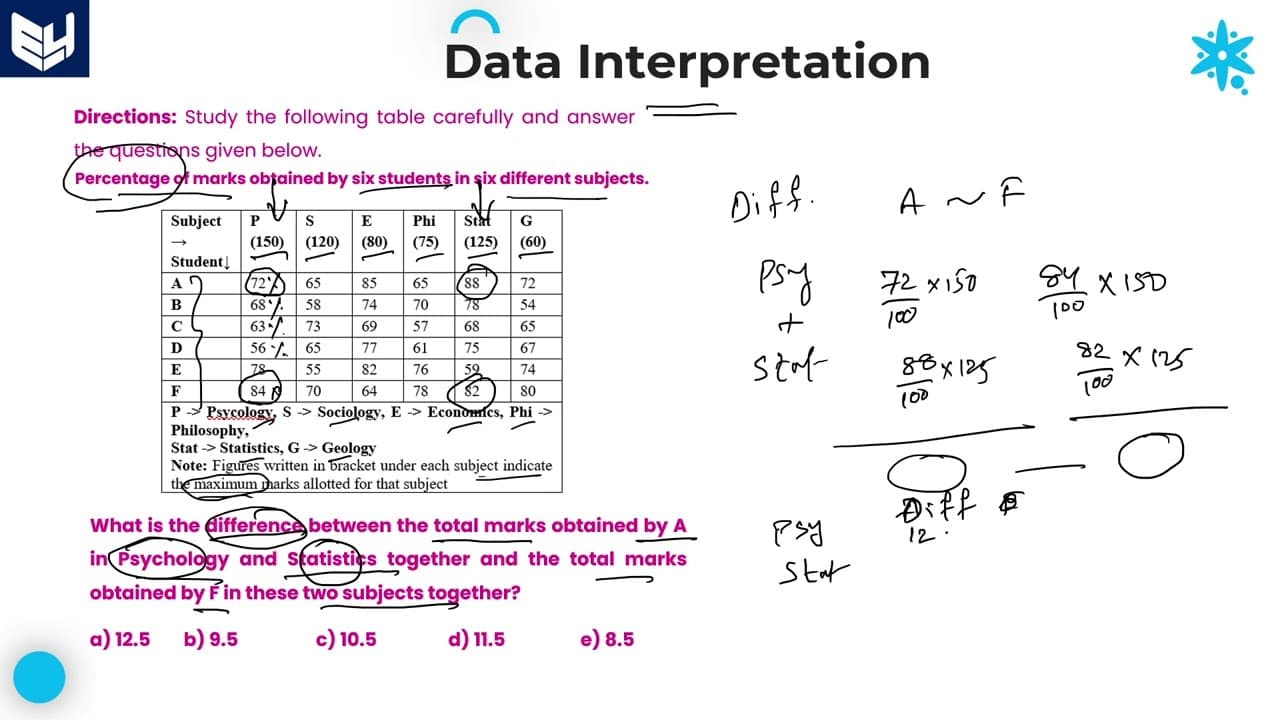
hi everyone welcome to the session in this session i will continue the problems on tableau data and reflection see the information which is given in the question study the following table carefully and answer the questions given below here the information is about a percentage of marks obtained by six students in six different subjects here the inf... Read More
Key Insights
- 💋 Understanding the maximum marks for each subject is crucial for accurate percentage-to-mark conversions.
- 🤪 Calculating differences in scores can often be simplified by working directly with percentages rather than going through mark multiplications at every step.
- 💋 It’s essential to distinguish between average percentages and average marks, as each requires different calculations.
- 👻 Efficient data management in calculations allows for better time management during exams or problem-solving scenarios.
- 🛝 Awareness of rounding and mixed fractional averages is important for achieving correct averages in assessments.
- 🧑🎓 Students should be cautious about potential errors in calculations and prioritize accuracy over speed in complex problems.
- ⌛ Learning to apply mathematical shortcuts can significantly reduce calculation times, improving overall performance.
Install to Summarize YouTube Videos and Get Transcripts
Explore YouTube Video Summarizer or Get YouTube Transcript Extractor
Questions & Answers
Q: What method can be used to calculate the difference between two students' scores in a subject?
To find the difference between two students' scores, first convert their percentages into actual marks by multiplying the percentage by the maximum marks for the subject. Then, subtract the lesser score from the greater score to find the difference. This approach simplifies comparison across diverse subjects.
Q: How is the average percentage of marks for all students in a subject calculated?
The average percentage is calculated by summing the individual percentages and dividing by the number of students. For example, if six students have percentages of 65%, 58%, 73%, 65%, 55%, and 70%, the total is 386%, divided by 6 gives an average of approximately 64.33%.
Q: What is the process for calculating total marks for a single student across multiple subjects?
To find the total marks for a student, determine the marks for each subject by converting the percentage into marks (percentage * maximum marks). For example, if a student scored 72% in psychology (150 max), the marks would be 108. Repeat this for each subject and sum all the results for the total.
Q: What was the unique approach mentioned for simplifying the calculations between students?
A unique technique discussed was determining differences in marks directly from calculated percentages rather than converting all scores first. By noting how many percentage points higher one student is than another, you can compute marks based on the maximum scores independently, streamlining the process.
Summary & Key Takeaways
-
The session focuses on understanding how to calculate total and average marks from percentage scores for six students across six different subjects.
-
Several methods are demonstrated for calculating differences between students' scores in subjects like psychology and statistics, highlighting efficient approaches to data handling.
-
The calculations also cover overall averages in sociology and philosophy, emphasizing the importance of careful arithmetic to derive accurate results from percentages.
Read in Other Languages (beta)
Share This Summary 📚
Summarize YouTube Videos and Get Video Transcripts with 1-Click
Try YouTube Summary with ChatGPT & Claude or YouTube Transcript Generator