What Caused the Deaths of Every U.S. President?
TL;DR
The deaths of U.S. presidents were often due to health issues, assassinations, or medical mismanagement. Notable cases include George Washington, who suffered from harmful treatment, and William McKinley, whose assassination led to enhanced presidential security measures. Additionally, several presidents, like John Adams and Thomas Jefferson, died on the same date, highlighting interesting historical coincidences.
Transcript
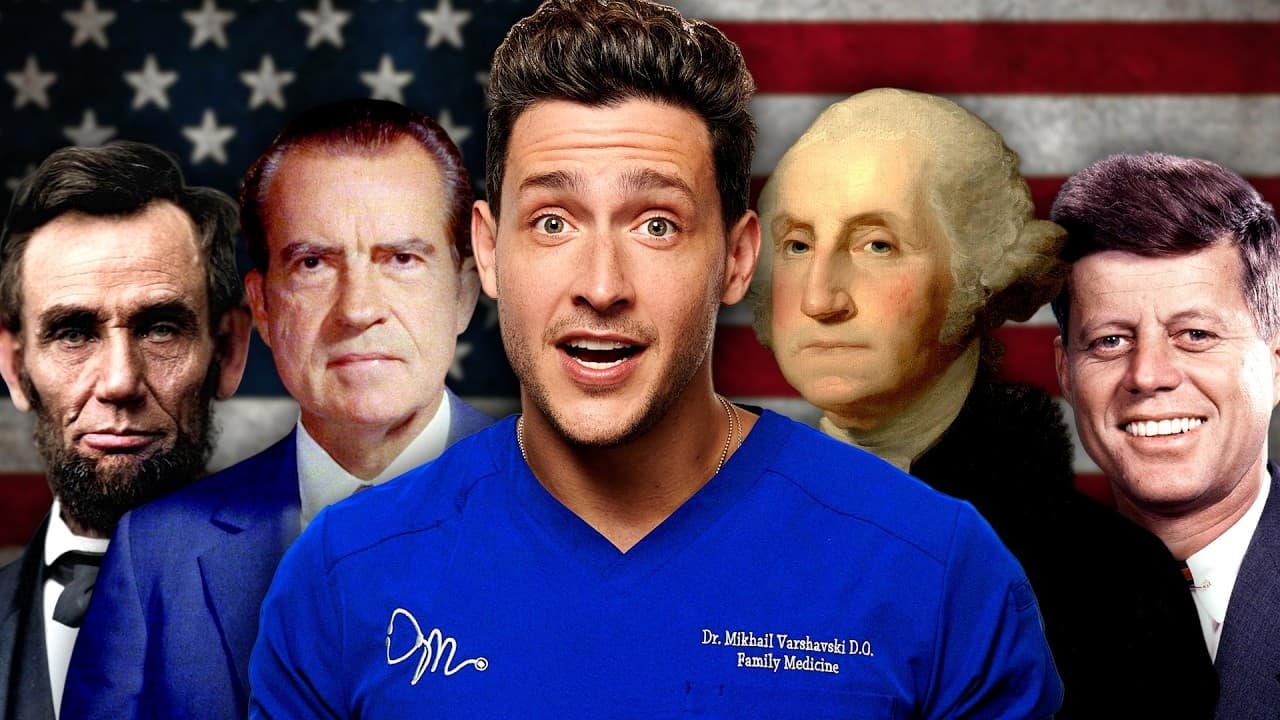
- There have been 45 presidents in the history of the United States, and as of uploading this video, 39 of them have died. Today, I'm talking about what killed every president and the bizarre circumstances that surrounded many of their deaths. Four assassinations, a top secret surgery aboard a fishing boat. God bless America and pee woop. George Wa... Read More
Key Insights
- 😷 Medical treatment in the 18th and 19th centuries often lacked knowledge of germ theory, leading to harmful practices.
- 🥳 The coincidence of Adams and Jefferson’s deaths on the same day contributes to a deeper historical narrative of American independence.
- 🔒 The assassination of presidents has historically influenced changes in security protocols for future administrations.
- 🧑⚕️ Presidential health issues have often remained private, reflecting societal pressures on leaders to maintain an image of invincibility.
- 💊 The varying causes of deaths among presidents reveal trends in health care, lifestyle choices, and the evolution of modern medicine.
- 😥 Poised at a time of political tension, the case of Zachary Taylor serves as a point of curiosity in historical narratives about presidential fate.
- 😷 The role of a president's health and medical history is crucial in understanding their effectiveness during their term.
Install to Summarize YouTube Videos and Get Transcripts
Explore YouTube Video Summarizer or Get YouTube Transcript Extractor
Questions & Answers
Q: How did George Washington's medical treatment contribute to his death?
Washington's demise in 1799 was worsened by the medical practices of the time. After developing a sore throat, his doctors drained significant amounts of blood and applied various harmful treatments, which severely weakened him, resulting in his death. Modern medicine suggests he likely would have survived with proper care.
Q: What unusual circumstances surrounded the deaths of Adams and Jefferson?
Both former presidents died on July 4th, 1826, precisely 50 years after the Declaration of Independence was signed, making their deaths a remarkable coincidence. While the causes were different, John Adams died from heart failure, whereas Jefferson's health declined, leading to death shortly after Adams, highlighting a significant moment in American history.
Q: What happened to William Henry Harrison after his inaugural address?
Harrison delivered an extensive inaugural address in inclement weather, which many believed led to his contraction of pneumonia. He died just a month into his presidency due to the infection, illustrating the dangers of early presidential duties and the limitations of medical knowledge at the time.
Q: How did Abraham Lincoln's assassination impact presidential security?
Lincoln's assassination in April 1865 by John Wilkes Booth brought about a national discussion regarding the safety of the president. His death ultimately led to Congress formally assigning the Secret Service to protect future presidents in 1906 as a direct response to security failings.
Q: What secret medical issue did Grover Cleveland experience while in office?
Cleveland underwent a clandestine surgery aboard a yacht in 1893 to remove a cancerous growth from the roof of his mouth. This operation, performed by multiple surgeons, was kept secret from the public for years, demonstrating the lengths to which he went to maintain political stability.
Q: What controversies surround Zachary Taylor's death?
Taylor's death in 1850 was enveloped in controversy, with some believing he was poisoned due to his anti-slavery stance, while others attributed it to cholera or dysentery from food contamination. This intrigue led to exhumation attempts to uncover scientific proof, which ultimately did not confirm poisoning.
Q: What was notable about John F. Kennedy’s health at the time of his assassination?
Kennedy's health problems, including chronic back pain and other ailments, were well-documented and influenced his assassination. His back brace hindered his ability to react quickly after the first shot, leading to critical injuries that would prove fatal, showcasing the intersections of health and historical events.
Q: How did Richard Nixon's age affect the cause of his death?
Nixon died at 81 due to a stroke caused by a blood clot that traveled to his brain. His age and health issues intensified the risks associated with such a condition, highlighting the challenges older presidents face regarding health and well-being during and after their time in office.
Summary & Key Takeaways
-
The video discusses the deaths of all U.S. presidents, detailing their causes and unusual circumstances, highlighting a mix of assassinations, health issues, and medical missteps.
-
Notable cases include George Washington, who suffered from improper medical treatment, and William McKinley, whose assassination led to increased presidential protection.
-
The narrative also covers interesting coincidences, like John Adams and Thomas Jefferson dying on the same day, July 4th, 1826, providing a unique perspective on American history.
Read in Other Languages (beta)
Share This Summary 📚
Summarize YouTube Videos and Get Video Transcripts with 1-Click
Try YouTube Summary with ChatGPT & Claude or YouTube Transcript Generator
Explore More Summaries from Doctor Mike 📚




Summarize YouTube Videos and Get Video Transcripts with 1-Click
Try YouTube Summary with ChatGPT & Claude or YouTube Transcript Generator