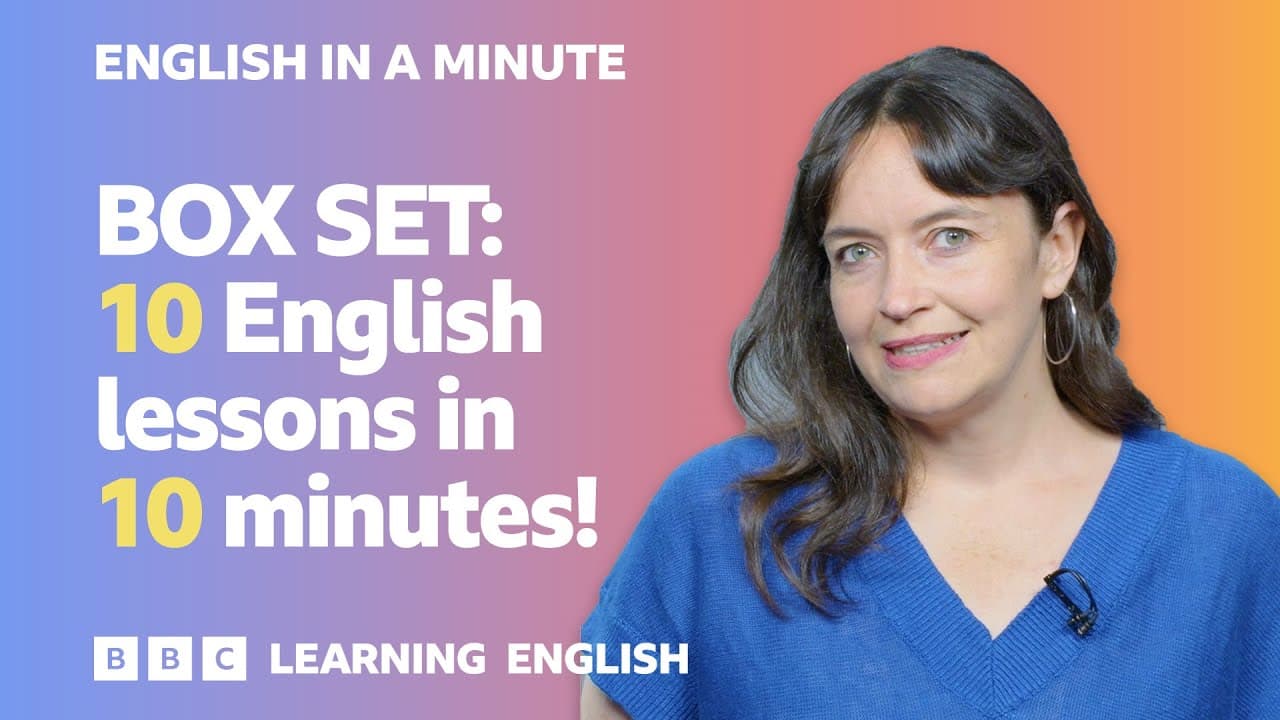
BOX SET: English In A Minute 3 – TEN English lessons in 10 minutes!
TL;DR
Learn essential English vocabulary and grammar in ten minutes.
Transcript
'wow' is that it's quite informal, and we use it mostly when speaking, so our intonation is quite important. The most common use of 'wow' is as an exclamation to express surprise. Wow! You shaved your beard off! The surprise can be a neutral surprise, but it's often a pleasant surprise. Did you make that cake? For me? Wow! We also use 'wow' to show... Read More
Key Insights
- The word 'wow' is used to express surprise or admiration and can be used as an exclamation or a verb. Its placement in a sentence can vary, and its intonation is crucial in spoken English.
- The words 'soon', 'early', and 'quickly' have similar meanings but different usages. 'Soon' refers to something happening shortly, 'early' indicates before the expected time, and 'quickly' describes a fast pace.
- The phrases 'be going to' and present continuous are used for future plans. 'Be going to' suggests a probable plan, while present continuous indicates a more definite and difficult-to-cancel plan.
- The past participles 'been' and 'gone' differ in meaning. 'Been' describes a completed visit, while 'gone' indicates someone has traveled to a place and is still there.
- The words 'person', 'persons', 'people', and 'peoples' have specific uses. 'Person' is singular, 'people' is plural, 'persons' is formal, and 'peoples' refers to nations or ethnic groups.
- 'Hard' and 'hardly' have different meanings. 'Hard' means difficult or intense, while 'hardly' means almost not. They can be used with words like 'any' or 'ever' to describe quantity or frequency.
- The word 'quite' has multiple uses and meanings, often indicating a moderate degree. It can mean less than 'very' but more than 'a little', and its meaning changes based on its placement in a sentence.
- Differences between American and British English include variations in spelling, such as '-er' vs. '-re', '-ize' vs. '-ise', and '-or' vs. '-our'. Consistency in using one style is important.
Install to Summarize YouTube Videos and Get Transcripts
Explore YouTube Video Summarizer or Get YouTube Transcript Extractor
Questions & Answers
Q: What is the main use of the word 'wow'?
The main use of the word 'wow' is as an exclamation to express surprise, wonder, or amazement. It is informal and often used in spoken English, where intonation plays a significant role. It can also function as a verb, meaning to make others feel admiration or excitement.
Q: How do 'soon', 'early', and 'quickly' differ in usage?
'Soon' is used for events happening shortly from now, 'early' indicates something occurring before the expected time, and 'quickly' describes actions performed at a fast pace. Each word has a specific context in which it is appropriately used to convey timing or speed.
Q: What is the difference between 'be going to' and present continuous?
'Be going to' is used for future plans that are probable but not definite, while present continuous is for plans that are almost certain and difficult to cancel. The choice between them depends on the level of certainty and details involved in the plan.
Q: In what context are 'been' and 'gone' used differently?
'Been' is used to describe completed visits, implying a person has returned, while 'gone' indicates someone has traveled to a place and remains there. The context of the sentence determines which past participle is appropriate, based on whether the visit is complete or ongoing.
Q: What are the distinctions between 'person', 'persons', 'people', and 'peoples'?
'Person' is singular, 'people' is its plural form, 'persons' is a more formal and polite plural, and 'peoples' refers to nations or ethnic groups. Understanding these distinctions helps in choosing the correct term based on formality and context.
Q: How do 'hard' and 'hardly' differ in meaning?
'Hard' typically means difficult, strong, or intense, whereas 'hardly' is an adverb meaning almost not. 'Hardly' can be used with words like 'any' or 'ever' to describe limited quantity or frequency, creating a contrast with the intensity implied by 'hard'.
Q: What are the different uses of 'quite'?
'Quite' can mean less than 'very' but more than 'a little' when used before adjectives or adverbs. It can also modify verbs like 'enjoy' and 'like', or change meaning when used as 'quite a' before nouns. Its usage depends on the context and sentence structure.
Q: What are some spelling differences between American and British English?
American English often uses '-er', '-ize', and '-or', while British English uses '-re', '-ise', and '-our'. Examples include 'center' vs. 'centre', 'organize' vs. 'organise', and 'color' vs. 'colour'. Consistency in using one style is important for clarity and coherence.
Summary & Key Takeaways
-
This video offers a concise English lesson covering various vocabulary and grammar topics, including the use of 'wow', differences between 'soon', 'early', and 'quickly', and the distinction between 'be going to' and present continuous.
-
It explains the differences between 'been' and 'gone', 'person', 'persons', 'people', and 'peoples', as well as the meanings of 'hard' and 'hardly'. The lesson also covers the uses of 'quite' and differentiates between 'journey' and 'trip'.
-
The video highlights spelling differences between American and British English and provides guidance on using 'make' and 'do'. The lesson aims to improve English vocabulary and grammar in a short, engaging format.
Read in Other Languages (beta)
Share This Summary 📚
Summarize YouTube Videos and Get Video Transcripts with 1-Click
Try YouTube Summary with ChatGPT & Claude or YouTube Transcript Generator
Explore More Summaries from BBC Learning English 📚

Summarize YouTube Videos and Get Video Transcripts with 1-Click
Try YouTube Summary with ChatGPT & Claude or YouTube Transcript Generator