Direct Indirect Object: English Grammar
TL;DR
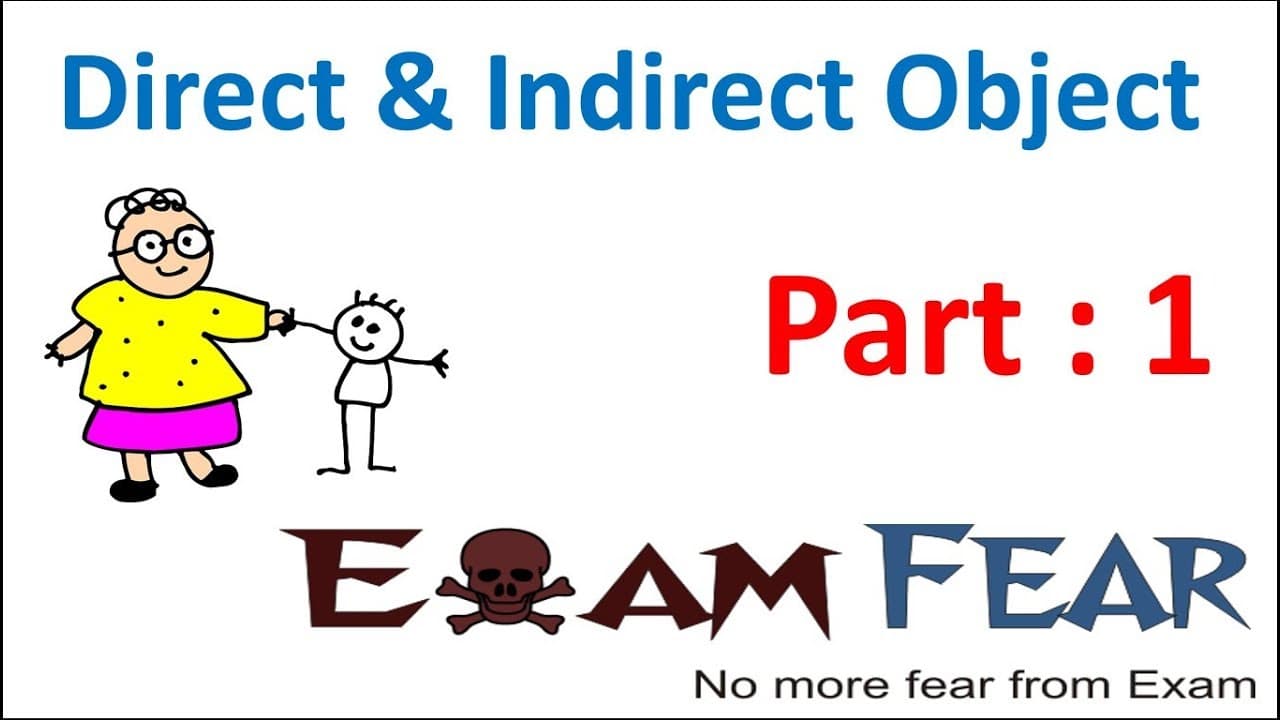
This video explains the difference between direct and indirect objects in English grammar and provides useful guidelines for identifying them in sentences.
Transcript
hello friends this video on direct and indirect object part one is brought to you by example.com no more fear from exam many times we are confused between direct object and indirect object and we are unable to identify which one is direct object and which one is indirect so here this video is dedicated to direct and indirect object so that we get t... Read More
Key Insights
- 🎭 Direct objects are the receivers of actions performed by subjects, while indirect objects are the people or things for whom the actions are performed.
- 😷 Direct objects can be identified by asking "what" or "whom" after the action verb, while indirect objects can be identified by asking questions like "for what" or "to whom."
- 📢 Direct objects can be nouns, pronouns, phrases, or clauses, while indirect objects are typically nouns or pronouns.
- 📁 Subjective pronouns cannot be used as direct objects, and only action verbs can have direct objects.
- 💁 Object complements provide additional information about the object and follow linking verbs, while subject complements describe or complete the meaning of the subject.
Install to Summarize YouTube Videos and Get Transcripts
Explore YouTube Video Summarizer or Get YouTube Transcript Extractor
Questions & Answers
Q: What is a direct object?
A direct object is the receiver of the action performed by the subject in a sentence. It can be identified by asking the question "what" or "whom" after the action verb.
Q: How do you identify an indirect object?
An indirect object is the person or thing for whom the action is performed. It can be identified by asking questions like "for what" or "to whom" after the action verb.
Q: Can a direct object be a pronoun?
Yes, a direct object can be a pronoun. It can also be a noun, phrase, or clause.
Q: What verbs can have direct objects?
Only action verbs can have direct objects. Linking verbs, such as "be" verbs, do not show action and therefore do not have direct objects.
Q: What is the difference between a direct object and an object complement?
A direct object is the receiver of the action, while an object complement describes or provides more information about the object. Object complements follow linking verbs and complete the meaning of the subject.
Q: Can subjective pronouns be used as direct objects?
No, subjective pronouns (such as "I," "he," or "we") cannot be used as direct objects. They are always used as subjects in a sentence.
Q: What is the role of a subject complement?
A subject complement follows a linking verb and describes or adds more meaning to the subject. It completes the subject by describing how the subject is.
Q: Where can I find more educational content and resources?
You can visit example.com for free quality education, video lessons, notes, and online tests on various subjects like physics, chemistry, mathematics, and biology.
Summary & Key Takeaways
-
Direct objects are the receivers of the action performed by the subject in a sentence, while indirect objects are the person or thing for whom the action is performed.
-
Direct objects can be identified by asking the question "what" or "whom" after the action verb, while indirect objects can be identified by asking questions like "for what" or "to whom."
-
Direct objects can be nouns, pronouns, phrases, or clauses, while indirect objects are typically nouns or pronouns.
-
Action verbs are the only verbs that can have direct objects, and subjective pronouns are never used as direct objects.
Read in Other Languages (beta)
Share This Summary 📚
Summarize YouTube Videos and Get Video Transcripts with 1-Click
Try YouTube Summary with ChatGPT & Claude or YouTube Transcript Generator
Explore More Summaries from LearnoHub - Class 11, 12 📚



Summarize YouTube Videos and Get Video Transcripts with 1-Click
Try YouTube Summary with ChatGPT & Claude or YouTube Transcript Generator