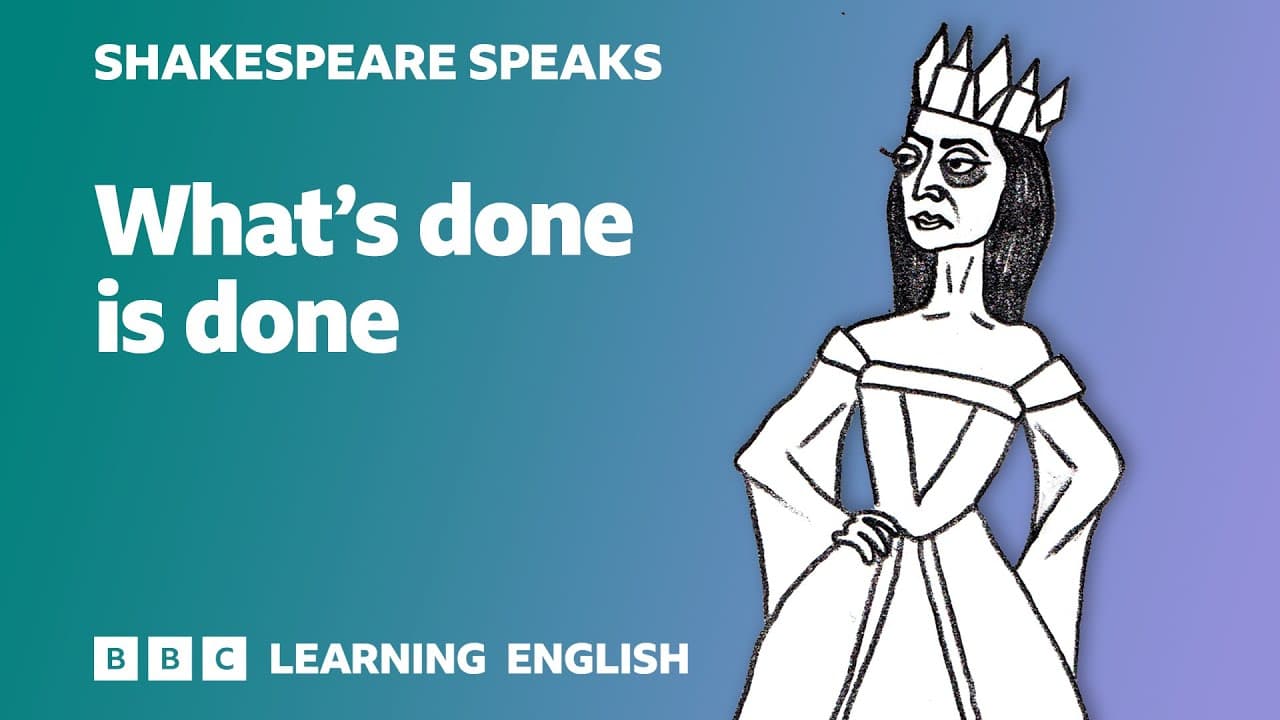
🎭 What's done is done - Learn English vocabulary & idioms with 'Shakespeare Speaks'
TL;DR
Exploring Shakespeare's famous idiom about accepting the past.
Transcript
It was a late summer's morning. William Shakespeare is at the market. A pound of plums, please, Mary. Here you are Mr Will. Mary? You're not your usual happy self this fine morning. I feel terrible, Mr Will. I did an awful thing to that Nell Butcher – she's had her eye on my George for ages. I've had enough. I put pepper all over her fruit pies. Oh... Read More
Key Insights
- The phrase 'What's done is done' originates from Shakespeare's play Macbeth, where it highlights the futility of dwelling on past actions.
- Lady Macbeth uses the phrase to encourage her husband to move past his guilt over murder, demonstrating her pragmatic yet ruthless nature.
- In modern context, 'What's done is done' is often used to advise letting go of past mistakes and focusing on future actions.
- The narrative illustrates how Shakespeare's language and expressions continue to influence contemporary idiomatic expressions.
- The episode uses a market scene to introduce the idiom, making the learning experience relatable and engaging for English learners.
- The story emphasizes the importance of accepting responsibility for one's actions and the psychological impact of guilt.
- The content is part of a series aimed at teaching English vocabulary and idioms through Shakespeare's works.
- The episode encourages learners to reflect on their own experiences with regret and how they can apply the idiom in real life.
Install to Summarize YouTube Videos and Get Transcripts
Explore YouTube Video Summarizer or Get YouTube Transcript Extractor
Questions & Answers
Q: What is the origin of the phrase 'What's done is done'?
The phrase 'What's done is done' originates from William Shakespeare's play Macbeth. In the play, Lady Macbeth uses the phrase to tell her husband to stop feeling guilty about murdering the King and to focus on the future. It highlights the futility of dwelling on past actions that cannot be changed.
Q: How is the idiom 'What's done is done' used in modern contexts?
In modern contexts, the idiom 'What's done is done' is often used to advise individuals to let go of past mistakes and concentrate on future actions. It serves as a reminder that dwelling on the past is unproductive and that one should focus on moving forward with a positive mindset.
Q: What role does Lady Macbeth play in the use of the idiom?
Lady Macbeth plays a crucial role in the use of the idiom 'What's done is done' as she uses it to counsel her husband, Macbeth, to move past his guilt over the murder of the King. Her pragmatic yet ruthless nature is highlighted as she encourages him to focus on their ambitions rather than his remorse.
Q: How does the episode make the learning experience engaging for English learners?
The episode makes the learning experience engaging for English learners by setting the narrative in a relatable context—a market scene where Shakespeare advises a character named Mary. This relatable setting, combined with the use of a famous idiom, helps learners connect with the material and understand the practical application of Shakespeare's language.
Q: What psychological themes are explored in the episode?
The episode explores psychological themes such as guilt, responsibility, and the impact of past actions on the present. Through the characters of Macbeth and Lady Macbeth, the narrative delves into the emotional turmoil caused by guilt and the importance of accepting responsibility while moving forward with one's life.
Q: What is the educational purpose of the Shakespeare Speaks series?
The educational purpose of the Shakespeare Speaks series is to teach English vocabulary and idioms through the works of William Shakespeare. By using engaging narratives and relatable contexts, the series aims to make Shakespeare's language accessible and relevant to modern English learners, highlighting the timelessness of his expressions.
Q: How does the episode encourage reflection on personal experiences with regret?
The episode encourages reflection on personal experiences with regret by illustrating the concept of 'What's done is done' through relatable scenarios. Learners are prompted to consider their own past mistakes and how they can apply the idiom in real life to move forward positively, emphasizing the importance of learning from the past without dwelling on it.
Q: What additional resources are offered to enhance the learning experience?
To enhance the learning experience, the episode offers additional resources such as a free lesson plan and worksheet available for download. These resources are designed to complement the episode by providing structured activities and materials that reinforce the learning of Shakespeare's idioms and vocabulary in an educational setting.
Summary & Key Takeaways
-
This episode of Shakespeare Speaks explores the idiom 'What's done is done' from the play Macbeth, emphasizing the importance of moving past guilt and regret. Lady Macbeth uses this phrase to counsel her husband, Macbeth, to forget his remorse over his actions, highlighting her pragmatic approach.
-
The narrative is set in a market where Shakespeare advises a character named Mary to let go of her guilt over a prank gone wrong. This setting makes the concept relatable and engaging, showing how Shakespeare's language remains relevant in modern contexts.
-
The episode is part of a series designed to teach English vocabulary and idioms using Shakespeare's works, demonstrating the timelessness of his language. The idiom 'What's done is done' is used to illustrate the futility of dwelling on past mistakes, encouraging a forward-thinking mindset.
Read in Other Languages (beta)
Share This Summary 📚
Summarize YouTube Videos and Get Video Transcripts with 1-Click
Try YouTube Summary with ChatGPT & Claude or YouTube Transcript Generator
Explore More Summaries from BBC Learning English 📚

Summarize YouTube Videos and Get Video Transcripts with 1-Click
Try YouTube Summary with ChatGPT & Claude or YouTube Transcript Generator