Hunting for dinosaurs showed me our place in the universe | Kenneth Lacovara
TL;DR
Learn the secrets of finding dinosaurs: find rocks of the right age, sedimentary rocks, and explore desert areas.
Transcript
How do you find a dinosaur? Sounds impossible, doesn't it? It's not. And the answer relies on a formula that all paleontologists use. And I'm going to tell you the secret. First, find rocks of the right age. Second, those rocks must be sedimentary rocks. And third, layers of those rocks must be naturally exposed. That's it. Find those three things ... Read More
Key Insights
- 🦖 Paleontologists use a formula to find dinosaurs: find rocks of the right age, sedimentary rocks, and layers naturally exposed.
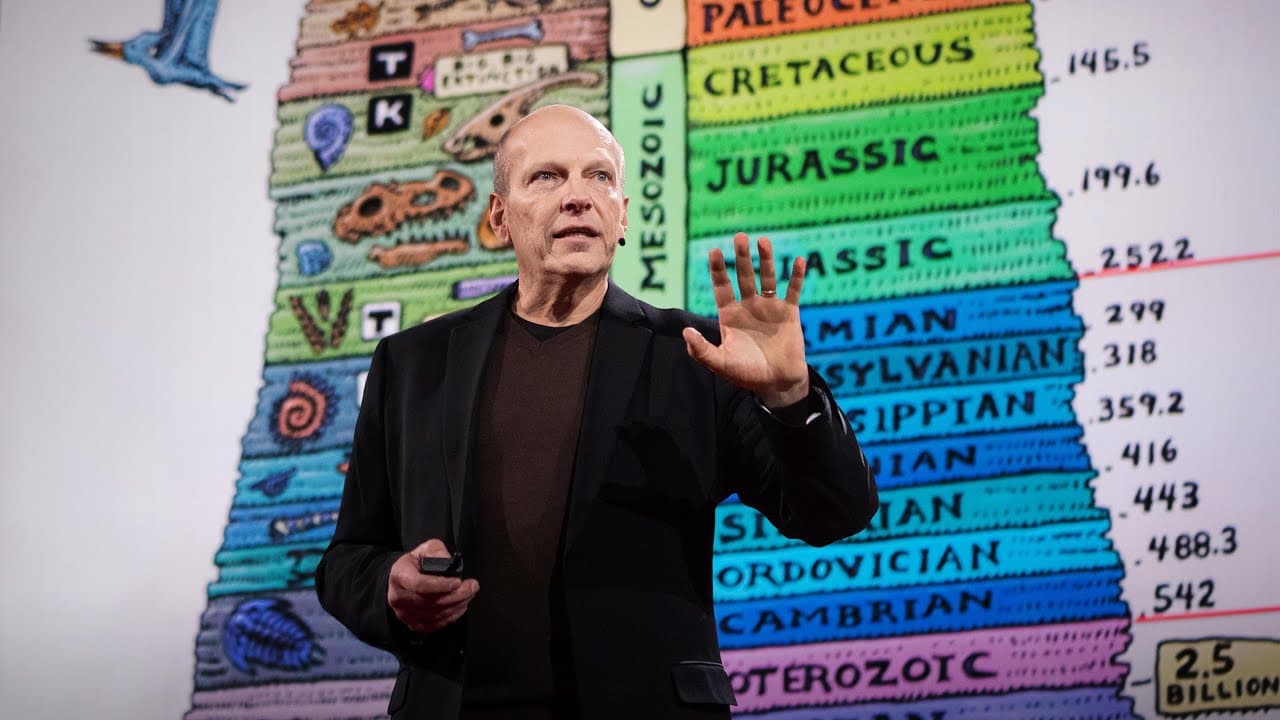
- 🦴 The age and type of rocks determine what fossils can be found; older rocks for trilobites, younger Mesozoic rocks for dinosaurs.
- 📚 Geologists developed mapping techniques to understand the Earth's history and predict where certain types of rocks might occur.
- 🏜️ To find fossils, go to a desert-like environment with exposed sedimentary rocks and minimal plant coverage.
- 💡 To find scientifically significant fossils, it's best to explore unexplored areas away from other paleontologists.
- 🦕 Paleontologists discovered a new dinosaur species, Dreadnoughtus schrani, which was 85 feet long and weighed 65 tons.
- 🌍 The geological record provides insight into Earth's history, showing the improbable events that led to our existence. ⏰ The fossil record reminds us of the potential fragility of our species and our responsibility to address the current environmental crisis.
Install to Summarize YouTube Videos and Get Transcripts
Explore YouTube Video Summarizer or Get YouTube Transcript Extractor
Questions & Answers
Q: How do paleontologists find dinosaurs?
Paleontologists find dinosaurs by following a formula that involves finding rocks of the right age, which are sedimentary rocks, and that have naturally exposed layers. By finding these three things and exploring the ground, there is a good chance of finding fossils.
Q: What type of rocks do paleontologists look for to find dinosaurs?
Paleontologists look for sedimentary rocks, as fossils can only form in these types of rocks. Igneous rocks formed by magma or metamorphic rocks that have been heated and squeezed do not contain fossils.
Q: How does the Earth's geology impact the discovery of fossils?
The Earth's geological processes pose challenges to the discovery of fossils. Geological processes such as mutilation, compression, folding, tearing, scorching, and baking can destroy or alter rocks and their fossils. Additionally, the vastness and complexity of the Earth's rock record make it difficult to decipher and understand without proper exploration and mapping.
Q: Why is it important to be in a desert when searching for dinosaur fossils?
It is important to be in a desert environment when searching for dinosaur fossils because deserts tend to have fewer plants covering the rocks and more erosion occurring, which exposes new bones at the surface. This makes it easier to spot fossils and increases the chances of finding significant discoveries.
Q: What is the additional factor that helps in finding scientifically significant fossils?
The additional factor that helps in finding scientifically significant fossils is to get as far away from other paleontologists as possible. This increases the chances of finding something new to science, as relatively unexplored areas have a higher probability of yielding unique and significant fossil discoveries.
Summary & Key Takeaways
-
Paleontologists use a formula to find dinosaurs: find rocks of the right age, sedimentary rocks, and exposed layers of those rocks.
-
Earth's history is written in rocks, with the oldest at the bottom and the youngest at the top, but finding well-preserved fossils is challenging due to geological processes.
-
To find scientifically significant fossils, it's best to go to unexplored areas and get as far away from other paleontologists as possible.
Read in Other Languages (beta)
Share This Summary 📚
Summarize YouTube Videos and Get Video Transcripts with 1-Click
Try YouTube Summary with ChatGPT & Claude or YouTube Transcript Generator
Explore More Summaries from TED 📚





Summarize YouTube Videos and Get Video Transcripts with 1-Click
Try YouTube Summary with ChatGPT & Claude or YouTube Transcript Generator