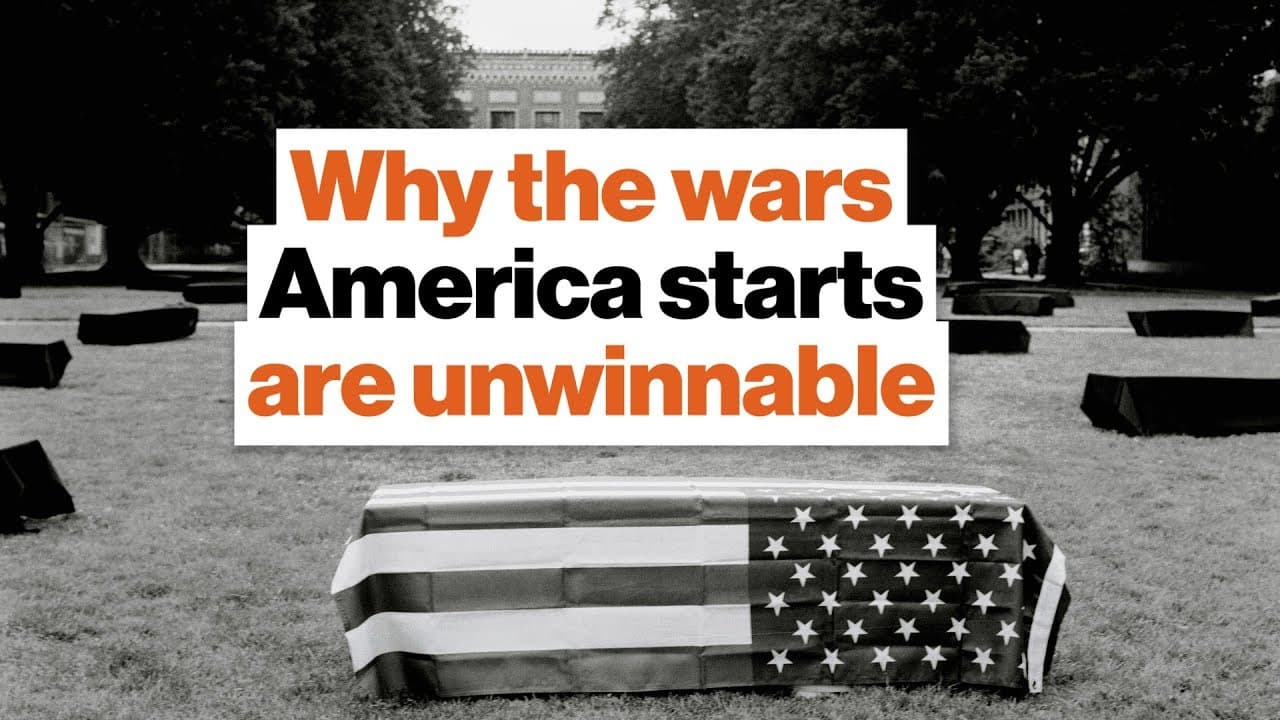
Why the wars America starts are unwinnable | Danny Sjursen | Big Think
TL;DR
The US involvement in Iraq and Afghanistan is marked by civil wars, unwinnable conflicts, profit motives, and the sunk cost fallacy.
Transcript
Iraq and Afghanistan are very different wars. They’ve been equally ill-advised in my opinion. Iraq, what I saw in Iraq was a civil war, a straight forward civil war. And I remember a moment in 2007, three of my soldiers were already dead, about eight had them wounded in a unit of just 20 soldiers, so we were pretty battered, we were pretty beaten u... Read More
Key Insights
- 🫱 American interventions in Iraq and Afghanistan created destabilizing civil wars, fueling violence and chaos.
- ⏮️ The unwinnable nature of the Afghan conflict is highlighted through historical parallels with previous occupying forces.
- 🇦🇫 Corrupt and ineffective governments in Iraq and Afghanistan contribute to the prolonged conflicts and hinder progress.
- 🦾 The military-industrial complex profits from arms sales and influences US foreign policy decisions.
- 🥺 The sunk cost fallacy hampers the US ability to withdraw from wars, leading to extended conflict engagements.
- 😚 US presidents fear the perception of losing in wars, perpetuating the cycle of violence and unrest.
- 🌍 The societal implications of perpetual warfare and the impact on future generations require introspection and reassessment of national priorities.
Install to Summarize YouTube Videos and Get Transcripts
Explore YouTube Video Summarizer or Get YouTube Transcript Extractor
Questions & Answers
Q: What were the major challenges faced by American soldiers in Iraq and Afghanistan?
American soldiers in Iraq faced a civil war spawned by the invasion, becoming targets of both sides. In Afghanistan, the historical patterns show a long-standing struggle against the Taliban and ineffective governance.
Q: How do profit motives play a role in perpetuating these conflicts according to the speaker?
The speaker highlights the military-industrial complex's profit-making from arms sales and the substantial US military budget, influencing decisions to prolong wars for economic gains.
Q: What is the sunk cost dilemma mentioned in the content, and how does it affect US decisions in these conflicts?
The sunk cost dilemma refers to the reluctance to withdraw from wars due to the immense human and financial investments. It leads to the fear of appearing as losers, prolonging conflicts beyond logical solutions.
Q: Why does the speaker suggest reevaluating US interventions in Iraq and Afghanistan and other related conflicts?
The speaker advocates for a critical examination of ongoing wars due to their ineffectiveness, illegitimate governments, and the lack of clear objectives or strategies, urging a reconsideration of US foreign policy.
Summary & Key Takeaways
-
The speaker witnessed the devastating impact of the civil war in Iraq, sparked by the American invasion, leading to chaos and violence between factions.
-
Afghanistan is portrayed as an unwinnable war, mirroring historical failures of occupying forces and creating a prolonged insurgency with the Taliban.
-
The US interventions in Iraq and Afghanistan are muddled by corrupt, ineffective governments, perpetuating conflicts with no clear victory in sight.
Read in Other Languages (beta)
Share This Summary 📚
Summarize YouTube Videos and Get Video Transcripts with 1-Click
Try YouTube Summary with ChatGPT & Claude or YouTube Transcript Generator
Explore More Summaries from Big Think 📚




Summarize YouTube Videos and Get Video Transcripts with 1-Click
Try YouTube Summary with ChatGPT & Claude or YouTube Transcript Generator