Shocking New Physics Reveals Truth of Simulation Theory & Life After Death
TL;DR
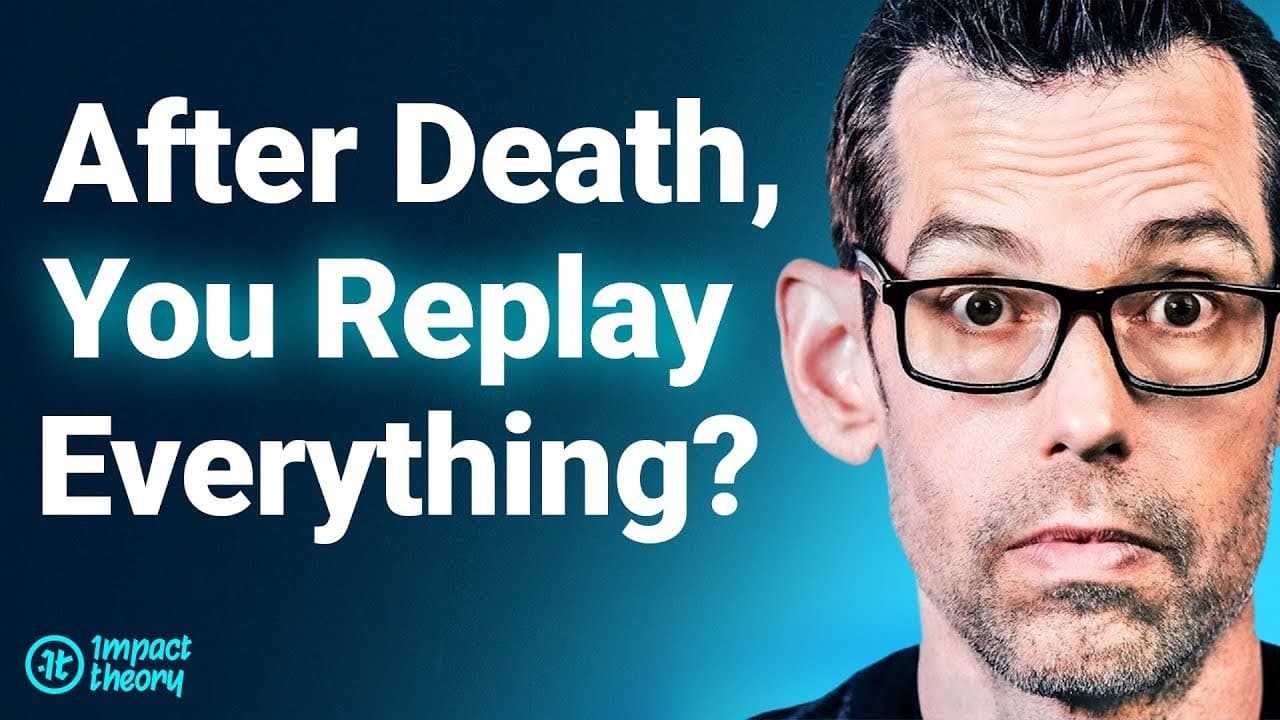
Rizwan Virk discusses the universe as a simulation blending science and mysticism.
Transcript
in 2022 three scientists won the Nobel Prize for proving that the universe is not locally real meaning particles don't exist in a fixed state until they're observed what does that mean in simple terms the universe only renders when you look at it this has been proven scientifically and it's made one question above all the obvious one to ask are we ... Read More
Key Insights
- The 2022 Nobel Prize highlighted that the universe isn't locally real, suggesting reality only renders upon observation, akin to video games.
- Rizwan Virk, with a background in gaming and quantum physics, argues a simulated universe is more plausible than a purely physical one.
- Quantum indeterminacy, illustrated by Schrodinger’s cat, supports the simulation theory by showing how reality manifests upon observation.
- The universe's fine-tuning for life may indicate either a higher intelligence or a simulation running multiple trials to achieve the right conditions.
- Mystic traditions, like Hinduism and Buddhism, describe reality as an illusion or dream, paralleling modern simulation concepts.
- The free will debate explores whether humans are NPCs with predetermined paths or players with control from outside the simulation.
- Near-death experiences and life reviews suggest death might not be the end but a transition, possibly logging out of the simulation.
- Understanding the simulation framework can offer new perspectives on personal challenges and the nature of reality itself.
Install to Summarize YouTube Videos and Get Transcripts
Explore YouTube Video Summarizer or Get YouTube Transcript Extractor
Questions & Answers
Q: What is the significance of the 2022 Nobel Prize in the context of simulation theory?
The 2022 Nobel Prize recognized that the universe is not locally real, meaning particles don't exist in a fixed state until observed. This aligns with simulation theory, suggesting that reality only renders when observed, much like how video games work. This scientific discovery supports the idea that our universe could be a simulated environment, where observation determines reality.
Q: How does Rizwan Virk connect ancient mysticism with modern simulation theory?
Rizwan Virk sees parallels between ancient mysticism and modern simulation theory, noting that many religious traditions describe reality as a dream or illusion. He argues that these descriptions align with the simulation hypothesis, suggesting that ancient mystics may have been describing a simulated universe without the modern vocabulary to express it. This connection provides a bridge between spiritual beliefs and scientific concepts.
Q: What role does quantum indeterminacy play in the simulation hypothesis?
Quantum indeterminacy, exemplified by Schrodinger’s cat, plays a crucial role in the simulation hypothesis by illustrating how reality manifests upon observation. In quantum mechanics, particles exist in multiple states until observed, similar to how a simulation only renders what is necessary. This supports the idea that our universe operates on a similar principle, where observation collapses probabilities into a single reality.
Q: How does the simulation hypothesis address the concept of free will?
The simulation hypothesis offers a framework for understanding free will by distinguishing between NPCs (non-player characters) and players. NPCs operate on predetermined rules, while players, or souls, may have the ability to make choices from outside the simulation. This suggests that while our physical actions may be guided by rules, there could be an element of free will exercised by a consciousness beyond the simulation.
Q: What insights does the simulation hypothesis provide on life after death?
The simulation hypothesis suggests that life after death might not be the end but a transition, similar to logging out of a game. Near-death experiences and life reviews, where individuals report observing their lives from a detached perspective, support the idea that consciousness could exist beyond the physical body. This aligns with the notion that our current life is part of a larger simulation, and death is merely a change in state.
Q: Why does Rizwan Virk believe the universe is fine-tuned for life?
Rizwan Virk argues that the universe's fine-tuning for life could indicate either a higher intelligence or a simulation running multiple trials to achieve optimal conditions. The precise constants that allow for life suggest intentional design or a simulated environment testing various scenarios. This perspective challenges the notion of a purely random universe, proposing a purposeful structure behind existence.
Q: How does the concept of a multiverse relate to the simulation hypothesis?
The multiverse concept relates to the simulation hypothesis by suggesting that multiple universes could exist, each a different simulation or trial. This idea supports the notion that our universe is one of many, each with varying conditions and outcomes. In a simulated multiverse, resources are optimized, rendering only necessary scenarios, similar to how video games manage computational limits.
Q: What does Rizwan Virk suggest about the purpose of the simulation?
Rizwan Virk speculates that the simulation's purpose could be to test human behavior, see if we can overcome challenges, or evolve into an intergalactic species. The simulation might assess how we interact with each other and our environment, offering a platform for growth and learning. This perspective implies that our experiences and decisions are part of a larger experiment or game designed to explore potential outcomes.
Summary & Key Takeaways
-
Rizwan Virk discusses the possibility that our universe is a simulation, using insights from quantum physics and video game development. He highlights how reality seems to render only upon observation, similar to how video games work, suggesting a non-physical universe.
-
The conversation delves into ancient mysticism and its parallels with modern technology, suggesting that descriptions of reality as a dream or illusion in religions like Hinduism and Buddhism align with the simulation hypothesis, even if they lacked modern terminology.
-
Virk and Tom explore the implications of the simulation hypothesis on concepts like free will, life after death, and the universe's fine-tuning, offering a new framework for understanding personal and existential challenges.
Read in Other Languages (beta)
Share This Summary 📚
Summarize YouTube Videos and Get Video Transcripts with 1-Click
Try YouTube Summary with ChatGPT & Claude or YouTube Transcript Generator
Explore More Summaries from Tom Bilyeu 📚

Summarize YouTube Videos and Get Video Transcripts with 1-Click
Try YouTube Summary with ChatGPT & Claude or YouTube Transcript Generator