A legendary question with a surprising answer
TL;DR
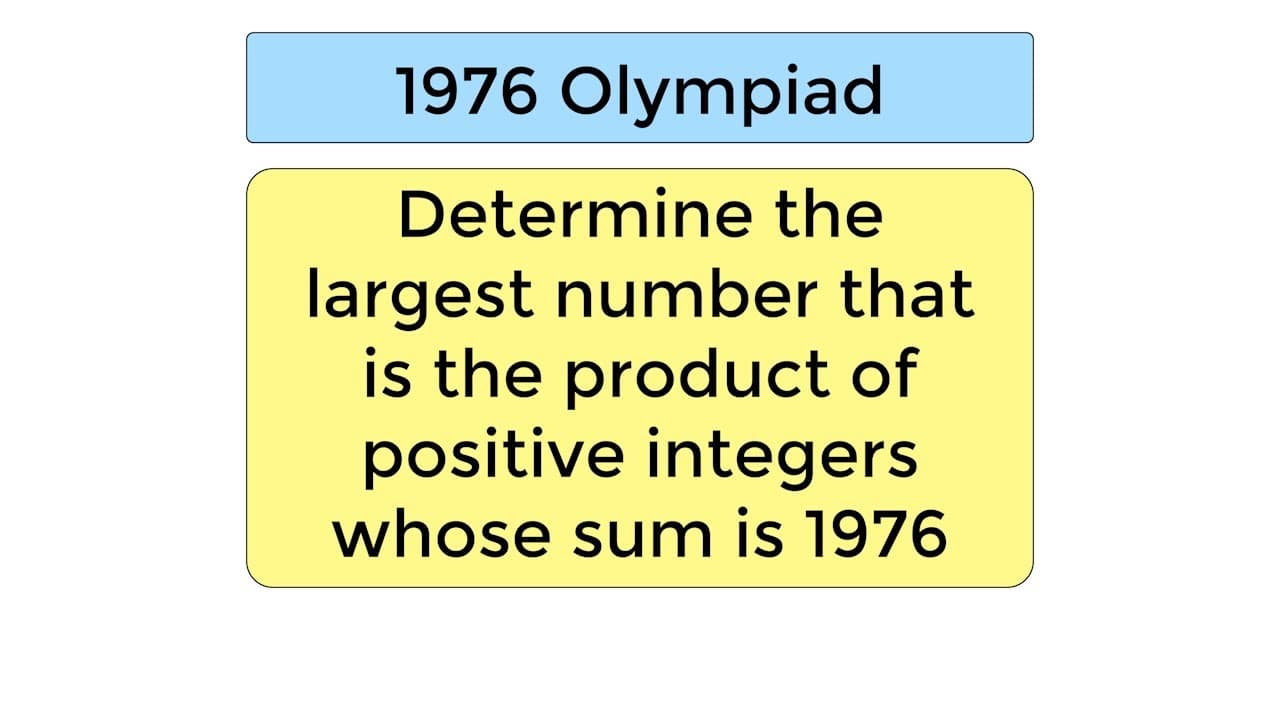
Determine the largest number that is the product of positive integers whose sum is 1976.
Transcript
hey this is preshtal Walker here's a delightful question from the international mathematical Olympiad in 1976. determine the largest number that is the product of positive integers whose sum is 1976. interestingly three years later on the Putnam competition there was basically the same question for 1979. I guess in the pre-internet days it was easi... Read More
Key Insights
- 😷 The International Mathematical Olympiad problem from 1976 asks for the largest number that is the product of positive integers whose sum is 1976.
- 🥰 The optimal strategy for maximizing the product is to choose as many threes as possible and potentially adding twos based on the remainder of the number divided by three.
- 💼 The general case can be solved by considering the divisibility of the number by three and using specific formulas for each case.
Install to Summarize YouTube Videos and Get Transcripts
Explore YouTube Video Summarizer or Get YouTube Transcript Extractor
Questions & Answers
Q: What is the question from the International Mathematical Olympiad in 1976?
The question asks to determine the largest number that is the product of positive integers whose sum is 1976.
Q: What is the optimal strategy for maximizing the product?
The optimal strategy is to choose as many threes as possible and potentially add twos based on the remainder of the number divided by three.
Q: How can the general case be solved?
If the number is divisible by three, the product is equal to 3 to the power of K. If the number leaves a remainder of one when divided by three, the product is equal to 2 squared multiplied by 3 to the power of K minus 1. If the number leaves a remainder of two when divided by three, the product is equal to 2 multiplied by 3 to the power of K.
Q: Why is three chosen as the special number?
The number three is chosen because, in a continuous case, maximizing the product involves getting as close to e (approximately 2.718) as possible. In the case of whole numbers, three is the closest number to e.
Key Insights:
- The International Mathematical Olympiad problem from 1976 asks for the largest number that is the product of positive integers whose sum is 1976.
- The optimal strategy for maximizing the product is to choose as many threes as possible and potentially adding twos based on the remainder of the number divided by three.
- The general case can be solved by considering the divisibility of the number by three and using specific formulas for each case.
- The number three is chosen because it is the closest whole number to e, which maximizes the product in a continuous case.
Summary & Key Takeaways
-
The video discusses a question from the International Mathematical Olympiad in 1976, where the goal is to find the largest product of positive integers whose sum is 1976.
-
The presenter explores various examples to find patterns and deduce the optimal strategy for maximizing the product.
-
The video explains that choosing as many threes as possible and potentially adding twos gives the highest product, based on the remainder of the number divided by three.
Read in Other Languages (beta)
Share This Summary 📚
Summarize YouTube Videos and Get Video Transcripts with 1-Click
Try YouTube Summary with ChatGPT & Claude or YouTube Transcript Generator
Explore More Summaries from MindYourDecisions 📚


Summarize YouTube Videos and Get Video Transcripts with 1-Click
Try YouTube Summary with ChatGPT & Claude or YouTube Transcript Generator