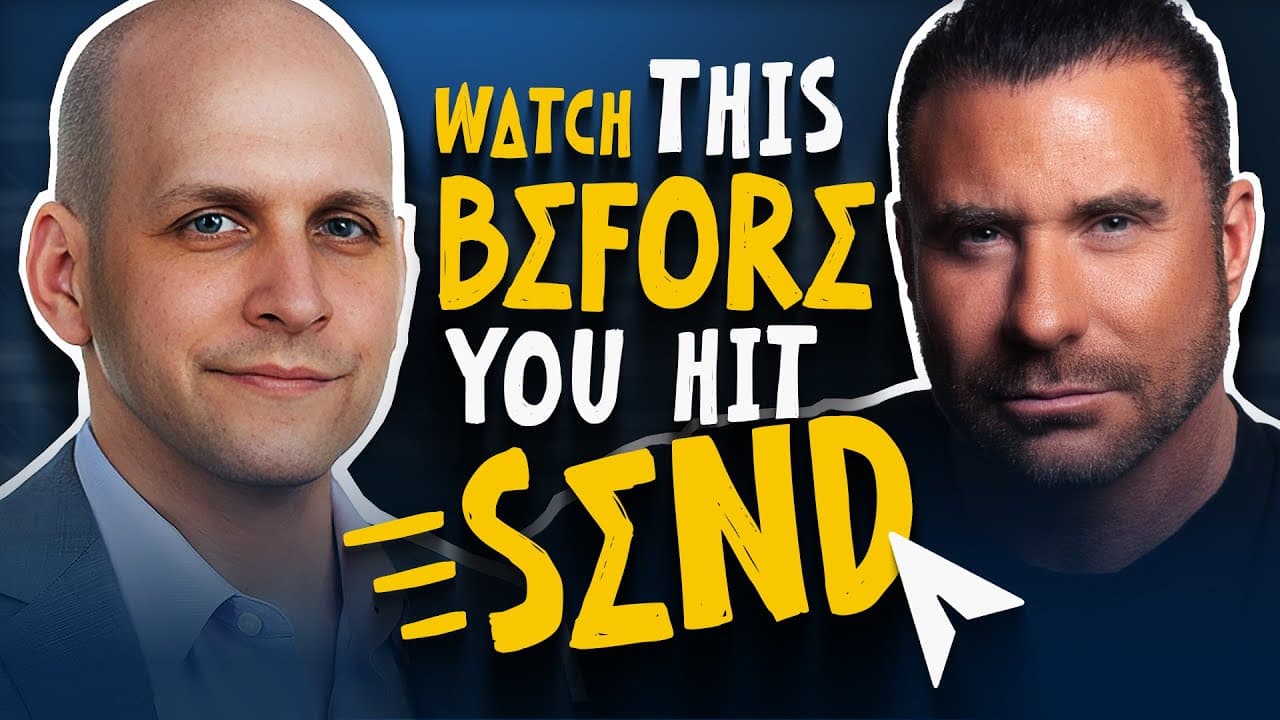
How to Regain Online Influence: Tips from Andrew Brodsky
TL;DR
To regain online influence, focus on effective virtual communication. Choose the right communication mode for your message, such as audio for high-impact interactions, and use the PING framework: Perspective-taking, Initiative, Nonverbal cues, and Goals. This approach helps build trust and charisma, even in digital spaces, and can improve both personal and professional relationships.
Transcript
i found in my life that people that sometimes are really good at one type of communication aren't good at like digital communication there are all these arguments happening about is remote work good is remote work bad and the thing that they're all missing is that it doesn't matter where anyone works anymore whether they're at home or office we're ... Read More
Key Insights
- Virtual charisma is crucial for maintaining influence online, even for naturally charismatic people.
- The PING framework helps enhance virtual communication through Perspective-taking, Initiative, Nonverbal cues, and Goals.
- Audio communication is often more effective than email or text for conveying emotion and authenticity.
- Video meetings can be more engaging with the use of music, video clips, and interactive elements like polls.
- Small talk is important in virtual settings for building rapport and trust, despite its time cost.
- Overcrafting emails can lead to increased anxiety and may not improve communication effectiveness.
- Understanding and respecting others' communication preferences can strengthen relationships.
- AI can aid in communication but may undermine trust if overused or detected by recipients.
Install to Summarize YouTube Videos and Get Transcripts
Explore YouTube Video Summarizer or Get YouTube Transcript Extractor
Questions & Answers
Q: How to build charisma in virtual meetings?
Building charisma in virtual meetings involves maintaining eye contact, managing your background, and using nonverbal cues like nodding and acknowledging others. It's important to be mindful of how you're perceived, as virtual settings can lead to misinterpretations. Engaging participants through interactive elements like polls or video clips can also enhance charisma and keep the audience engaged.
Q: Why is audio communication recommended over email?
Audio communication is recommended over email because it conveys emotion and authenticity more effectively. While email can come across as cold and impersonal, audio allows tone and inflection to communicate nuances that text cannot. It also masks nonverbal cues that might be misinterpreted in video calls, providing a balance of effort and emotional clarity.
Q: What is the PING framework in virtual communication?
The PING framework is a strategy for effective virtual communication, consisting of Perspective-taking, Initiative, Nonverbal cues, and Goals. Perspective-taking involves understanding the other person's viewpoint, Initiative focuses on adding missing elements to communication, Nonverbal cues emphasize the importance of visual and auditory signals, and Goals determine the best mode of communication for the situation.
Q: How can small talk improve virtual meetings?
Small talk in virtual meetings can improve rapport and trust among participants. It reduces anonymity and makes individuals feel more connected, which can lead to better collaboration and outcomes. However, it's important to balance small talk with productivity by setting agendas and time limits to ensure meetings remain focused and efficient.
Q: What are the effects of overcrafting communication?
Overcrafting communication, such as spending excessive time perfecting emails, can increase anxiety and may not enhance message effectiveness. It can lead to messages that seem overly anxious or insincere. It's important to find a balance where messages are clear and error-free but not overly edited to the point of diminishing returns.
Q: How does AI impact virtual communication?
AI can aid in virtual communication by assisting with brainstorming, editing, and reducing errors. However, relying too heavily on AI for important interactions may undermine trust if recipients suspect the message isn't genuine. AI is best used for low-stakes, repetitive tasks, while important communications should reflect the sender's authentic voice.
Q: What strategies reduce Zoom fatigue?
To reduce Zoom fatigue, ensure meetings are necessary and consider shorter, more focused sessions with fewer participants. Alternate between cameras on and off depending on the meeting's purpose, and use interactive elements to maintain engagement. Evaluate whether certain meetings could be replaced with emails or other forms of communication to save time and energy.
Q: How can communication preferences strengthen connections?
Understanding and respecting others' communication preferences can strengthen connections by ensuring interactions are comfortable and effective for all parties. Asking about preferences shows consideration and can lead to more productive and satisfying exchanges, as individuals are more likely to engage positively when their preferred modes of communication are used.
Summary & Key Takeaways
-
Effective virtual communication requires adapting to digital platforms while maintaining authenticity. The PING framework—Perspective-taking, Initiative, Nonverbal cues, Goals—provides a structured approach to enhance communication. Audio interactions are often more effective than text for conveying emotion and maintaining authenticity.
-
Building charisma in virtual settings involves being mindful of nonverbal cues, such as eye contact and background professionalism. Small talk, although often overlooked, plays a critical role in establishing trust and rapport in digital communications.
-
To combat Zoom fatigue, consider the necessity of meetings and opt for shorter, focused sessions. Understanding others' communication preferences and leveraging AI responsibly can further improve virtual interactions, maintaining influence and connection in an increasingly digital world.
Read in Other Languages (beta)
Share This Summary 📚
Summarize YouTube Videos and Get Video Transcripts with 1-Click
Try YouTube Summary with ChatGPT & Claude or YouTube Transcript Generator
Explore More Summaries from Ed Mylett 📚





Summarize YouTube Videos and Get Video Transcripts with 1-Click
Try YouTube Summary with ChatGPT & Claude or YouTube Transcript Generator