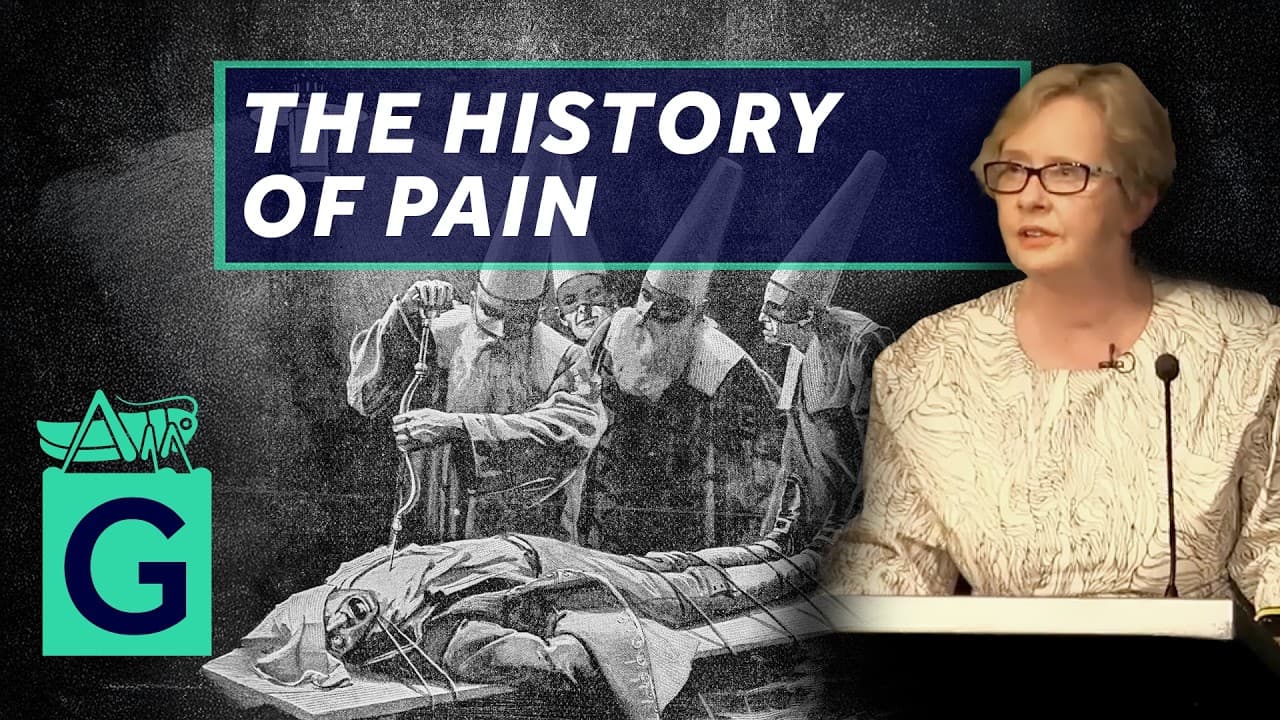
The History of Pain - Professor Joanna Bourke
TL;DR
Pain is explored as a phantom that haunts medical encounters, shifting from visual representations in the 19th century to modern textual and clinical approaches.
Transcript
hello and welcome I'm really really thrilled to be here tonight to speak to you because my topic tonight is something that we all are very much aware of and that is pain pain in our own lives and of course pain in the lives of our loved ones friends and acquaintances and one of the things I'm going to be suggesting today is that pain itself is a ph... Read More
Key Insights
- 👨🎨 Pain is depicted as a phantom entity that poses challenges in clinical communication and understanding of subjective suffering.
- 😷 Visual representations of pain evolved from expressive faces in the 19th century to schematic images and pain maps in modern medical texts.
- 😑 Medical professionals' interpretation of pain signals shifted from empathetic readings in the past to skepticism towards facial expressions in the present.
- 😷 The changing portrayal of pain in medical texts reflects broader shifts in medicine towards objective diagnoses and the separation of bodily components.
- 😑 Attitudes towards pain have influenced how patients' expressions of suffering are perceived and valued in clinical settings.
Install to Summarize YouTube Videos and Get Transcripts
Explore YouTube Video Summarizer or Get YouTube Transcript Extractor
Questions & Answers
Q: How did Richard Rene Louis Shay view pain in his classic text "The Surgery of Pain"?
Louis Shay viewed pain as an invisible entity, with clinicians struggling to understand and communicate the suffering of their patients through visual observations and gestures.
Q: How did surgical illustrations by Charles Bell differ from modern medical textbooks in representing pain?
Bell's illustrations emphasized expressive faces of pain to elicit sympathy and understanding, contrasting with modern texts that used schematic images with expressionless faces to pinpoint pain locations.
Q: What role did pain maps play in diagnosing pain according to Harold Palmer?
Pain maps helped distinguish organic from functional pain, with symmetrical versus asymmetrical pain regions indicating different interpretations of patient complaints and symptoms.
Q: How have attitudes towards facial expressions of pain shifted from the 19th century to the modern era?
While earlier physicians valued expressive faces of pain as a means of understanding and empathizing, modern clinicians view them skeptically, often associating exaggerated expressions with ulterior motives or financial/social consequences.
Summary & Key Takeaways
-
Pain is considered a phantom that haunts clinical encounters, with its invisibility posing challenges in communication for sufferers.
-
Visual representations of pain were common in the 19th century but faded out as medicine professionalized and focused on objective diagnoses.
-
From facial expressions to pain maps, the evolution of representing pain in medical texts reflects changing attitudes towards patient experiences.
Read in Other Languages (beta)
Share This Summary 📚
Summarize YouTube Videos and Get Video Transcripts with 1-Click
Try YouTube Summary with ChatGPT & Claude or YouTube Transcript Generator
Explore More Summaries from Gresham College 📚

Summarize YouTube Videos and Get Video Transcripts with 1-Click
Try YouTube Summary with ChatGPT & Claude or YouTube Transcript Generator