Context Free Grammar in automata | CFG | Example-1 | TOC | Lec-49 | Bhanu Priya
TL;DR
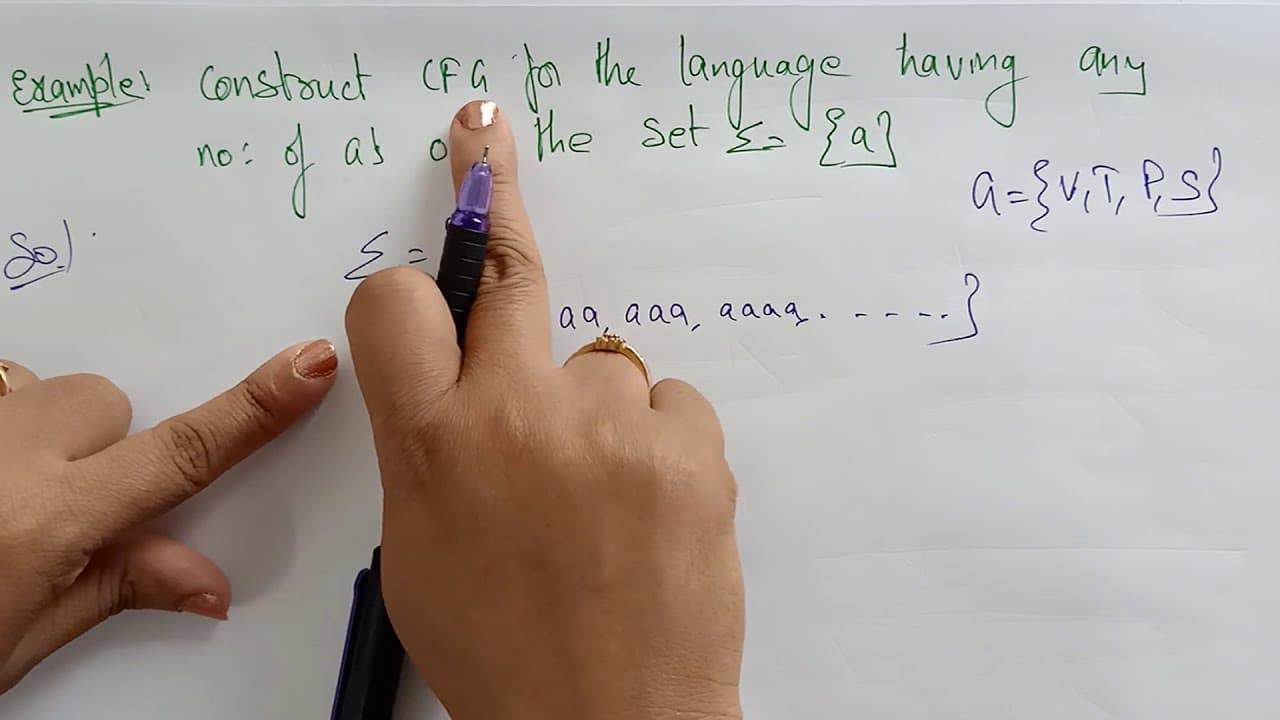
This video explains how to construct a context-free grammar for languages consisting of any number of 'a's.
Transcript
hi students welcome back in the previous video I explained about what is the context free grammar that is a context-free grammar it's a combination of the it's defined as a four tuples Reed TPS for ntps V is a set of non terminals T is a set of terminals and P's the production rules and s is the start symbol so here we are asking the question line ... Read More
Key Insights
- 🥶 Context-free grammars are essential for defining programming languages and various types of formal languages using specific structured rules.
- 🤬 The concept of terminals and non-terminals is crucial, where terminals represent actual symbols of the language, and non-terminals are placeholders that can be replaced by other symbols.
- 🤬 Production rules guide the transformation of non-terminal symbols to terminal strings, ensuring that all possible combinations of terminals can be generated.
- 😑 The closure operator in regular expressions allows for the generation of languages represented by zero or more instances of symbols, which is foundational in theoretical computer science.
- 🥶 The step-by-step method of deriving strings from a specific context-free grammar enhances understanding and application of theoretical concepts in practical scenarios.
- 🥶 Epsilon plays multiple roles in context-free grammars, enabling the allowance of string lengths of zero and simplifying productions.
- 😑 Understanding both regular expressions and context-free grammars provides a solid foundation for further studies in theoretical computer science and language processing.
Install to Summarize YouTube Videos and Get Transcripts
Explore YouTube Video Summarizer or Get YouTube Transcript Extractor
Questions & Answers
Q: What are the components of a context-free grammar?
A context-free grammar is defined as a four-tuple (N, T, P, S), where N represents a set of non-terminals, T represents a set of terminals, P is the set of production rules defining how strings can be generated, and S is the start symbol from which the generation of strings begins.
Q: Can you explain the significance of epsilon in context-free grammar?
Epsilon represents the empty string in context-free grammar and is significant because it allows the grammar to generate languages that can include strings of varying lengths, including lengths of zero, which provide flexibility in defining languages and expressions.
Q: How is a regular expression developed for a given language in context-free grammar?
To develop a regular expression for a language within context-free grammar, one must analyze the patterns and sequences of the language. For example, for a language consisting of any number of 'a's, the regular expression a* is constructed, which indicates zero or more occurrences of the terminal 'a'.
Q: How do you derive strings using the context-free grammar rules?
To derive strings using context-free grammar rules, one starts with the start symbol and recursively applies production rules. Each application replaces the non-terminals with their corresponding productions until only terminals are left, resulting in valid strings of the language specified by the grammar.
Summary & Key Takeaways
-
The video details the definition and components of context-free grammar, explained as a four-tuple involving non-terminals, terminals, production rules, and a start symbol.
-
A specific example is provided to construct a context-free grammar for a language with any number of 'a's, including the empty string, utilizing the production rules derived from the associated regular expression.
-
The process of generating strings from the context-free grammar is illustrated through detailed steps, showing how to derive strings until reaching the desired form while applying the production rules effectively.
Read in Other Languages (beta)
Share This Summary 📚
Summarize YouTube Videos and Get Video Transcripts with 1-Click
Try YouTube Summary with ChatGPT & Claude or YouTube Transcript Generator