MIDI Message | CG | Computer Graphics | Lec-57 | Bhanu Priya
TL;DR
MIDI messages enable communication between musical devices using a low-bandwidth protocol.
Transcript
hi students welcome back coming to the next concept in this mi di is that my di messages where you are talking about the musical instrument digital interface so far I explained what exactly the musical instrument digital interface is and what are the components of mi da system and hardware components of mi da system now let's see what is this mi da... Read More
Key Insights
- 🛟 MIDI serves as a universal language for electronic musical instruments, enabling seamless interaction.
- 😒 It uses standard messages that include a status byte for channel and command identification, along with two data bytes.
- 🪡 MIDI messages significantly reduce data transmission needs, focusing on performance rather than audio quality.
- 👻 The protocol's design allows for real-time interactions between multiple musical devices within a setup.
- 🎮 The capacity to control up to 16 channels makes MIDI an ideal choice for intricate musical arrangements.
- 👻 The low bandwidth of MIDI messages allows for faster communication, aiding performance in live situations.
- 🎼 Understanding MIDI is crucial for modern music production, enabling composers and producers to utilize technology effectively.
Install to Summarize YouTube Videos and Get Transcripts
Explore YouTube Video Summarizer or Get YouTube Transcript Extractor
Questions & Answers
Q: What is MIDI, and why is it significant in music production?
MIDI, or Musical Instrument Digital Interface, is a protocol that allows electronic musical instruments to communicate with each other. It is significant because it enables musicians to control multiple instruments from a single device, streamlining the creation process and improving the efficiency of music production.
Q: How do MIDI messages differ from traditional audio signals?
MIDI messages differ from traditional audio signals because they do not carry audio information directly. Instead, they transmit performance data, such as which notes to play and when, allowing instruments to generate sound based on these commands. This results in significantly lower bandwidth requirements, making MIDI a more efficient choice for electronic music production.
Q: What are the basic components of a MIDI message?
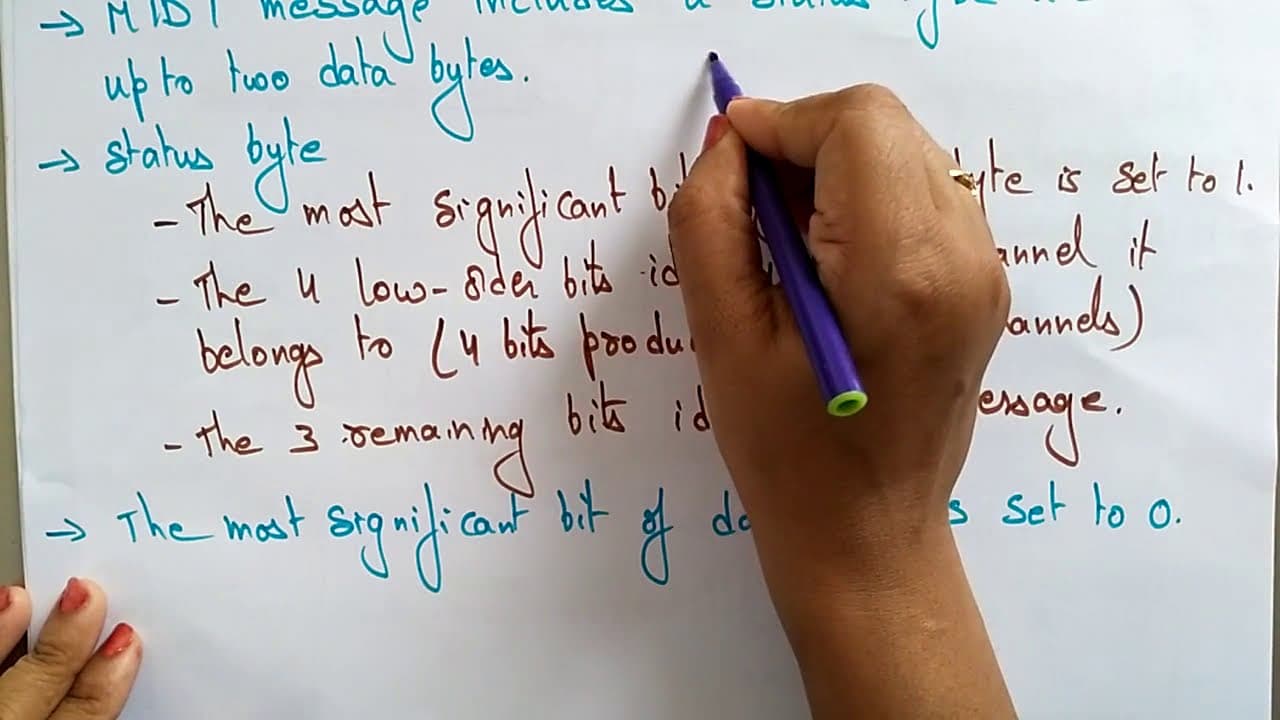
A basic MIDI message consists of a status byte, which identifies the type of message, and up to two data bytes. The status byte indicates the channel and command, while the data bytes typically convey additional information like note numbers and their velocities. This structure allows for detailed communication between devices.
Q: Can you provide examples of different types of MIDI commands?
Yes, MIDI commands include 'note on', which signifies that a key has been pressed, and 'note off', which indicates that a key has been released. Other commands include 'program change', used to configure sounds played by the instrument, and 'control change', which alters various parameters of sound production, enhancing musical expression.
Q: What is the role of the status byte in a MIDI message?
The status byte in a MIDI message is crucial as it indicates the message type and the channel on which the command is directed. It consists of eight bits where the most significant bit indicates if the byte is a status byte or data byte, while the lower bits specify which instrument channel is being addressed, allowing for organized communication among multiple devices.
Q: How many MIDI channels are supported in a single MIDI setup?
A single MIDI setup supports 16 channels, allowing various instruments to operate concurrently. This means that each channel can control a different instrument or sound, enabling complex arrangements and orchestrations within a piece of music while ensuring that all devices can communicate without interference.
Summary & Key Takeaways
-
MIDI messages facilitate the communication between synthesizers, keyboards, and computers, allowing them to share musical information.
-
Each MIDI message comprises a status byte and up to two data bytes, which specify commands like note on, note off, and program changes.
-
The status byte includes the channel information and message identifiers, while data bytes often represent note numbers and velocity.
Read in Other Languages (beta)
Share This Summary 📚
Summarize YouTube Videos and Get Video Transcripts with 1-Click
Try YouTube Summary with ChatGPT & Claude or YouTube Transcript Generator