What Is Linear Regression and How Does It Work?
TL;DR
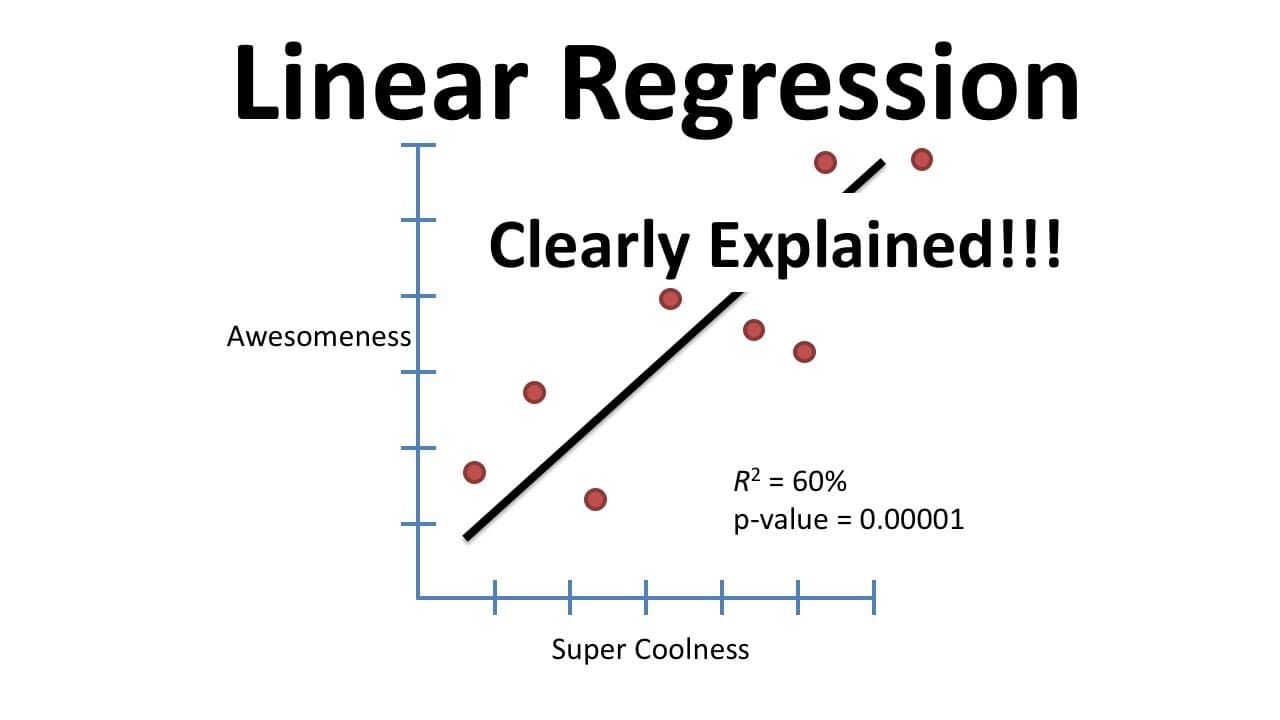
Linear regression is a statistical method that models the relationship between variables by fitting a line to data using least squares, calculating R-squared to assess goodness of fit. This technique quantifies how much variance in the dependent variable can be explained by the independent variable(s), while the p-value indicates the statistical significance of that relationship.
Transcript
Say that on a boat headed towards that quest Join me on this boat. Let's go to stab quest it's super cool Hello, and welcome to static quest Static Quest is brought to you by the friendly folks in the genetics department at the University of North Carolina at Chapel Hill Today, we're going to be talking about linear regression Aka General Linear mo... Read More
Key Insights
- 🫥 Linear regression involves fitting a line to data using least squares, which minimizes the squared distance between the line and the data points.
- 🌥️ R-squared measures the proportion of the variance in the response variable that can be explained by the predictor variable(s), with larger values indicating a better fit.
- 😀 The relationship between variables in linear regression can be assessed using the p-value, which indicates the likelihood of obtaining the observed relationship by chance.
- 😫 The p-value is determined by comparing the observed F-statistic (which quantifies the reduction in variance) to the distribution of F-statistics for randomly generated data sets.
- 😀 Equations with more parameters (e.g., additional predictor variables) in linear regression can have a larger F-statistic, but the adjusted R-squared accounts for this by penalizing overly complex models.
- 🫥 Linear regression can be extended to multiple dimensions, fitting a plane instead of a line, to quantify the relationship between multiple predictor variables and a response variable.
- 😀 The interpretation of R-squared and the significance of the p-value depend on the specific context and the nature of the data.
Install to Summarize YouTube Videos and Get Transcripts
Explore YouTube Video Summarizer or Get YouTube Transcript Extractor
Questions & Answers
Q: What is the purpose of linear regression?
Linear regression is used to quantify the relationship between variables by fitting a line to the data using least squares.
Q: How is R-squared calculated?
R-squared is calculated by comparing the variance (sum of squares) explained by the fitted line to the total variance in the data.
Q: What does a larger R-squared value indicate?
A larger R-squared value indicates a stronger relationship between the variables and a better fit of the line to the data.
Q: What is the significance of the p-value in linear regression?
The p-value is used to determine the statistical significance of the relationship between variables, with smaller values indicating a more reliable relationship.
Key Insights:
- Linear regression involves fitting a line to data using least squares, which minimizes the squared distance between the line and the data points.
- R-squared measures the proportion of the variance in the response variable that can be explained by the predictor variable(s), with larger values indicating a better fit.
- The relationship between variables in linear regression can be assessed using the p-value, which indicates the likelihood of obtaining the observed relationship by chance.
- The p-value is determined by comparing the observed F-statistic (which quantifies the reduction in variance) to the distribution of F-statistics for randomly generated data sets.
- Equations with more parameters (e.g., additional predictor variables) in linear regression can have a larger F-statistic, but the adjusted R-squared accounts for this by penalizing overly complex models.
- Linear regression can be extended to multiple dimensions, fitting a plane instead of a line, to quantify the relationship between multiple predictor variables and a response variable.
- The interpretation of R-squared and the significance of the p-value depend on the specific context and the nature of the data.
- Understanding linear regression and its key concepts is essential for accurately analyzing and interpreting relationships between variables in statistical analysis.
Summary & Key Takeaways
-
Linear regression involves using least squares to fit a line to the data, calculating R-squared to assess the fit, and determining the p-value for the relationship.
-
R-squared is a measure of how much of the variation in one variable can be explained by another variable, with larger values indicating a better fit.
-
The p-value helps determine the statistical significance of the relationship, with smaller values suggesting a more reliable relationship.
Read in Other Languages (beta)
Share This Summary 📚
Summarize YouTube Videos and Get Video Transcripts with 1-Click
Try YouTube Summary with ChatGPT & Claude or YouTube Transcript Generator
Explore More Summaries from StatQuest with Josh Starmer 📚



Summarize YouTube Videos and Get Video Transcripts with 1-Click
Try YouTube Summary with ChatGPT & Claude or YouTube Transcript Generator