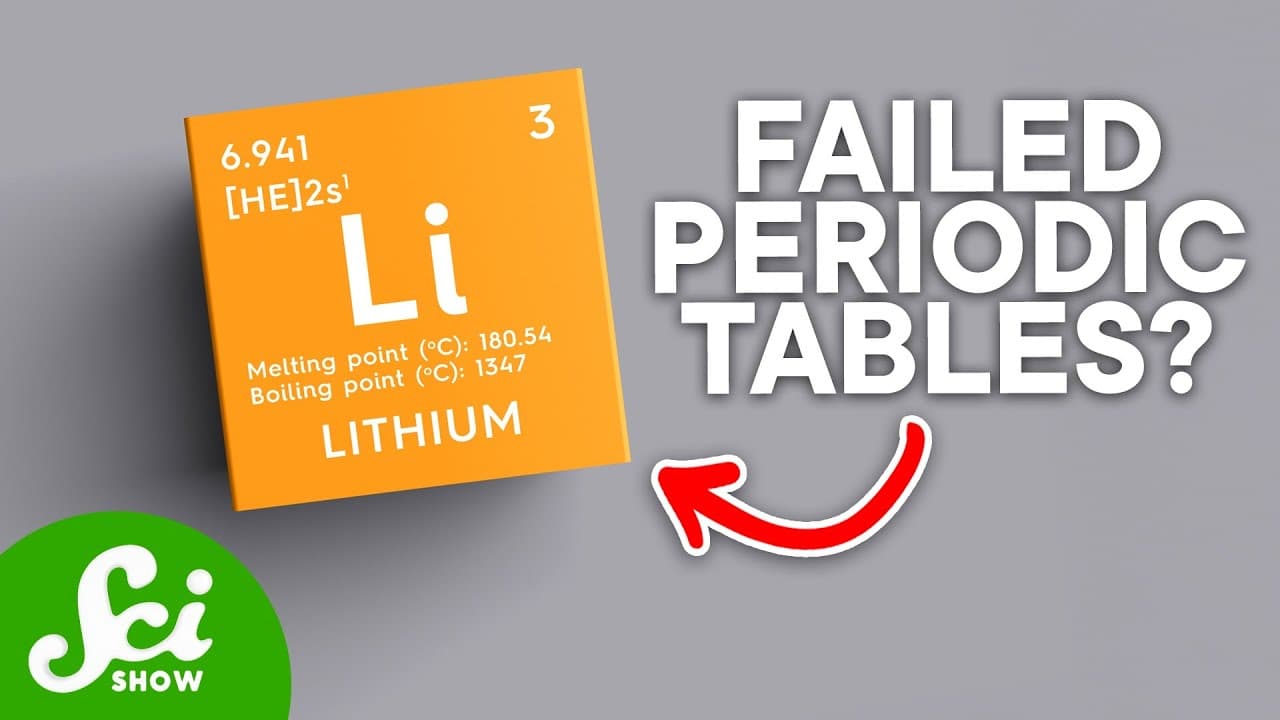
5 Periodic Tables We Don't Use and Why
TL;DR
From Mendeleev's predictions to modern designs, explore the varied history of periodic tables.
Transcript
[INTRO] At its heart, science is about finding patterns in the world and explaining why they happen. Every field has them, but few patterns are as well known -- or as useful -- as chemistry’s periodic table. In fact, it’s so ubiquitous that we often think of a single, universal periodic table. Really, though, scientists have proposed all sorts of v... Read More
Key Insights
- 📈 The periodic table's organization reveals trends in element properties and relationships.
- 👍 Mendeleev's table included predictions for undiscovered elements, proving its predictive power.
- 🎨 Alternative periodic table designs offer unique visualization methods for element relationships.
- 🗨️ The left-step table by Charles Janet aids in understanding electron configurations and predicting properties.
- 👥 The concept of triads in element groups has historical significance and aesthetic appeal.
- 🥺 Constant tinkering with the periodic table leads to the discovery of new patterns and serves different scientific needs.
- 😵💫 Spirals, helical, and 3D designs add creativity to the visualization of the periodic table.
Install to Summarize YouTube Videos and Get Transcripts
Explore YouTube Video Summarizer or Get YouTube Transcript Extractor
Questions & Answers
Q: What is the significance of the organization of elements in the standard periodic table?
The organization of elements into groups and periods in the standard periodic table helps to showcase trends in properties like size and reactivity, aiding chemists in understanding element relationships and behavior.
Q: How did Mendeleev's table differ from the modern periodic table?
Mendeleev's table was based on atomic mass, while the modern table is based on atomic number. Mendeleev also made predictions for undiscovered elements which were later confirmed, showcasing the predictive power of his table.
Q: What was unique about Charles Janet's left-step table?
Charles Janet's left-step table, favored by physicists, shows the order in which electrons fill energy shells, aiding in predicting chemical and physical properties based on electron configurations.
Q: Why did chemist Eric Scerri propose a new periodic table design based on triads?
Scerri proposed a new design based on triads to showcase the historical elegance and predictive power of these element groups, aligning elements with similar properties in orderly patterns.
Summary & Key Takeaways
-
The standard periodic table organizes elements into groups and periods based on their properties and relationships.
-
Mendeleev's original table, based on atomic mass, included predictions for undiscovered elements, like gallium.
-
Various alternative periodic table designs, from spirals to left-step layouts, offer different ways to visualize element relationships.
Read in Other Languages (beta)
Share This Summary 📚
Summarize YouTube Videos and Get Video Transcripts with 1-Click
Try YouTube Summary with ChatGPT & Claude or YouTube Transcript Generator
Explore More Summaries from SciShow 📚


Summarize YouTube Videos and Get Video Transcripts with 1-Click
Try YouTube Summary with ChatGPT & Claude or YouTube Transcript Generator