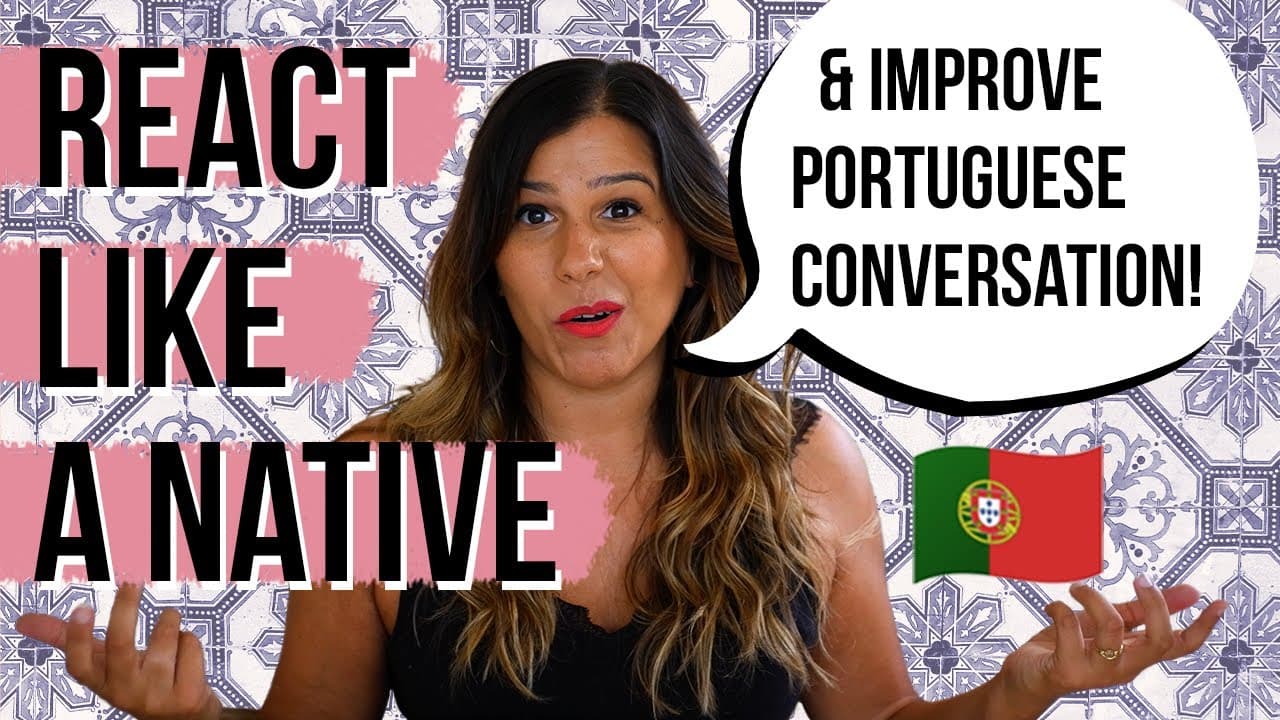
European Portuguese Conversation Tips - REACT like a NATIVE speaker! (Part 2)
TL;DR
Learn quick reactions for fluent Portuguese conversations.
Transcript
are you struggling to hold a conversation in Portuguese? we all know that memorizing a bunch of phrases is one thing but actually being able to participate in a conversation that flows is another it's something that's going to take quite a long time to hone but what if I told you there was a quick and easy way to fake it till you make it? I'm t... Read More
Key Insights
- Memorizing phrases is different from engaging in flowing conversations; quick reactions can bridge this gap effectively.
- Natural reactions in Portuguese can make you sound more advanced, aiding in smoother conversations.
- The pronunciation of 'que' in Portuguese differs from Spanish, emphasizing a closed 'e' sound.
- Mastering the single 'R' sound in Portuguese can be challenging but is crucial for proper pronunciation.
- Using short reactions in conversations can demonstrate understanding beyond mere nodding.
- Portuguese often uses 'ai' for expressions similar to 'oh' in English, adding authenticity to conversations.
- The video offers practical tips for improving conversational skills in European Portuguese.
- Resources such as free lessons and pronunciation guides are available to deepen understanding and fluency.
Install to Summarize YouTube Videos and Get Transcripts
Explore YouTube Video Summarizer or Get YouTube Transcript Extractor
Questions & Answers
Q: Why is it important to learn quick reactions in Portuguese conversations?
Learning quick reactions in Portuguese conversations is important because it helps maintain the flow of dialogue and makes the speaker sound more advanced. Quick reactions demonstrate understanding and engagement, preventing conversations from becoming stagnant and allowing for more natural interaction.
Q: How does the pronunciation of 'que' in Portuguese differ from Spanish?
In Portuguese, 'que' is pronounced with a closed 'e' sound, unlike the more open pronunciation in Spanish. This subtle difference is important for sounding authentic in European Portuguese, as it involves a specific vowel sound produced in the throat, highlighting the nuanced pronunciation required for fluency.
Q: What challenge do learners face with the single 'R' sound in Portuguese?
Learners often find the single 'R' sound in Portuguese challenging because it requires a single tap of the tongue on the roof of the mouth, similar to the American pronunciation of 'water.' This sound is distinct from the double 'R' and can be difficult to master, yet it's essential for accurate pronunciation.
Q: What is a common Portuguese expression equivalent to 'oh' in English?
In Portuguese, the expression 'ai' is commonly used as an equivalent to the English 'oh.' This interjection is frequently used to convey a range of emotions, adding authenticity to conversations and making them sound more natural, as it reflects a native speaker's typical response.
Q: What resources are available for further learning of European Portuguese?
The video mentions several resources for further learning European Portuguese, including a free lesson for beginners and a pronunciation guide. These resources are designed to help learners improve their conversational skills and pronunciation, offering practical tips and techniques for mastering the language.
Q: How can short reactions improve Portuguese conversational skills?
Short reactions can significantly improve Portuguese conversational skills by allowing speakers to participate actively in dialogue. These reactions convey understanding and engagement, preventing awkward pauses and making conversations flow more naturally. They also help learners sound more fluent and confident in their language abilities.
Q: What is the benefit of using natural reactions in conversations?
Using natural reactions in conversations benefits learners by making them sound more like native speakers. It enhances the authenticity of their speech, demonstrates comprehension, and keeps the conversation dynamic. This approach allows learners to practice real-life interactions and build confidence in their speaking skills.
Q: Why is it important to practice pronunciation in learning Portuguese?
Practicing pronunciation is crucial in learning Portuguese because it ensures clear communication and helps learners be understood by native speakers. Proper pronunciation also enhances the speaker's confidence and credibility, making them sound more like a native and facilitating smoother conversations in the language.
Summary & Key Takeaways
-
The video provides tips on using natural reactions to improve fluency in European Portuguese conversations. It emphasizes the importance of quick responses to sound more advanced and maintain the flow of dialogue.
-
Viewers are guided on the correct pronunciation of common expressions, such as 'que', and the challenging single 'R' sound, which are crucial for sounding like a native speaker.
-
The content includes practical examples and encourages using short, natural reactions to demonstrate understanding, with additional resources offered for further learning.
Read in Other Languages (beta)
Share This Summary 📚
Summarize YouTube Videos and Get Video Transcripts with 1-Click
Try YouTube Summary with ChatGPT & Claude or YouTube Transcript Generator
Explore More Summaries from Talk the Streets 📚


![Learn European Portuguese Outside of Portugal! [NEW apps & TOP tips!] thumbnail](/_next/image?url=https%3A%2F%2Fi.ytimg.com%2Fvi%2F0K81C-5Z1I0%2Fhqdefault.jpg&w=750&q=75)

Summarize YouTube Videos and Get Video Transcripts with 1-Click
Try YouTube Summary with ChatGPT & Claude or YouTube Transcript Generator