How to Find the Optimal Point on a Budget Line
TL;DR
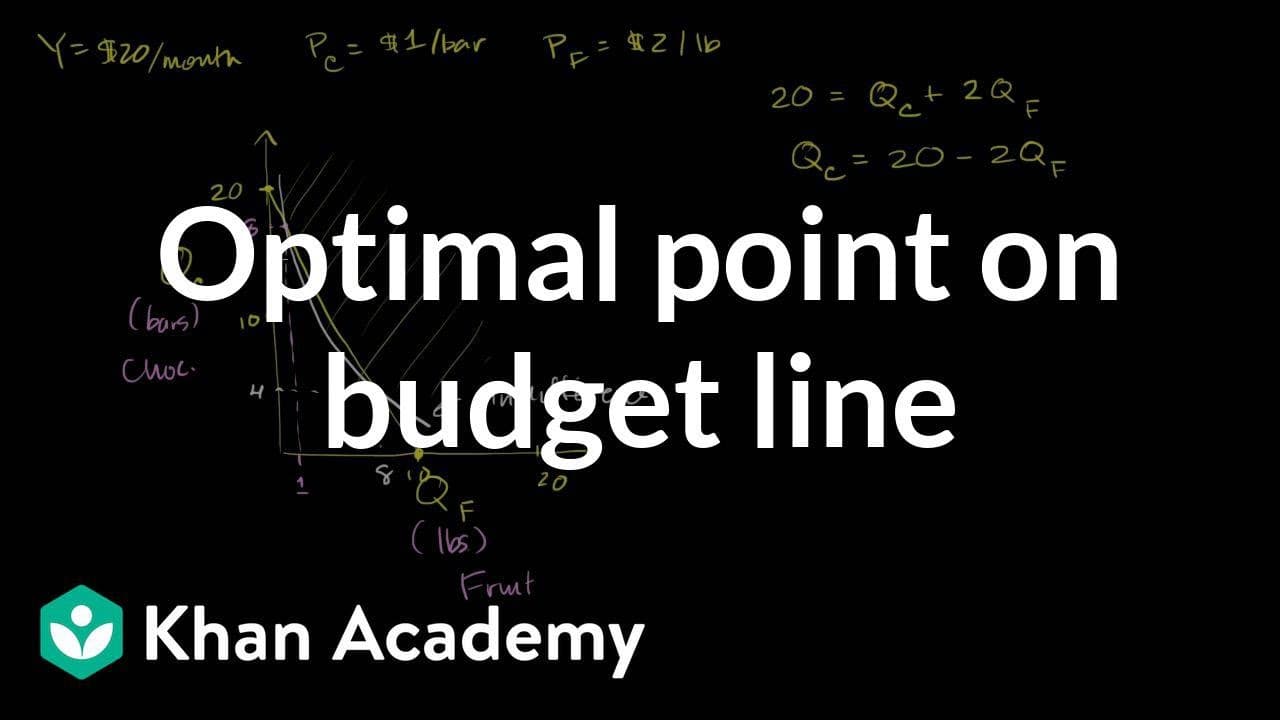
To determine the optimal point on a budget line, consumers should choose a combination of goods where the budget line is tangent to an indifference curve. This tangency indicates maximum total utility, as it represents the best trade-off between different goods given varying prices and preferences.
Transcript
So let's just review what we've seen with budget lines. Let's say I'm making $20 a month. So my income is $20 per month. Let's say per month. The price of chocolate is $1 per bar. And the price of fruit is $2 per pound. And we've already done this before, but I'll just redraw a budget line. So this axis, let's say this is the quantity of chocolate.... Read More
Key Insights
- 🫥 Budget lines represent the trade-offs consumers face when allocating their income between different goods.
- 👋 Indifference curves depict the various combinations of goods that provide the same level of satisfaction.
- 🫥 The optimal allocation occurs when the budget line is tangent to an indifference curve.
- 💱 Changes in prices can lead to shifts in budget lines and changes in the quantity demanded of goods.
- 🫥 Maximizing total utility involves choosing a point on the budget line that is tangent to an indifference curve.
- 👉 Consumers will generally prefer points above and to the right of an indifference curve.
- ☠️ The slope of an indifference curve represents the marginal rate of substitution, indicating the willingness to trade between goods.
Install to Summarize YouTube Videos and Get Transcripts
Explore YouTube Video Summarizer or Get YouTube Transcript Extractor
Questions & Answers
Q: What is a budget line and what does it represent?
A budget line shows the different combinations of goods a consumer can afford to purchase given their income and the prices of the goods.
Q: What do indifference curves represent in consumer theory?
Indifference curves represent different combinations of goods that provide the same level of satisfaction or utility to the consumer.
Q: How can we determine the optimal allocation of goods?
The optimal allocation occurs when the budget line is tangent to an indifference curve, meaning the consumer is maximizing utility given their budget and preferences.
Q: How does a change in price affect the quantity demanded of a good?
Assuming access to indifference curves, a decrease in price generally leads to an increase in the quantity demanded, as seen with the example of fruit in the content.
Summary & Key Takeaways
-
Budget lines show the combinations of goods that can be purchased given a fixed income and prices.
-
Indifference curves represent different combinations of goods that provide the same level of satisfaction.
-
To maximize total utility, consumers should choose a point on the budget line that is tangent to an indifference curve.
Read in Other Languages (beta)
Share This Summary 📚
Summarize YouTube Videos and Get Video Transcripts with 1-Click
Try YouTube Summary with ChatGPT & Claude or YouTube Transcript Generator
Explore More Summaries from Khan Academy 📚



Summarize YouTube Videos and Get Video Transcripts with 1-Click
Try YouTube Summary with ChatGPT & Claude or YouTube Transcript Generator