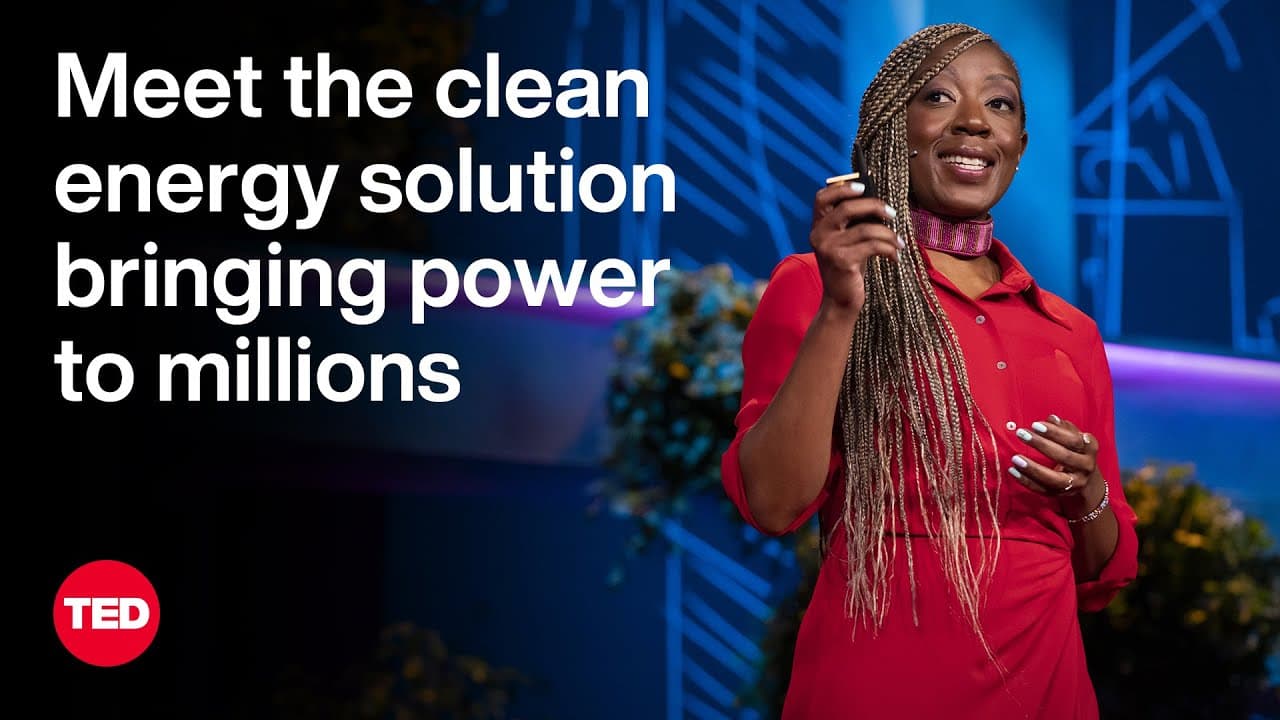
Meet Mini-Grids — the Clean Energy Solution Bringing Power to Millions | Tombo Banda | TED
TL;DR
Mini-grids can provide localized clean energy solutions, connecting households and businesses in hard-to-reach areas, and are a profitable and sustainable way to spread electrification across Africa.
Transcript
In 1994, electricity came to my mother's childhood village in Zomba, Malawi, where my grandmother still lived. I used to love going to Zomba as a kid. I was a typical city brat romanticizing village life. I used to love going, I used to get to carry water on my head. And I remember the smell of kerosene as my grandma told stories at night, and my g... Read More
Key Insights
- 🖤 Mini-grids offer a solution to the lack of electricity access in Africa, providing clean and sustainable energy to communities.
- 🛟 Access to electricity not only improves individuals' lives but also benefits the local economy and environment.
- 🤗 Revenue increase and cost reduction strategies, such as appliance financing and using second-hand batteries, can make mini-grids more profitable.
- 🥺 Successful examples of mini-grids in Africa have led to increased business activities, disposable income, and improved quality of life.
Install to Summarize YouTube Videos and Get Transcripts
Explore YouTube Video Summarizer or Get YouTube Transcript Extractor
Questions & Answers
Q: How do mini-grids work and what components do they typically include?
Mini-grids are localized energy systems consisting of a solar panel array, battery bank, backup system, and a small distribution network. In areas near rivers, hydropower turbines can also be connected to the system.
Q: How can mini-grids be deployed more quickly and affordably than extending the main grid?
Unlike traditional electrification methods that can be slow and expensive, mini-grids can be quickly and cheaply deployed, especially in hard-to-reach areas. They can also be connected to the main grid if it becomes available in the future.
Q: How do mini-grids benefit local communities?
Mini-grids provide clean energy for lighting, charging phones, and powering appliances in households and businesses. They create job opportunities during construction and maintenance, connect health centers and schools, and stimulate local economies.
Q: What challenges do mini-grids face in terms of profitability?
Mini-grids often serve areas where electricity is primarily used for lighting or charging phones, resulting in low revenues for providers. To attract more investors, the profitability of mini-grids needs to increase, ideally reaching around 12% return on investment.
Summary & Key Takeaways
-
Access to electricity is still limited in many parts of Africa, with less than 15% of Malawians and over 500 million people in sub-Saharan Africa lacking electricity.
-
Mini-grids, standalone energy systems powered by solar panels or hydropower turbines, can quickly and economically provide clean energy to communities, creating jobs and supporting local economies.
-
Lack of electrification leads to environmental damage, including increased use of diesel generators and deforestation for firewood, and exacerbates the effects of climate change, such as more frequent and intense cyclones.
Read in Other Languages (beta)
Share This Summary 📚
Summarize YouTube Videos and Get Video Transcripts with 1-Click
Try YouTube Summary with ChatGPT & Claude or YouTube Transcript Generator
Explore More Summaries from TED 📚




Summarize YouTube Videos and Get Video Transcripts with 1-Click
Try YouTube Summary with ChatGPT & Claude or YouTube Transcript Generator