Mastering Supply & Demand: A 3-Step Trading Guide
TL;DR
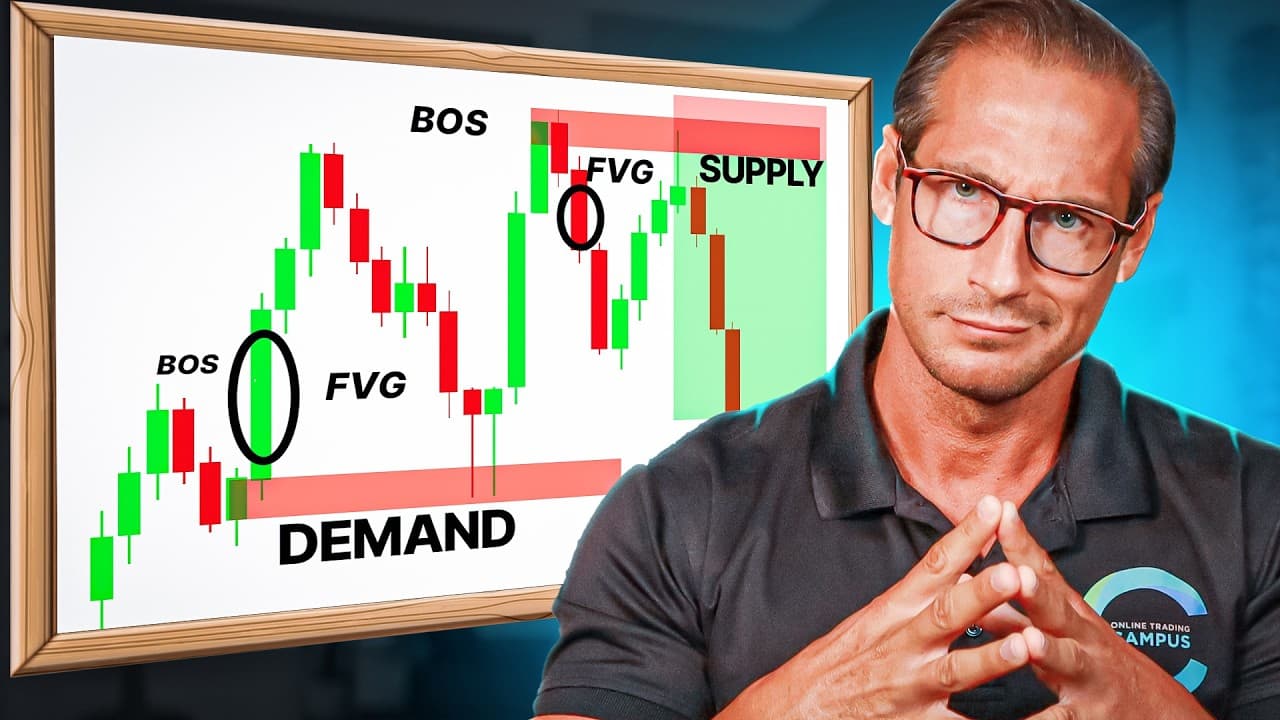
This video outlines a three-step trading strategy focused on supply and demand. It emphasizes the importance of assessing price locations on higher time frames to determine buying or selling opportunities. A practical session using Swiss franc futures illustrates how to identify and analyze supply and demand zones effectively.
Transcript
ladies and gentlemen welcome back on my YouTube channel for another supply and demand trading strategy lesson you ask for it and I deliver it's another freestyle lesson where I go through the slides explain the theory and right after we're going to do a practical Hands-On application on the charts where I again explain the theory bu... Read More
Key Insights
- The video introduces a three-step mechanical process for trading supply and demand, focusing on location, direction, and zoning.
- The location step involves assessing the current position on a higher time frame to determine if the price is cheap, expensive, or in equilibrium.
- Multiple time frame analysis is essential for accurate supply and demand trading, using daily, weekly, and monthly charts.
- Freshness of supply and demand zones is crucial; zones should be untested or minimally tested for higher trade probability.
- The strategy can be applied to various income streams, including day trading and swing trading, but not scalping.
- High time frame zones offer more significant imbalances and higher probabilities of successful trades compared to lower time frames.
- The video emphasizes the importance of conservative rules and adjusting them based on market conditions.
- Practical chart application is demonstrated using the Swiss franc futures to illustrate the identification of supply and demand zones.
Install to Summarize YouTube Videos and Get Transcripts
Explore YouTube Video Summarizer or Get YouTube Transcript Extractor
Questions & Answers
Q: What is the three-step process mentioned in the video?
The three-step process consists of location, direction, and zoning. Location involves assessing the current position on a higher time frame to determine if the price is cheap, expensive, or in equilibrium. Direction assesses the current trend, and zoning involves setting stops, entries, and targets on lower time frames.
Q: Why is multiple time frame analysis important?
Multiple time frame analysis is crucial because it helps traders assess supply and demand zones more accurately. Using daily, weekly, and monthly charts allows traders to identify high-probability zones and make informed trading decisions, ensuring a comprehensive view of market conditions.
Q: How is freshness of zones determined?
Freshness of zones is determined by whether a supply or demand zone has been touched or violated before. Fresh zones are untested or minimally tested, increasing the probability of successful trades. Freshness can be measured based on preferred or wider versions, with a 25% violation allowance.
Q: Which income streams can the strategy be applied to?
The strategy can be applied to various income streams, including day trading (daily income) and swing trading (weekly and monthly income). However, it is not suitable for scalping or high-frequency trading due to the lower probability of success on lower time frames.
Q: What is the significance of high time frame zones?
High time frame zones, such as weekly and monthly charts, offer more significant imbalances and a higher probability of successful trades compared to lower time frames. These zones provide a broader market perspective, allowing traders to identify high-quality supply and demand areas.
Q: How are conservative rules adjusted in trading?
Conservative rules are adjusted based on market conditions and specific trading scenarios. While some rules are fixed, others can be adapted to ensure flexibility and accuracy in identifying supply and demand zones. Adjustments are made to maintain high-quality trading standards.
Q: What practical example is used in the video?
The video uses Swiss franc futures as a practical example to demonstrate the identification of supply and demand zones. It illustrates the process of assessing location, determining freshness, and applying the three-step strategy to real market charts, highlighting the importance of conservative rules.
Q: Why are low time frames not covered in the strategy?
Low time frames, such as those used in scalping or high-frequency trading, are not covered because they offer lower probabilities of successful trades. The strategy focuses on higher time frames, which provide more significant imbalances and higher success rates, ensuring a more reliable trading approach.
Summary & Key Takeaways
-
The video provides a comprehensive overview of a three-step supply and demand trading strategy, focusing on location, direction, and zoning. The location step assesses price positioning on higher time frames to determine trade actions.
-
Multiple time frame analysis is emphasized, using daily, weekly, and monthly charts to identify supply and demand zones. Freshness and untested zones are crucial for high-probability trades.
-
The strategy is applicable for day and swing trading but not scalping. Practical application is demonstrated using Swiss franc futures, highlighting the importance of conservative rules and adjustments.
Read in Other Languages (beta)
Share This Summary 📚
Summarize YouTube Videos and Get Video Transcripts with 1-Click
Try YouTube Summary with ChatGPT & Claude or YouTube Transcript Generator
Explore More Summaries from Bernd Skorupinski 📚



Summarize YouTube Videos and Get Video Transcripts with 1-Click
Try YouTube Summary with ChatGPT & Claude or YouTube Transcript Generator