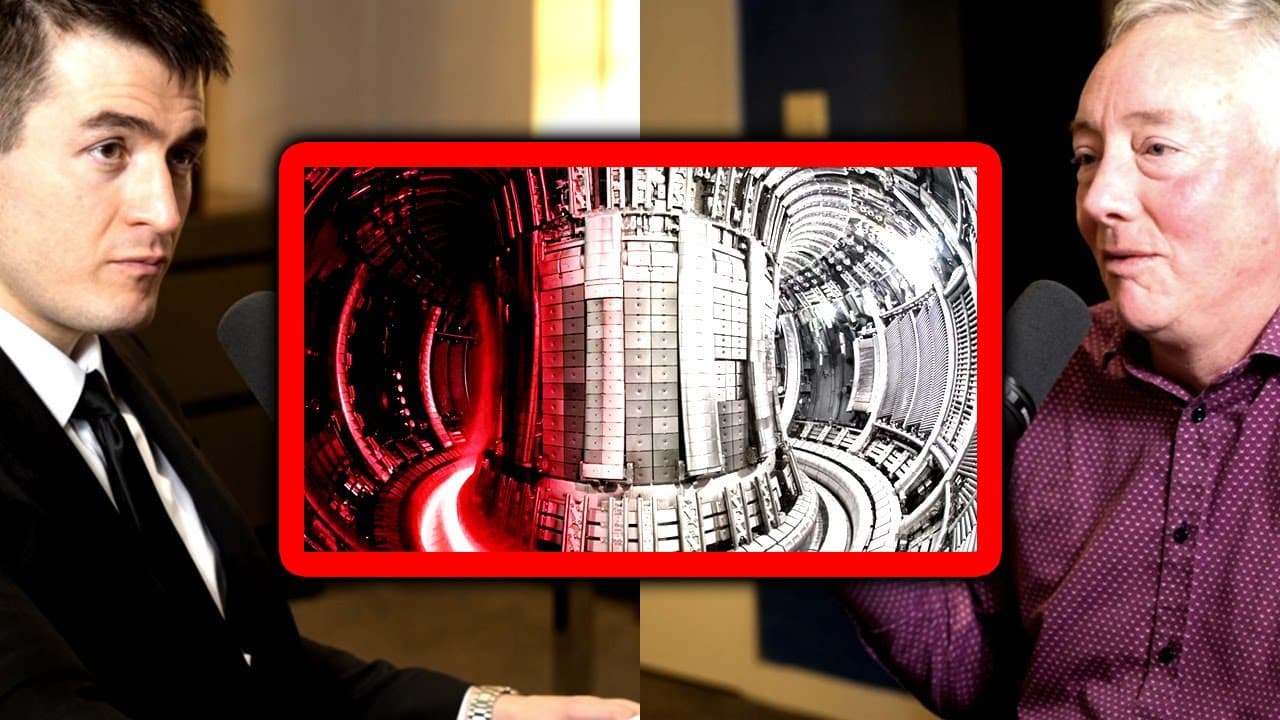
When will Nuclear Fusion Power Plants become reality? | Dennis Whyte and Lex Fridman
TL;DR
The advent of a robust commercial fusion industry, with multiple companies and goals of carbon-free energy, is bringing us closer to the future of nuclear fusion for electricity production.
Transcript
the natural question when people hear breakthrough with the with the inertial confinement with the magnetic confinement is so when will we have commercial yeah um reactors power plants that are actually producing electricity what's your sense um looking out into the future when do you think you can Envision the future where we have actual electrici... Read More
Key Insights
- 🙈 The commercial fusion industry has seen significant growth, with multiple companies working towards commercial fusion.
- 🥶 The private sector's focus on fusion is driven by investor demands and the need for carbon-free energy sources.
- 🛄 Different countries have varying timelines for commercial fusion, with the US aiming for the early 2030s.
- 🇨🇷 The major engineering hurdles in commercial fusion include cost, achieving the fusion state, and developing viable energy extraction methods.
- 🔬 Fusion requires a multidisciplinary approach, involving physics, engineering, materials science, and more.
- 😒 The use of new superconducting materials and advancements in computing have contributed to the progress in commercial fusion.
- 😤 Modularizing the problem and forming smaller, focused teams can help accelerate progress.
Install to Summarize YouTube Videos and Get Transcripts
Explore YouTube Video Summarizer or Get YouTube Transcript Extractor
Questions & Answers
Q: When can we expect commercial fusion reactors to produce electricity?
The advent of a robust commercial fusion industry, supported by private sector funding, suggests that we could see electricity production from fusion in the early 2030s.
Q: What is driving the push for fusion in the private sector?
The private sector recognizes the geopolitical and economic importance of carbon-free energy sources. Investors are demanding solutions, leading to an increase in companies working on fusion technologies.
Q: How are different countries and governments approaching the timeline for commercial fusion?
Different countries have varying timelines for commercial fusion. The US government aims to have a pilot fusion plant putting electricity on the grid by the early 2030s, while the UK targets 2040 and China aims for the mid-2030s.
Q: What are the major engineering hurdles in achieving commercial fusion?
One major hurdle is the cost of building a fusion power plant, which requires large-scale units due to the difficulty of maintaining fusion at smaller scales. Achieving the fusion state itself, with the right temperature, density, and energy confinement time, is also a challenge.
Summary & Key Takeaways
-
The commercial fusion industry has seen significant growth in the past few years, with over 20 companies working on different approaches to achieve commercial fusion.
-
The private sector's focus on fusion is driven by both investor demands and the need for carbon-free energy sources in the market.
-
The timeline for commercial fusion is estimated to be in the early 2030s, with the goal of putting fusion-powered electricity on the grid.
Read in Other Languages (beta)
Share This Summary 📚
Summarize YouTube Videos and Get Video Transcripts with 1-Click
Try YouTube Summary with ChatGPT & Claude or YouTube Transcript Generator
Explore More Summaries from Lex Clips 📚




Summarize YouTube Videos and Get Video Transcripts with 1-Click
Try YouTube Summary with ChatGPT & Claude or YouTube Transcript Generator