Stories For Sleep | Burned for Belief: Surviving the Reformation Fires | Sleep Stories
TL;DR
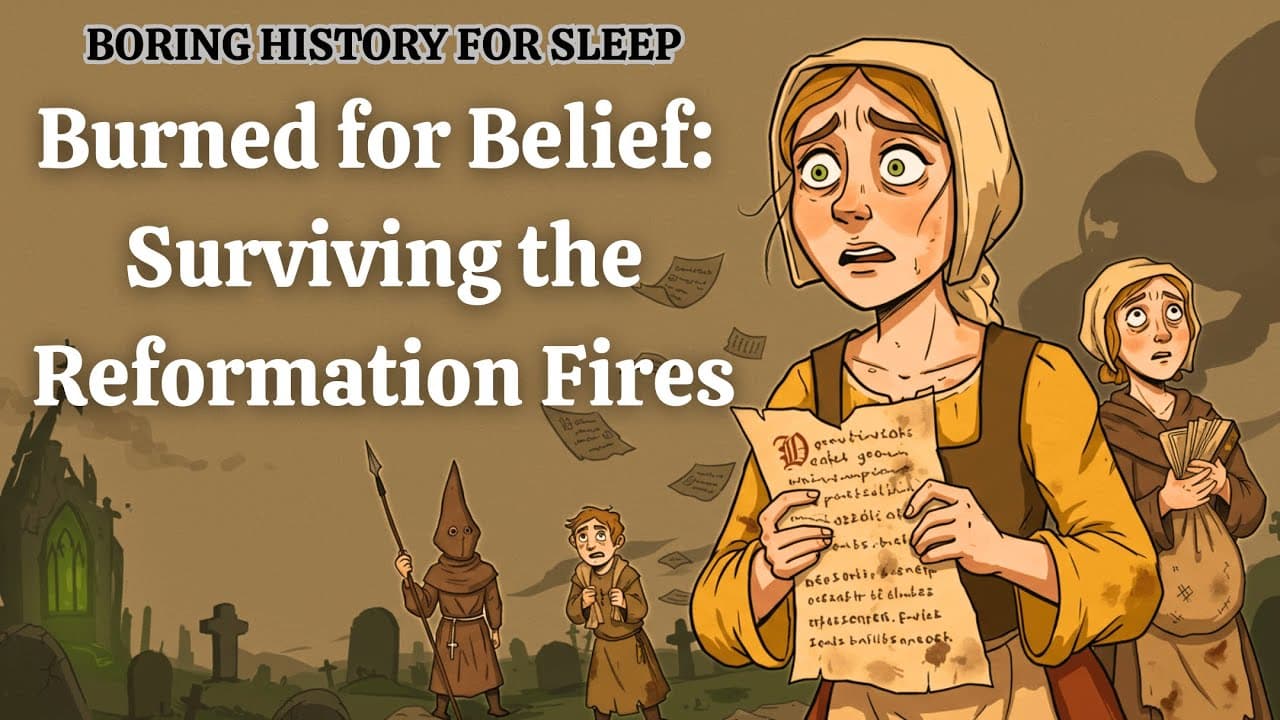
Experience the Reformation through a calming sleep story.
Transcript
Close your eyes if you'd like and let the world slip away for a moment. Picture yourself settling into a quiet, dimly lit room, the kind where the air feels soft and still, carrying only the faint crackle of a hearth or the distant chirp of a night creature outside. You're here to wander through a time long past. A time when the world trembled on t... Read More
Key Insights
- The Reformation was a transformative period where Martin Luther's ideas challenged the Catholic Church, leading to significant religious and societal changes.
- Martin Luther's 95 Theses, nailed to a church door in 1517, questioned the Church's practices, particularly the sale of indulgences, and sparked widespread debate.
- The printing press played a crucial role in spreading Reformation ideas, making written works more accessible and enabling the rapid dissemination of revolutionary thoughts.
- Peasants and common folk, inspired by Luther's ideas, began questioning the Church's authority, leading to uprisings and a reevaluation of religious practices.
- The Catholic Church responded with the Counter-Reformation, aiming to reform its practices and reaffirm its doctrines to counter Protestant growth.
- The Jesuit Order was established as part of the Counter-Reformation, focusing on education, missionary work, and defending Catholic doctrine.
- The Reformation was not just a religious movement; it also had significant political and social implications, affecting the power dynamics within Europe.
- The Reformation's legacy includes the proliferation of vernacular Bibles, increased literacy, and the empowerment of individuals to interpret religious texts independently.
Install to Summarize YouTube Videos and Get Transcripts
Explore YouTube Video Summarizer or Get YouTube Transcript Extractor
Questions & Answers
Q: What role did the printing press play in the Reformation?
The printing press was instrumental in the Reformation, allowing Martin Luther's ideas to spread rapidly and widely. It enabled the mass production of pamphlets, Bibles, and other writings, making them accessible to a larger audience. This dissemination of information challenged the Catholic Church's monopoly on religious texts and facilitated the spread of Protestant ideas across Europe.
Q: How did Martin Luther's actions challenge the Catholic Church?
Martin Luther challenged the Catholic Church by publicly criticizing its practices, particularly the sale of indulgences, which he viewed as corrupt. His 95 Theses questioned the Church's authority and doctrine, advocating for a return to scripture as the sole source of religious authority. Luther's defiance and subsequent writings inspired a movement that called for significant religious reform and questioned the Church's role in salvation.
Q: What was the Catholic Church's response to the Reformation?
The Catholic Church responded to the Reformation with the Counter-Reformation, a movement aimed at reforming internal practices and reaffirming Catholic doctrine. This included the establishment of the Jesuit Order, which focused on education and missionary work, and the Council of Trent, which addressed doctrinal issues and sought to curb abuses. The Church aimed to counteract Protestant growth and restore its influence.
Q: How did the Reformation affect ordinary people in Europe?
The Reformation significantly impacted ordinary people by challenging the existing religious order and empowering individuals to interpret religious texts independently. The availability of vernacular Bibles allowed people to read scripture in their own language, fostering a personal connection to faith. This shift led to increased literacy and a questioning of traditional authority, contributing to social and political changes across Europe.
Q: What was the significance of the Diet of Worms?
The Diet of Worms was a significant event where Martin Luther was asked to recant his writings before Emperor Charles V. Luther's refusal to recant, famously stating, 'Here I stand, I can do no other,' marked a pivotal moment in the Reformation. It solidified his break with the Catholic Church and underscored his commitment to his beliefs, inspiring others to question the Church's authority.
Q: Who were the Jesuits, and what was their role in the Counter-Reformation?
The Jesuits, or the Society of Jesus, were founded by Ignatius of Loyola as part of the Counter-Reformation. They played a crucial role in revitalizing the Catholic Church through education, missionary work, and defending Catholic doctrine. Jesuit schools became centers of learning, helping to combat Protestant ideas and spread Catholic teachings, thereby strengthening the Church's influence worldwide.
Q: How did the Reformation lead to social and political changes?
The Reformation led to social and political changes by challenging the Church's authority and encouraging individuals to think independently about faith. This shift undermined the Church's control over societal norms and governance, leading to the rise of secular power and the questioning of traditional hierarchies. It also contributed to the development of nation-states and influenced the course of European history.
Q: What legacy did the Reformation leave for future generations?
The Reformation's legacy includes the democratization of religious knowledge, increased literacy, and the empowerment of individuals to interpret scripture independently. It paved the way for modern concepts of religious freedom and individualism. The Reformation also set the stage for future religious and political movements, highlighting the enduring impact of ideas on shaping society and history.
Summary & Key Takeaways
-
The Reformation was a pivotal moment in history, marked by Martin Luther's defiance against the Catholic Church and the widespread dissemination of his ideas through the printing press. This period saw a shift in religious practices and societal structures, as ordinary people began questioning the Church's authority.
-
The Catholic Church's response, known as the Counter-Reformation, involved reforms and the establishment of the Jesuit Order to maintain its influence. This era was characterized by a struggle between maintaining traditional religious authority and embracing new interpretations of faith.
-
The Reformation's impact extended beyond religion, influencing political and social realms. It led to increased literacy, the spread of vernacular Bibles, and a more personal approach to faith. The Reformation's legacy is a testament to the power of ideas and the enduring quest for religious and intellectual freedom.
Read in Other Languages (beta)
Share This Summary 📚
Summarize YouTube Videos and Get Video Transcripts with 1-Click
Try YouTube Summary with ChatGPT & Claude or YouTube Transcript Generator