How Cellular Automata Illustrate Entropy and Order
TL;DR
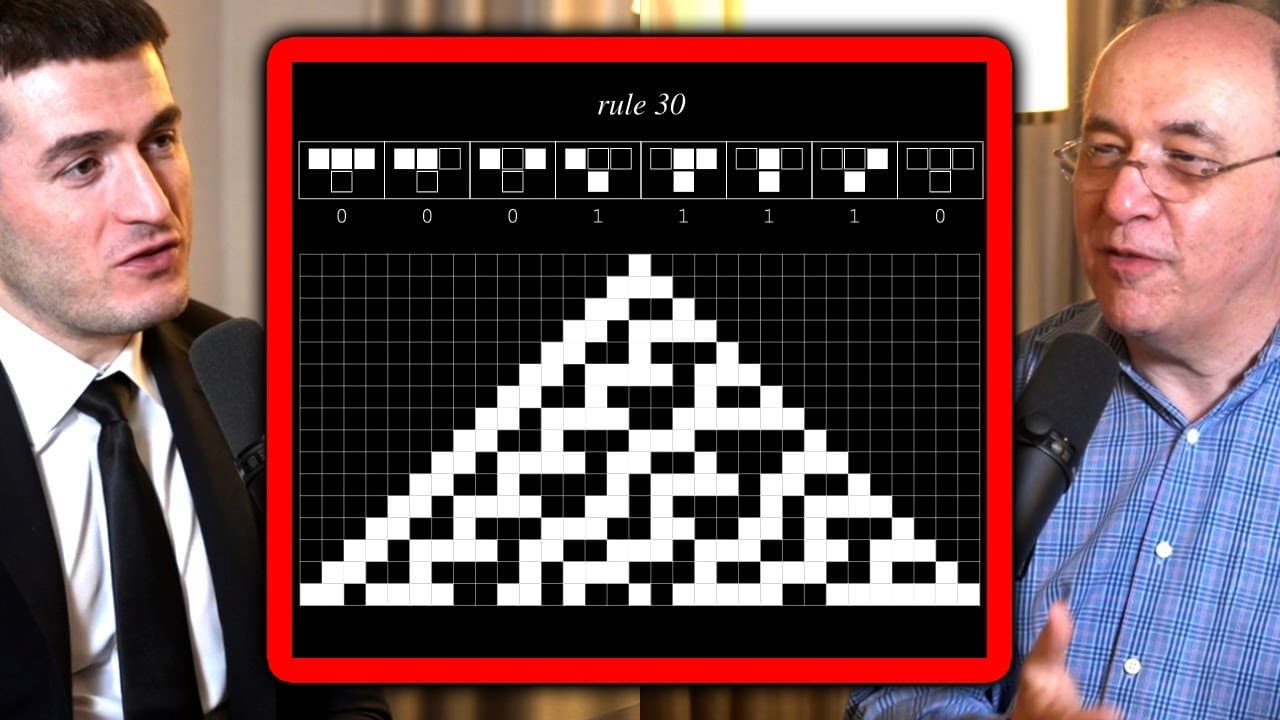
Cellular automata demonstrate how simple rules can lead to complex and seemingly random behaviors, serving as a physical analogy for the second law of thermodynamics. Rule 30, a notable example, creates an orderly triangular pattern despite its chaotic-looking structure, highlighting the challenges of predictability faced by computationally bounded observers.
Transcript
is there a connection to the second law of Thermodynamics and cellular automata oh yes those are the things you the things you've discovered About Cellular automata yes okay so when I first started selling Cellular automata my first papers about them were you know the first sentence was always about the second row of thermodynamics it was always ab... Read More
Key Insights
- 💁 Cellular automata exhibit irreducible computational behavior, forming complex patterns from simple rules.
- 📏 Rule 30 is a cellular automaton that produces a pattern with random-like properties, highlighting computational irreducibility.
- 👮 The second law of thermodynamics describes the increase of entropy or disorder in a system.
- 🖐️ Computational irreducibility plays a role in both cellular automata and the second law, making predictions and reversibility challenging for computationally bounded observers.
- 👮 The connection between computational irreducibility and the second law emphasizes the limitations of observers to predict and manipulate complex systems.
- ❓ Understanding the behavior of cellular automata contributes to understanding fundamental physics and the nature of observers.
- 👮 The second law's focus on entropy increase aligns with the computational complexity that arises from irreducible computation.
- 🎙️ More videos with Stephen Wolfram:
Install to Summarize YouTube Videos and Get Transcripts
Explore YouTube Video Summarizer or Get YouTube Transcript Extractor
Questions & Answers
Q: What is the connection between cellular automata and the second law of thermodynamics?
Cellular automata exhibit irreducible computational behavior, similar to how the second law of thermodynamics describes the transition from order to disorder. Both involve simple rules producing complex patterns that are difficult to predict.
Q: What is the significance of Rule 30 in cellular automata?
Rule 30 is a specific cellular automaton that produces a triangular pattern with a seemingly random interior. Its properties highlight the complex behavior that can arise from simple rules and demonstrate the computational irreducibility found in many cellular automata.
Q: How does computational irreducibility relate to the second law of thermodynamics?
Computational irreducibility is a key aspect of understanding the second law of thermodynamics. It explains why computationally bounded observers, such as humans, cannot easily predict the exact outcomes of systems governed by simple rules. The second law's focus on entropy increase aligns with the complexity that arises from irreducible computation.
Q: Can computationally bounded observers prepare initial states to reverse the second law's entropy increase?
No, computationally bounded observers cannot prepare initial states to reverse the entropy increase described by the second law of thermodynamics. The exact configuration required to produce a specific ordered outcome would require extensive computation beyond the observer's capabilities.
Summary & Key Takeaways
-
Cellular automata are intrinsically irreversible processes that form orderly structures even from random initial conditions.
-
Rule 30 is a cellular automaton that produces a simple triangular pattern with a seemingly random interior.
-
Computational irreducibility is a key aspect of understanding the second law of thermodynamics, where computationally bounded observers cannot predict the exact outcome of a system.
Read in Other Languages (beta)
Share This Summary 📚
Summarize YouTube Videos and Get Video Transcripts with 1-Click
Try YouTube Summary with ChatGPT & Claude or YouTube Transcript Generator
Explore More Summaries from Lex Clips 📚


Summarize YouTube Videos and Get Video Transcripts with 1-Click
Try YouTube Summary with ChatGPT & Claude or YouTube Transcript Generator