How to Find the Limit at Infinity (NancyPi)
TL;DR
Learn various strategies for finding limits at infinity and negative infinity, including polynomial and rational expressions, as well as trigonometric and exponential functions.
Transcript
Hi guys! I'm Nancy. And I'm going to show you how to find the limit at infinity, or negative infinity. Limits are a pretty big topic, kind of a mess, so I have a few videos. If you're actually looking for limits not at infinity, but at a number or an introduction to limits, what they mean you can use the links in the description to jump to those ex... Read More
Key Insights
- 😑 The degree of the highest power term determines the limit for polynomial expressions at infinity.
- 😑 Rational expressions can be simplified using a shortcut based on the degrees of the numerator and denominator.
- 😘 (sin x)/x expressions always have a limit of 0.
Install to Summarize YouTube Videos and Get Transcripts
Explore YouTube Video Summarizer or Get YouTube Transcript Extractor
Questions & Answers
Q: How are limits at infinity and negative infinity different from regular limits?
Limits at infinity and negative infinity consider the behavior of a function as x becomes extremely large or extremely negative, rather than approaching a specific number.
Q: What is the shortcut for finding limits of rational expressions?
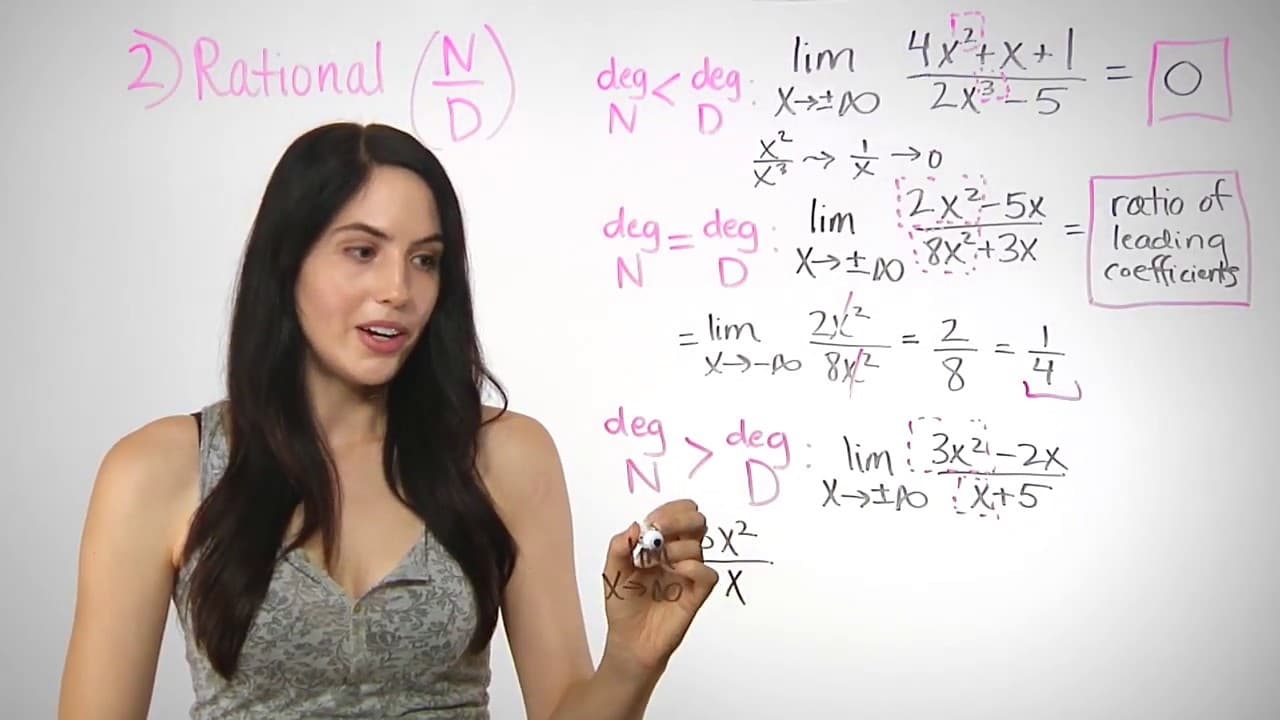
The shortcut involves comparing the degrees of the numerator and denominator. If the degree of the numerator is lower, the limit is 0. If the degrees are equal, the limit is the ratio of the leading coefficients. If the degree of the numerator is higher, the limit is either positive infinity or negative infinity.
Q: What is the limit of (sin x)/x as x approaches infinity?
The limit is 0 because the ratio of sine of x to x approaches 0 as x becomes extremely large.
Q: Is there a general rule for determining the limit of expressions with negative exponents?
Yes, expressions with negative exponents can be rewritten as 1 over the positive power, and the limit will depend on whether x approaches positive infinity or negative infinity. The limit will be 0 in both cases.
Key Insights:
- The degree of the highest power term determines the limit for polynomial expressions at infinity.
- Rational expressions can be simplified using a shortcut based on the degrees of the numerator and denominator.
- (sin x)/x expressions always have a limit of 0.
- Exponential expressions with negative exponents have a limit of 0 when x approaches infinity or negative infinity.
Summary & Key Takeaways
-
The video explains various types of limits at infinity, including polynomial expressions, rational expressions, (sin x)/x expressions, and exponential expressions.
-
For polynomial expressions, the highest power term determines the limit. If the power is even, the limit will be positive infinity, while if the power is odd, the limit will be negative infinity.
-
Rational expressions can be simplified using a shortcut by comparing the degrees of the numerator and denominator. If the degree of the numerator is lower, the limit is 0. If the degrees are equal, the limit is the ratio of the leading coefficients. If the degree of the numerator is higher, the limit is either positive infinity or negative infinity.
-
(sin x)/x expressions always have a limit of 0, while exponential expressions with negative exponents have a limit of 0 when x approaches positive infinity and a limit of 0 when x approaches negative infinity.
Read in Other Languages (beta)
Share This Summary 📚
Summarize YouTube Videos and Get Video Transcripts with 1-Click
Try YouTube Summary with ChatGPT & Claude or YouTube Transcript Generator
Explore More Summaries from NancyPi 📚
Summarize YouTube Videos and Get Video Transcripts with 1-Click
Try YouTube Summary with ChatGPT & Claude or YouTube Transcript Generator