Cascaded inverters | Driving large capacitance | Part-1/3 | VLSI | Lec-58
TL;DR
This video explains how to drive large capacitance loads in logic circuits effectively.
Transcript
hi everyone in this video you are going to learn about the concept called driving large capacitance loads driving large capacitor loads when we are studying about semos logic circuits the output of output of your logic circuit needs to be connected to any type of other logic circuit okay so when the output of one logic circuit is connected to the i... Read More
Key Insights
- 🌥️ Understanding large capacitance loads is critical for effective logic circuit design, particularly between microchips.
- 🐿️ Amphibious capacitance (off-chip) can dramatically impact the performance of on-chip electronic systems.
- 😘 The delay in signal propagation is significantly affected by the load capacitance, necessitating low resistance designs.
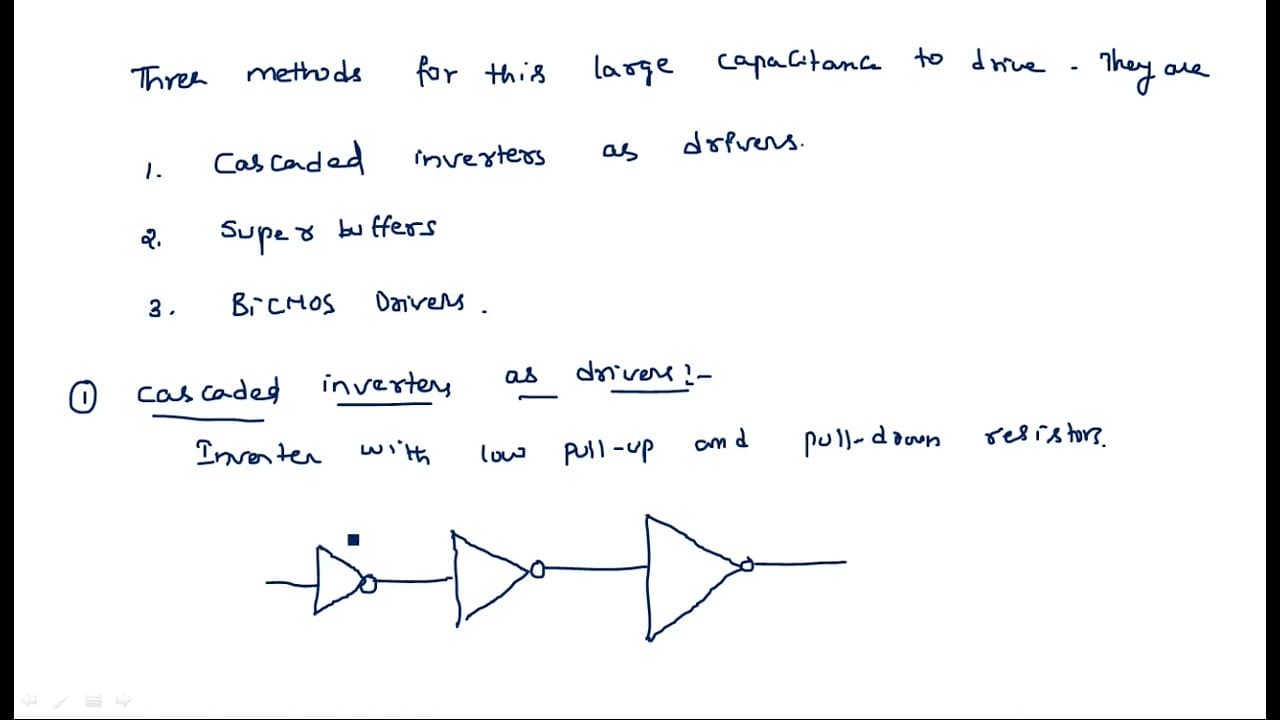
- ✋ Cascaded inverters are a practical solution for addressing high capacitance loads through strategic inverter sizing.
- 😘 The design of inverters must prioritize both low resistance and adequate delay management for robust circuit performance.
- 🐿️ Signal integrity is paramount when transitioning from on-chip to off-chip interactions due to high capacitance differences.
- 🥺 Optimization of transistor sizes in cascaded inverters can lead to significant improvements in circuit speed and efficiency.
Install to Summarize YouTube Videos and Get Transcripts
Explore YouTube Video Summarizer or Get YouTube Transcript Extractor
Questions & Answers
Q: What is the primary issue when connecting logic circuits with high capacitance?
The main issue arises when high capacitance at the input of a second logic circuit increases the load on the first circuit, causing signal delays. High input capacitance requires that the previous stage be capable of driving this load without significant lag, which is a crucial consideration in circuit design.
Q: How do off-chip capacitance levels compare to on-chip capacitance in electronic circuits?
Off-chip capacitance can be several orders of magnitude greater than on-chip capacitance, with a typical ratio of off-chip load capacitance being at least 10,000 times that of on-chip capacitance. This disparity creates significant challenges for signal integrity and propagation speeds in electronic designs.
Q: Why is it essential to use low resistance in driving large capacitance loads?
Low resistance in circuits helps minimize the product of resistance and capacitance, which is directly related to the signal delay. By reducing resistance, the circuit can handle larger capacitive loads more effectively, addressing the potential for long delays caused by high capacitance.
Q: What are cascaded inverters, and how do they help in driving large capacitance loads?
Cascaded inverters are a series of inverters configured such that each stage has increased width to manage higher capacitive loads. This design allows for reduced electrical resistance and minimizes delays in signal propagation, making it suitable for driving large capacitance effectively.
Q: What are some methods suggested to drive large capacitance loads in circuits?
The methods include using cascaded inverters, super buffers, and bios drivers. Each method focuses on maintaining low resistance and optimizing the driving capability of the circuit to ensure timely and robust signal transmission, which is crucial when interfacing different logic stages.
Q: How is the width of each transistor in a cascaded inverter adjusted, and why is this important?
In a cascaded inverter configuration, the width of each transistor increases by a specific factor as one moves from one stage to the next. This adjustment is vital to support larger capacitive loads without significantly increasing delay, improving the inverter's performance in driving the next stage.
Q: What role does capacitance play in determining the delay of signals in a circuit?
Capacitance directly influences delay, as the delay is calculated as the product of resistance and capacitance. Higher capacitance values result in longer delays, so effective management of capacitance is crucial for maintaining fast signal propagation.
Q: What is the relationship between the width factor and delay in cascaded inverters?
The delay per stage in cascaded inverters increases with the width factor of the transistors, which is adjusted to efficiently drive capacitive loads. This relationship highlights the balance needed between load capacity and the associated signal delay in circuit design.
Summary & Key Takeaways
-
The video discusses the concept of driving large capacitance loads in electronic circuits, specifically in the context of semiconductors, where outputs of one logic circuit connect to inputs of another.
-
It emphasizes the challenges posed by high input capacitance in subsequent logic stages, especially in cases where off-chip capacitance exceeds on-chip capacitance significantly.
-
The video introduces methods to mitigate delays caused by high capacitance loads, including using cascaded inverters, super buffers, and bios drivers to ensure low resistance and efficient signal propagation.
Read in Other Languages (beta)
Share This Summary 📚
Summarize YouTube Videos and Get Video Transcripts with 1-Click
Try YouTube Summary with ChatGPT & Claude or YouTube Transcript Generator