What Are Subqueries in SQL and How to Use Them?
TL;DR
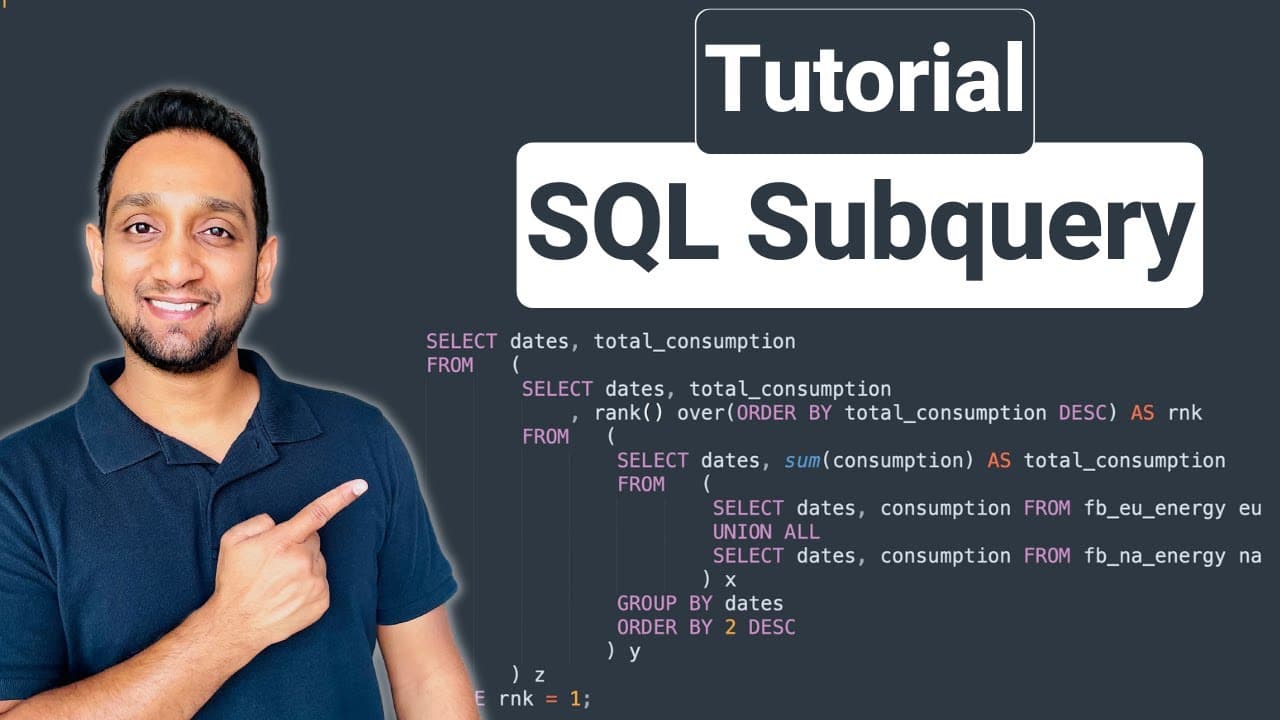
A subquery in SQL is a query embedded within another query, used to retrieve specific data based on conditions. There are three types: scalar subqueries return a single value, multiple row subqueries return multiple values potentially across several columns, and correlated subqueries depend on outer query values for their execution. Each serves distinct purposes in crafting dynamic SQL queries.
Transcript
this video is sponsored by brilliant hey guys i am tawfiq in this video let's learn about sub queries in sql now i'm going to start this video by explaining what sub queries are we'll try to write a sql query which contains a sub query and we'll see how sql will be processing a query statement which contains a sub query once you have this basic und... Read More
Key Insights
- ⚾ Sub-queries in SQL are used to retrieve specific data based on conditions and can be used in various clauses of a SQL statement.
- ↩️ Scalar sub-queries return one row and column, multiple row sub-queries return multiple rows with one or more columns, and correlated sub-queries depend on values from the outer query.
- 🍧 Sub-queries can be used in the SELECT, FROM, WHERE, and HAVING clauses of a SQL statement.
Install to Summarize YouTube Videos and Get Transcripts
Explore YouTube Video Summarizer or Get YouTube Transcript Extractor
Questions & Answers
Q: What is a sub-query in SQL?
A sub-query is an SQL query that is placed inside another query. It can be used in different clauses of a SQL statement to retrieve specific data based on certain conditions.
Q: What are the different types of sub-queries in SQL?
There are three types of sub-queries in SQL: scalar sub-queries, multiple row sub-queries, and correlated sub-queries. Scalar sub-queries return one row and column, multiple row sub-queries return multiple rows with either one or multiple columns, and correlated sub-queries depend on values from the outer query.
Q: How can a sub-query be used in a SQL statement?
Sub-queries can be used in different clauses of a SQL statement, including the SELECT, FROM, WHERE, and HAVING clauses. They allow for more complex queries and enable the retrieval of specific data based on conditions.
Q: What is the difference between a scalar sub-query and a correlated sub-query?
A scalar sub-query returns one row and column and can be executed independently of the outer query. However, a correlated sub-query is dependent on the values from the outer query and is executed once for each record processed by the outer query.
Q: How can a sub-query be used in the SELECT clause of a SQL statement?
A sub-query can be used in the SELECT clause to retrieve specific data based on conditions. However, it is generally not recommended to use a sub-query in the SELECT clause, as it can impact the performance of the query. Alternatives such as using a join can achieve the same result more efficiently.
Key Insights:
- Sub-queries in SQL are used to retrieve specific data based on conditions and can be used in various clauses of a SQL statement.
- Scalar sub-queries return one row and column, multiple row sub-queries return multiple rows with one or more columns, and correlated sub-queries depend on values from the outer query.
- Sub-queries can be used in the SELECT, FROM, WHERE, and HAVING clauses of a SQL statement.
- It is generally recommended to avoid using sub-queries in the SELECT clause, as it can negatively impact performance. Alternative methods, such as using joins, can achieve the same result more efficiently.
Summary & Key Takeaways
-
A sub-query is an SQL query placed inside another query, and it can be used in different clauses of a SQL statement.
-
Sub-queries can be scalar, multiple rows, or correlated, and they serve different purposes in SQL queries.
-
Scalar sub-queries return one row and column, multiple row sub-queries return multiple rows with either one or multiple columns, and correlated sub-queries depend on the values from the outer query.
Read in Other Languages (beta)
Share This Summary 📚
Summarize YouTube Videos and Get Video Transcripts with 1-Click
Try YouTube Summary with ChatGPT & Claude or YouTube Transcript Generator
Explore More Summaries from techTFQ 📚

Summarize YouTube Videos and Get Video Transcripts with 1-Click
Try YouTube Summary with ChatGPT & Claude or YouTube Transcript Generator