Republicans are Dangerous. Can the Democrats Succeed?
TL;DR
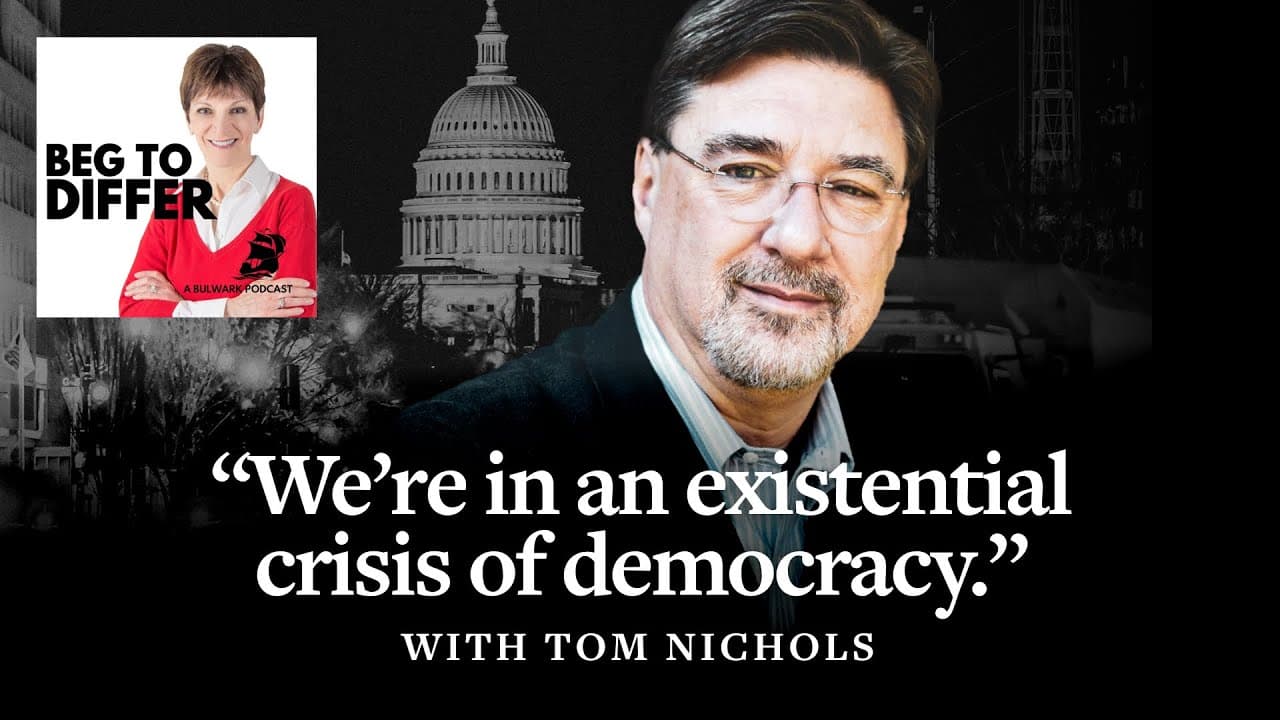
A panel discussion examines the current state of American politics, acknowledging the divide between centrists and progressives and the challenges facing the Democratic Party. The need for a comprehensive approach to address immigration and foreign policy is highlighted.
Transcript
welcome to beg to differ the bulwark's weekly roundtable discussion featuring civil conversation across the political spectrum we range from center left to center right i'm mona charan syndicated columnist and policy editor at the bulwark and i'm joined by our regulars bill galston of the brookings institution in the wall street journal and damon l... Read More
Key Insights
- 😀 The Democratic Party is divided between centrists and progressives, failing to unite in the face of an existential crisis of democracy.
- 😉 The Biden administration's heavy focus on spending to win over working-class white voters may not yield the desired political success.
- 🤨 The Republicans' refusal to raise the debt ceiling highlights the challenges of navigating bipartisan cooperation.
- 🤨 Biden's handling of immigration and foreign policy raises concerns about competence and effective communication with allies.
Install to Summarize YouTube Videos and Get Transcripts
Explore YouTube Video Summarizer or Get YouTube Transcript Extractor
Questions & Answers
Q: Why are centrists and progressives within the Democratic Party failing to unite in the face of a crisis of democracy?
Bill Galston argues that the lack of unity is a result of a failure to internalize the near-death experience of the past four years and the Democrats' approach to the existential crisis of democracy.
Q: Is the Democrats' heavy focus on spending to win over working-class white voters a viable strategy?
Sarah Longwell suggests that the Biden administration's strategy of piling up massive amounts of debt to improve the lives of working-class white voters who lean towards Trump may not yield the desired political success, as they may not credit Biden for the spending.
Q: How does the Republican Party's refusal to raise the debt ceiling affect the Democrats' approach?
Damon Linker argues that McConnell's refusal to cooperate on raising the debt ceiling highlights the obstructionist tactics employed by the Republicans, necessitating a different approach to navigate bipartisan cooperation.
Q: Should Biden reconsider his policies to address concerns about immigration and foreign policy?
Tom Nichols argues that Biden's foreign policy strategy, such as the Australia deal, could be strong, but the administration's lack of effective communication and consultation with allies has led to perception issues and controversy.
Summary & Key Takeaways
-
The panel discusses the strained relationship between centrists and progressives within the Democratic Party, highlighting their failure to unite in the face of an existential crisis of democracy.
-
Sarah Longwell argues that the Democrats' heavy focus on spending to win over working-class white voters may not be effective and risks jeopardizing the party's future political success.
-
The panel discusses the Republicans' unwillingness to raise the debt ceiling, with Mitch McConnell urging Democrats to solve the issue on their own, highlighting the challenges of navigating bipartisan cooperation.
-
The discussion also delves into the Biden administration's approach to immigration, with a focus on the recent controversy over Haitian refugees at the border.
Read in Other Languages (beta)
Share This Summary 📚
Summarize YouTube Videos and Get Video Transcripts with 1-Click
Try YouTube Summary with ChatGPT & Claude or YouTube Transcript Generator
Explore More Summaries from The Bulwark 📚
Summarize YouTube Videos and Get Video Transcripts with 1-Click
Try YouTube Summary with ChatGPT & Claude or YouTube Transcript Generator