How radio telescopes show us unseen galaxies | Natasha Hurley-Walker
TL;DR
In this content, the speaker discusses their journey from dreaming of exploring space as a child to becoming a professional astronomer, and shares their recent discoveries using radio telescopes.
Transcript
Transcriber: Joseph Geni Reviewer: Joanna Pietrulewicz Space, the final frontier. I first heard these words when I was just six years old, and I was completely inspired. I wanted to explore strange new worlds. I wanted to seek out new life. I wanted to see everything that the universe had to offer. And those dreams, those words, they took me on a j... Read More
Key Insights
- 🌌 The speaker's passion for space exploration was sparked at a young age and led them to become a professional astronomer. They embarked on a journey of discovery, which eventually led them to focus on astronomy and the use of telescopes.
- 🔭 The universe is too vast to be explored solely through spacecraft, so astronomers turn to telescopes like the Hubble Space Telescope. Its images, such as the Hubble Deep Field, reveal the immense number of galaxies in the universe.
- 🌈 Visible light, which is what our eyes can see, is only a fraction of the electromagnetic spectrum. Using visible light limits our exploration of the universe and hides other important processes emitting different types of light.
- 🌬️ Dust in the universe obstructs visible light, making it difficult to see deeper into space. Additionally, the phenomenon of redshift, caused by the expansion of the universe, shifts light towards the red end of the spectrum, making distant objects increasingly difficult to observe.
- 📡 Radio astronomy overcomes the limitations of visible light by utilizing low-frequency radio waves. Radio waves can pass through dust and are less affected by redshift, allowing astronomers to observe the universe in greater detail.
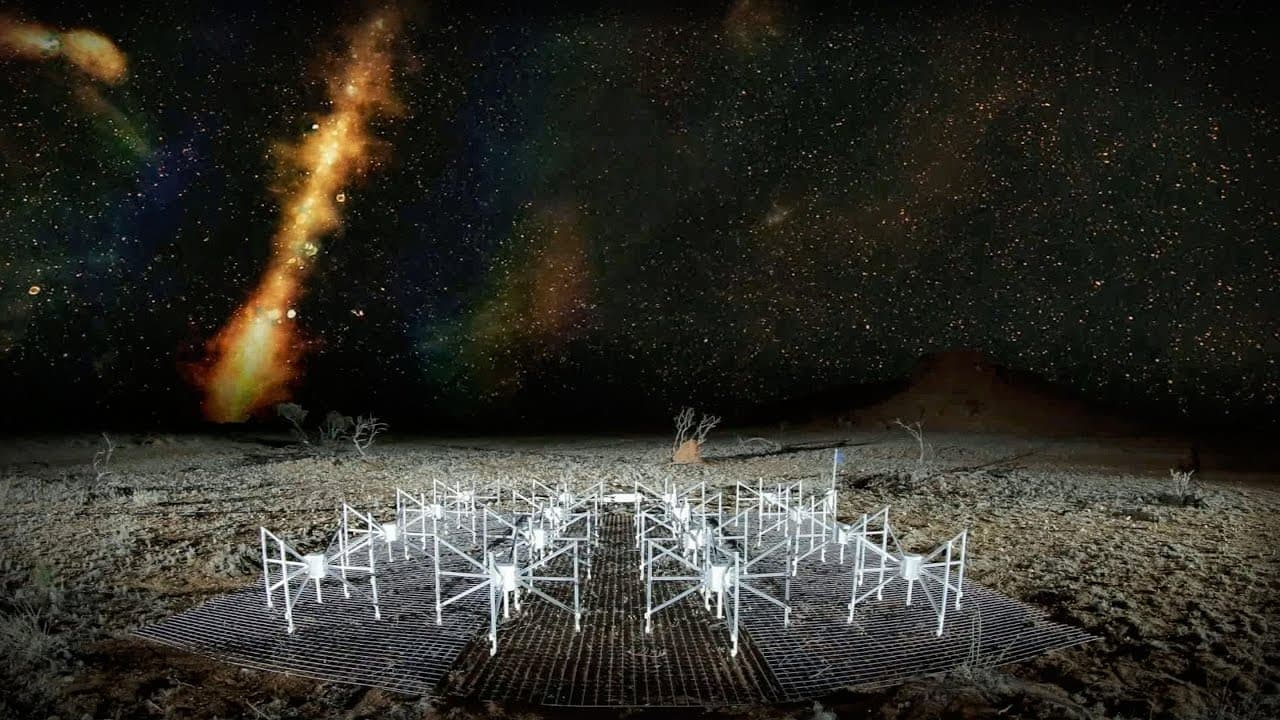
- 🤓 The Murchison Widefield Array is a radio telescope designed to capture low-frequency radio waves. Its construction involved a large group of students who volunteered their time to deploy radio dipoles across the desert, resulting in improved resolution and a better understanding of the universe.
- 💻 The speaker has spent years working with radio data collected by the Murchison Widefield Array. Their analysis has led to the GaLactic and Extragalactic All-sky MWA Survey (GLEAM), a comprehensive survey of the southern sky that provides insight into various physical processes in the universe.
- ⭐ By studying the radio emissions from distant galaxies, astronomers can observe the effects of supermassive black holes at their centers. These black holes generate powerful jets of material that emit radio waves, and the GLEAM survey has led to the discovery of thousands of distant galaxies with active black holes. Additionally, the survey has provided insights into star-forming regions and supernova remnants in our own galaxy.
Install to Summarize YouTube Videos and Get Transcripts
Explore YouTube Video Summarizer or Get YouTube Transcript Extractor
Questions & Answers
Q: What inspired the speaker to become an astronomer?
The speaker was inspired to become an astronomer after hearing the words "Space, the final frontier" at a young age and wanting to explore the universe.
Q: What did the speaker learn while doing their PhD?
The speaker learned that they would not be piloting a starship anytime soon, but they also learned that the universe is vast and can't be explored by spaceship alone.
Q: What are the limitations of using visible light to explore the universe?
Using visible light for exploration has two important problems. First, dust obscures the light of stars, making it difficult to see deeper into the universe. Second, the phenomenon of redshift causes objects moving away from us to appear redder, limiting our ability to see very distant objects.
Q: How does radio astronomy overcome the limitations of visible light?
Radio astronomy allows for deeper exploration by using radio waves, which are not blocked by dust. Additionally, redshift is less of a problem in radio astronomy, as receivers can be built to receive across a large band of frequencies.
Summary & Key Takeaways
-
The speaker was inspired by the idea of exploring space from a young age and pursued a career in astronomy.
-
Using telescopes like the Hubble Space Telescope, astronomers have been able to explore and observe distant galaxies.
-
The speaker and their team have built the Murchison Widefield Array, a radio telescope that allows for deeper exploration of the universe and the detection of distant galaxies. They hope to use future telescopes like the Square Kilometre Array to study the beginnings of the universe.
Read in Other Languages (beta)
Share This Summary 📚
Summarize YouTube Videos and Get Video Transcripts with 1-Click
Try YouTube Summary with ChatGPT & Claude or YouTube Transcript Generator
Explore More Summaries from TED 📚





Summarize YouTube Videos and Get Video Transcripts with 1-Click
Try YouTube Summary with ChatGPT & Claude or YouTube Transcript Generator