Permutations and Combinations | Examples | Aptitude | Part- 03 | Bharath Kumar
TL;DR
This session covers solving problems related to permutations and combinations using formulas and shortcuts.
Transcript
hi everyone welcome to the session in this session we are going to discussing about the problems related to permutations and combinations in the last sessions we have discussed about the introduction part of permutations and combinations now in this session onwards we are going to discussing about various models of problems related to permutations ... Read More
Key Insights
- 😀 Permutations (nPr) describe arrangements of r items from n and utilize factorial-based calculations.
- 💹 Combinations (nCr) quantify selections of r items from n without regard to order, modified by the factorial of r.
- 🌥️ Shortcuts for calculating permutations and combinations can considerably reduce the complexity, especially with larger values.
- ❓ Utilizing the relationship between combinations and permutations can streamline problem-solving.
- ❓ Understanding fundamental concepts is essential for tackling complex mathematical problems effectively.
- 🛩️ Problems featuring large n and small r benefit from specific techniques, improving calculation efficiency.
- 💹 The condition nCr = nCs acts as a useful tool for deriving values and understanding relationships within combinations.
Install to Summarize YouTube Videos and Get Transcripts
Explore YouTube Video Summarizer or Get YouTube Transcript Extractor
Questions & Answers
Q: What is the significance of nPr and nCr in problems involving permutations and combinations?
nPr and nCr are crucial in permutations and combinations as they quantify the arrangements and selections of items. nPr calculates the number of ways to choose and arrange r items from n available items, while nCr calculates the number of ways to select r items from n without regard to order. Understanding these concepts enables problem-solving in various fields, including probability and statistics.
Q: How can one quickly calculate nPr using the shortcut method?
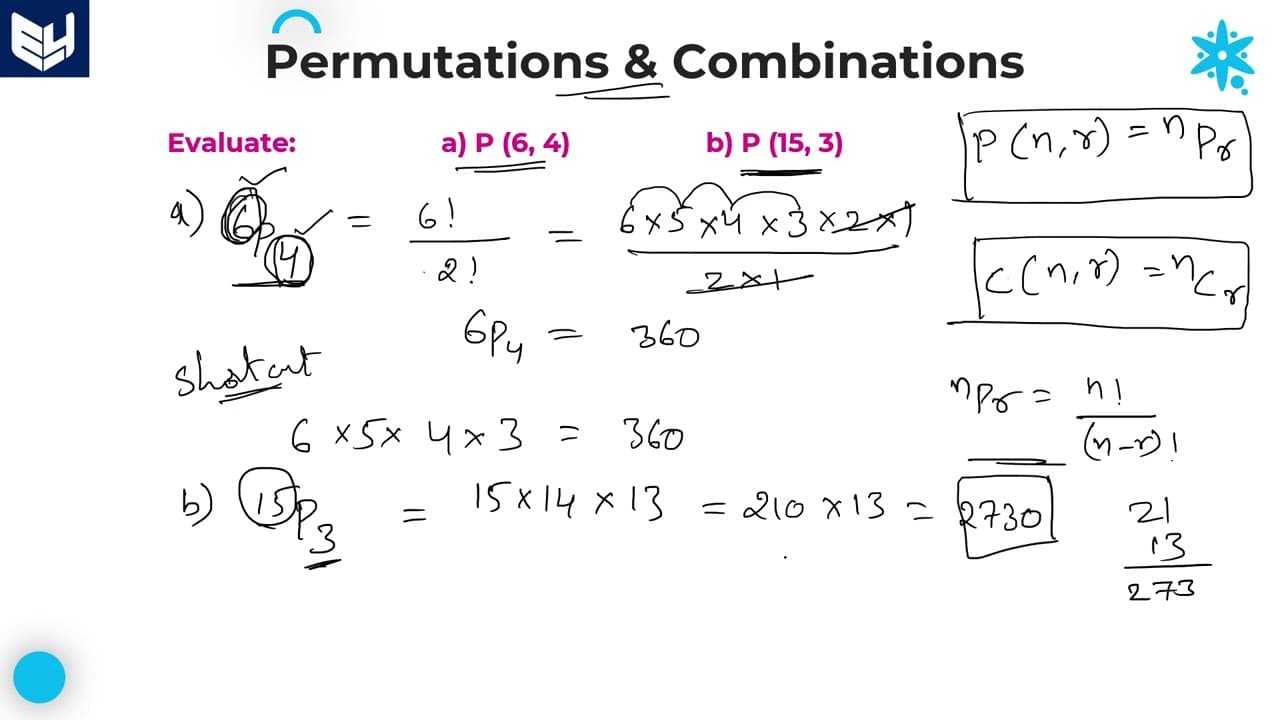
To quickly calculate nPr, one can write the descending product of n for r terms. For example, to find 6P4, calculate 6 × 5 × 4 × 3, which gives the correct permutation value without fully expanding factorials. This method saves time and is useful for larger values.
Q: What is the relationship between nCr and nPr?
The relationship between nCr and nPr is established through the formula nCr = nPr / r!. While nPr counts the arrangements of r items chosen from n, nCr represents the same selections without considering order. This relationship is useful for simplifying calculations, especially when factorials are involved.
Q: How do you calculate nCr when n is large and r is small?
For large n and small r, simplify calculations by using the formula nCr = n(n-1)(n-2)...(n-r+1) / r!. For instance, to compute 100C2, use the descending product starting from 100 and divide by the factorial of 2, which minimizes computation complexity and error.
Q: What is a common mistake to avoid when using the combination formula?
A common mistake is misapplying nCr as n(n-1)(n-2)...(n-r+1) without dividing by r!. Always remember to account for r! in the denominator, as it adjusts for overlapping arrangements, ensuring the selection count accurately reflects the number of unique combinations.
Q: Can you explain the significance of the condition nCr = nCs?
The condition nCr = nCs is significant because it implies either r = s or n = r + s. This principle helps in finding unknown values in combinatorial problems, providing a method to relate different combination expressions to simplify calculations and arrive at solutions.
Summary & Key Takeaways
-
The session begins with an introduction to permutations and combinations, revisiting definitions and previous discussions. It lays a foundation for solving related problems.
-
The speaker explains how to compute permutations (nPr) and combinations (nCr) using formulas, emphasizing shortcuts to simplify calculations for larger numbers.
-
Specific examples, like evaluating 6P4 and 11C3, demonstrate practical applications of nPr and nCr concepts, reinforcing the importance of understanding relationships between combinations and permutations.
Read in Other Languages (beta)
Share This Summary 📚
Summarize YouTube Videos and Get Video Transcripts with 1-Click
Try YouTube Summary with ChatGPT & Claude or YouTube Transcript Generator