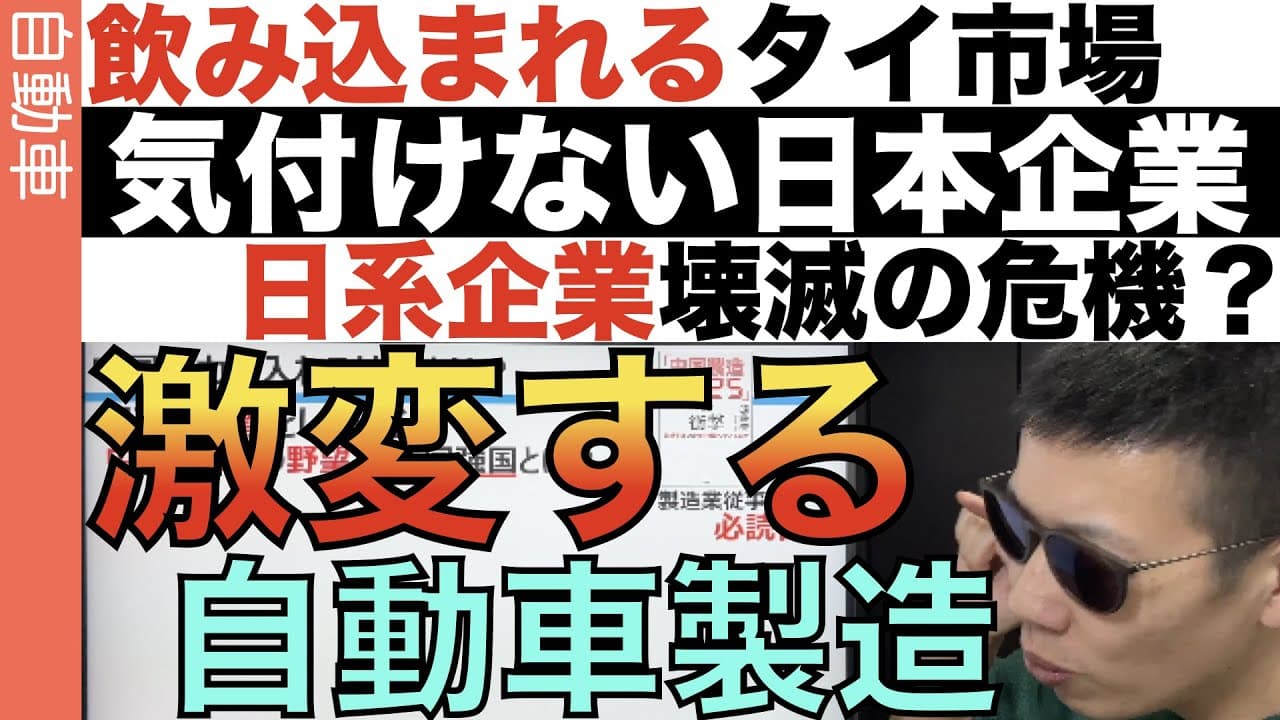
【製造クライシス前編】日本の製造業が「タイを失う」日が来るかもしれない
TL;DR
Japan's manufacturing influence in Thailand is waning due to China's rise.
Transcript
The other party is China. Japan recently lost to China. A China manufacturer used the largest space at the motor show venue. Hello. I'm Manufacturing man from Manufacturing man Channel . Maybe this video will be uploaded first. Continuing from the first time, I will shoot a video with Taro Yamada. I am Taro Yamada, a member of the House of Councilo... Read More
Key Insights
- Japan's manufacturing sector is losing its stronghold in Thailand, with Chinese companies increasing their direct investments and influence in the region.
- The quality gap between Thai and Japanese products has narrowed, while the price gap remains significant, leading to a decline in the appeal of Japanese products.
- Japanese companies are slow to adapt to new technologies like Electric Vehicles and FSW, putting them at a disadvantage compared to Chinese and Korean firms.
- Localization efforts in Japanese companies are hindered by centralized decision-making processes, which slows down operations and responsiveness in foreign markets.
- The depreciation of the yen and low salaries at Japanese companies in Thailand make it difficult to attract and retain talented local workforce.
- Cultural influence, such as the popularity of Korean pop culture, affects the perception of Japanese companies among young Thai individuals.
- The shift towards Electric Vehicles in Thailand presents a challenge for Japanese automakers, who currently dominate the engine car market but lack presence in the EV sector.
- Japan's market strategy focuses on outsourcing rather than tapping into local markets, limiting their growth potential in Southeast Asia.
Install to Summarize YouTube Videos and Get Transcripts
Explore YouTube Video Summarizer or Get YouTube Transcript Extractor
Questions & Answers
Q: Why is Japan losing its manufacturing influence in Thailand?
Japan is losing its manufacturing influence in Thailand due to several factors, including the rise of Chinese companies investing directly in the region, the narrowing quality gap between Thai and Japanese products, and the high price of Japanese goods. Additionally, Japan's slow adaptation to new technologies and centralized decision-making processes hinder their competitiveness.
Q: How are Chinese and Korean companies outperforming Japanese firms in Thailand?
Chinese and Korean companies are outperforming Japanese firms in Thailand by being more adaptable and responsive to market changes. They invest in new technologies like Electric Vehicles, allow local decision-making, and offer competitive salaries. Their cultural influence, such as the popularity of Korean pop culture, also enhances their appeal to the local workforce.
Q: What role does localization play in Japan's manufacturing challenges?
Localization plays a significant role in Japan's manufacturing challenges, as Japanese companies often centralize decision-making in Japan, leading to slow operations and responsiveness in foreign markets. This contrasts with Chinese and Korean companies, which empower local managers to make decisions, allowing them to adapt quickly to local needs and market changes.
Q: How is the shift towards Electric Vehicles affecting Japanese automakers in Thailand?
The shift towards Electric Vehicles (EVs) in Thailand is challenging Japanese automakers, who currently dominate the engine car market but lack a presence in the EV sector. As environmental concerns grow, the demand for EVs is expected to rise, and Japanese companies must adapt quickly to maintain their market share and competitiveness.
Q: What impact does the depreciation of the yen have on Japanese companies in Thailand?
The depreciation of the yen impacts Japanese companies in Thailand by making it difficult to secure investment from Japan and maintain cash flow. This financial strain, combined with relatively low salaries, makes it challenging to attract and retain skilled local talent, further hindering their ability to compete effectively in the market.
Q: Why are Thai people less interested in Japanese products compared to before?
Thai people are less interested in Japanese products due to their high prices and over-specifications, which do not align with local needs. The narrowing quality gap between Thai and Japanese products and the cultural influence of Korean pop culture also contribute to the declining appeal of Japanese goods.
Q: What is the significance of cultural influence in the manufacturing sector?
Cultural influence plays a significant role in the manufacturing sector by shaping consumer perceptions and preferences. For example, the popularity of Korean pop culture in Thailand enhances the appeal of Korean products and companies, making it harder for Japanese firms to compete despite their historical dominance in the market.
Q: What strategic changes should Japanese companies consider to regain their competitiveness?
To regain competitiveness, Japanese companies should consider adopting new technologies like Electric Vehicles and FSW, empowering local managers for quicker decision-making, offering competitive salaries to attract talent, and focusing on local market needs rather than just outsourcing. Additionally, they should enhance their cultural influence to improve brand perception and appeal.
Summary & Key Takeaways
-
Japan's manufacturing sector in Thailand is facing challenges as Chinese companies increase their direct investments and local manufacturing capabilities improve. The appeal of Japanese products is waning due to high prices and over-specifications.
-
Localization efforts by Japanese companies are hampered by centralized decision-making, and the depreciation of the yen makes it difficult to secure a skilled local workforce. Meanwhile, Chinese and Korean companies are more adaptable and responsive.
-
Cultural influences and the shift towards Electric Vehicles are reshaping the Thai market. Japanese automakers, currently dominant in engine cars, must adapt to the growing EV trend to maintain their market share.
Read in Other Languages (beta)
Share This Summary 📚
Summarize YouTube Videos and Get Video Transcripts with 1-Click
Try YouTube Summary with ChatGPT & Claude or YouTube Transcript Generator
Explore More Summaries from ものづくり太郎チャンネル 📚




Summarize YouTube Videos and Get Video Transcripts with 1-Click
Try YouTube Summary with ChatGPT & Claude or YouTube Transcript Generator