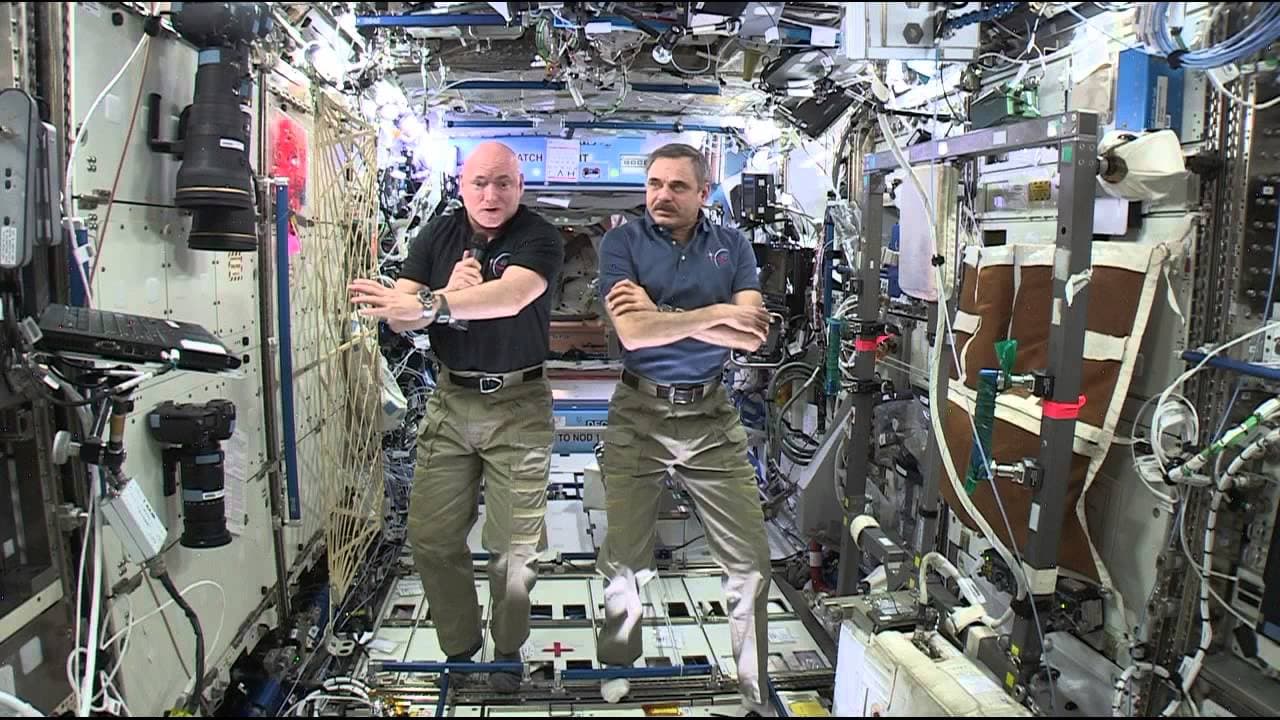
Space Station One-Year Crew Talks to Students
TL;DR
Two astronauts discuss their year-long mission in the International Space Station, including scientific experiments, maintenance, and understanding the effects of long-term space travel on the human body.
Transcript
station this is houston are you ready for the event we are ready for the event lbj library this is mission control houston please call station for a voice check station this is lbj library in austin texas how do you hear me we have you loud and clear how do you hear us we hear you wonderfully thank you so much all right i have our first student her... Read More
Key Insights
- 👾 The year-long mission involves performing around 400 scientific experiments and maintaining the space station.
- 🚙 The Russian Soyuz spacecraft is a reliable vehicle used for transportation and rescue missions to the International Space Station.
- 🫒 Living in microgravity has both positive and negative effects on the human body.
- 💦 The space station promotes sustainable practices, such as using solar energy, recycling water, and studying renewable energy and water conservation techniques.
- 🧑🚀 Astronaut training takes several years and begins before selection, emphasizing lifelong skill development.
- 👾 The space station provides a unique view of Earth, showcasing natural and human-made features and highlighting areas of pollution.
- 🧑🚀 Rehabilitation and subsequent training follow long-duration missions for astronauts.
Install to Summarize YouTube Videos and Get Transcripts
Explore YouTube Video Summarizer or Get YouTube Transcript Extractor
Questions & Answers
Q: What are the main activities conducted during the year-long mission in the International Space Station?
The astronauts carry out about 400 scientific experiments, perform maintenance tasks, and engage in activities to improve the space station. They are also preparing for a spacewalk to further enhance the station.
Q: Can you provide more information about the Russian Soyuz vehicle?
The Russian Soyuz spacecraft is a reliable vehicle that has been used for over 50 years. It serves as both a means of transportation to the space station and a rescue vehicle. It has undergone upgrades and is currently the only vehicle flying to the station.
Q: How is a year-long mission different from a regular mission?
A year-long mission is harder and more challenging due to the longer isolation period and increased responsibilities. It requires additional training and the ability to work with different crew members. The mission also focuses on understanding the physiological changes that occur during long-duration space travel.
Q: What does the launch feel like?
The launch is an unforgettable and exciting experience. It requires a lot of responsibility as it is a critical stage of space exploration. Even with experience, every launch is impressive and demands a high level of focus.
Q: What is being done on the International Space Station to address global energy problems?
The space station is an energy-efficient environment that utilizes solar energy to power its operations. It also recycles water and generates oxygen through a closed-loop environmental control system. These sustainability practices contribute to a better understanding of renewable energy and water conservation.
Q: What can you see from the space station?
The astronauts have a unique perspective from the space station and can observe around 90% of the Earth during their 90-minute orbits. They can see natural features such as oceans, landforms, and weather patterns. They also observe human-made structures like airports, cities, and pollution-affected areas.
Q: How long is the training period for astronauts?
Astronauts typically train for two to three years for long-duration space flights. However, the training starts even before being selected as an astronaut and can take five to six years in total. Lifelong training and skill development are crucial for the complex and challenging nature of life in space.
Q: What are the effects of space flight on the body?
Living in microgravity can cause numerous effects on the body, including loss of bone mass, muscle mass, and changes in vision and the immune system. Radiation exposure is also a concern. However, astronauts gain a unique perspective on the planet and work on important missions, making the experience rewarding.
Summary & Key Takeaways
-
The astronauts have approximately 400 scientific experiments throughout their year-long mission, covering various scientific disciplines.
-
They also perform maintenance on the space station and engage in activities to improve it, including spacewalks.
-
The mission focuses on understanding how the human body changes during long periods in space and preventing those changes, with the goal of future space travel to Mars.
Read in Other Languages (beta)
Share This Summary 📚
Summarize YouTube Videos and Get Video Transcripts with 1-Click
Try YouTube Summary with ChatGPT & Claude or YouTube Transcript Generator
Explore More Summaries from NASA 📚
Summarize YouTube Videos and Get Video Transcripts with 1-Click
Try YouTube Summary with ChatGPT & Claude or YouTube Transcript Generator