How Does Osmosis Work Using an Egg Experiment?
TL;DR
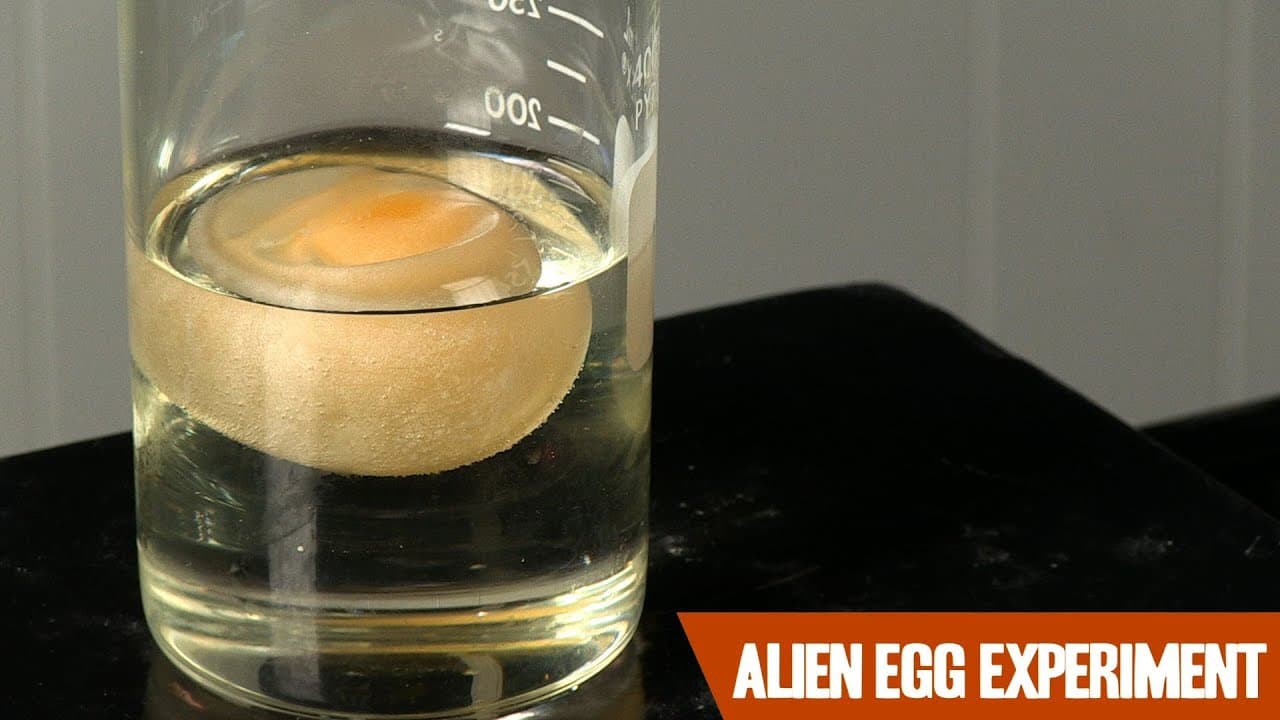
This experiment demonstrates osmosis using an egg by immersing it first in vinegar to dissolve the shell, allowing water to enter the egg. The egg expands as water moves from the vinegar into the high-concentration egg contents. Then, placing the egg in corn syrup reverses the process, drawing water out through osmosis, showing how substances move across a semipermeable membrane.
Transcript
SciShow theme Hello, this is Hank Green and welcome to SciShow Experiments! You know what I enjoy? Water. And the being alive that it makes possible. Our cells are constantly absorbing water through one of the simplest forms of chemical transport: osmosis. Which is the movement of materials in a solution across a membrane. And dissolved materials... Read More
Key Insights
- 😘 Osmosis is the movement of materials across a membrane from high to low concentration.
- ❓ Vinegar dissolves eggshells through a chemical reaction with calcium carbonate.
- 💦 Water enters the egg through osmosis after the shell dissolves, causing it to expand.
- 💦 Corn syrup, with higher solute concentration, extracts water from the egg through osmosis.
- 🪺 The experiment demonstrates osmosis and membrane permeability using an egg model.
- ❓ Understanding osmosis is crucial in biology and chemistry disciplines.
- 🤗 Science experiments like these provide hands-on learning experiences.
Install to Summarize YouTube Videos and Get Transcripts
Explore YouTube Video Summarizer or Get YouTube Transcript Extractor
Questions & Answers
Q: How does osmosis work in cells?
Osmosis is the movement of materials from high concentration to low concentration across a membrane in cells, maintaining equilibrium.
Q: What role does vinegar play in the egg osmosis experiment?
Vinegar dissolves the eggshell by reacting with calcium carbonate, creating a semipermeable membrane for water to enter the egg.
Q: Why does the egg expand in vinegar?
The egg absorbs water through osmosis from the vinegar, resulting in an increase in size as the water flows from a low concentration to a high concentration in the egg.
Q: How does corn syrup affect the egg in the experiment?
Corn syrup, with a higher concentration of dissolved material, causes water to leave the egg through osmosis, resulting in a shriveled egg in the end.
Summary & Key Takeaways
-
Cells absorb water through osmosis, the movement of materials across a membrane.
-
Using an egg as a model cell, the experiment shows osmosis in action.
-
Vinegar dissolves the eggshell, allowing water to enter the egg, and corn syrup removes water from the egg.
Read in Other Languages (beta)
Share This Summary 📚
Summarize YouTube Videos and Get Video Transcripts with 1-Click
Try YouTube Summary with ChatGPT & Claude or YouTube Transcript Generator
Explore More Summaries from SciShow 📚

Summarize YouTube Videos and Get Video Transcripts with 1-Click
Try YouTube Summary with ChatGPT & Claude or YouTube Transcript Generator