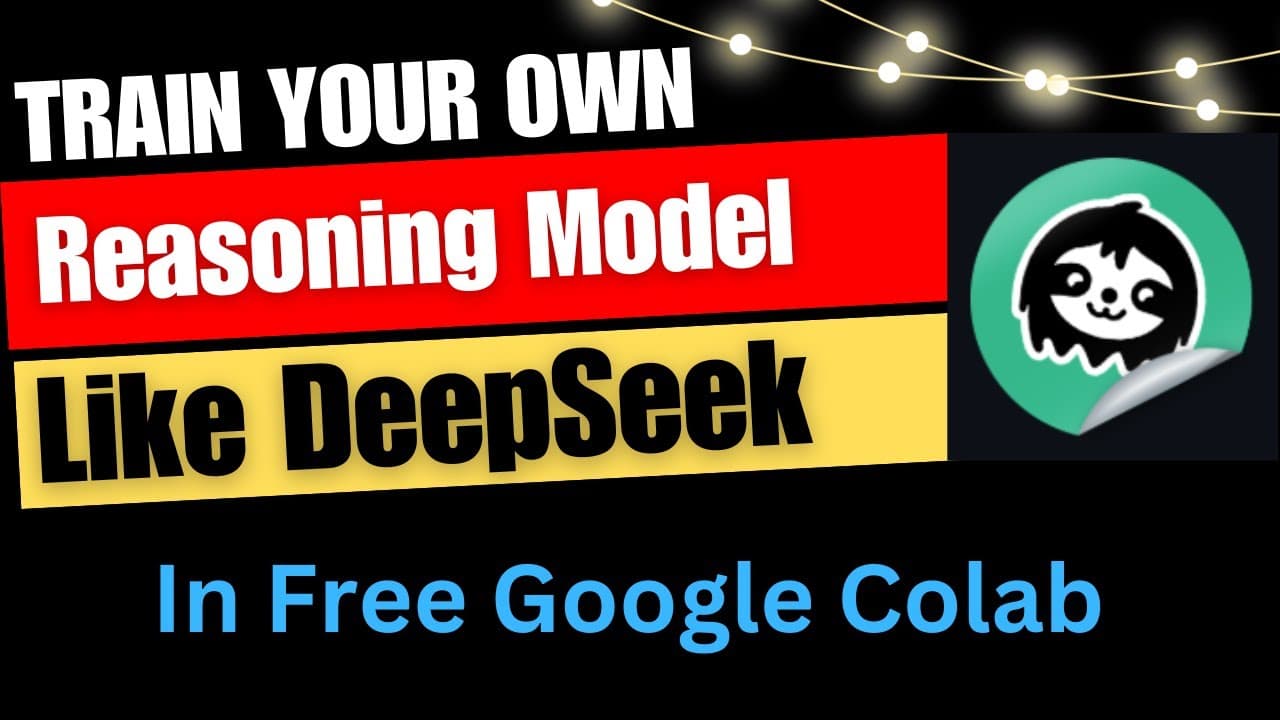
Train Your Own Reasoning Model Like DeepSeek R1 in Free Google Colab
TL;DR
Tutorial on training a reasoning model with GRPO using Google Colab.
Transcript
hello everyone this is Fahad mza and I welcome you to the channel at the start of this year everyone was talking about agents and almost every one out there was saying that this is going to be the year of agent tech software but it seems that reasoning is invol and people are not really talking about agents at the moment in this video I going to do... Read More
Key Insights
- The video emphasizes the shift from agent technology to reasoning in AI, highlighting the significance of reasoning capabilities in modern models.
- UNS Sloth is a library for fine-tuning large language models, making it easier to infuse reasoning into models like Llama.
- The tutorial utilizes Google Colab's free GPU resources to train a reasoning model, demonstrating the process step-by-step.
- Group Relative Policy Optimization (GRPO) is a key technique used to enhance reasoning in models, leveraging reinforcement learning principles.
- The video explains various parameters and settings in the training process, such as sequence length, LoRA rank, and gradient checkpointing.
- The training process involves defining reward functions to guide the model towards correct responses, essential in reinforcement learning.
- The tutorial provides insights into optimizing the training process, including learning rate scheduling and gradient clipping techniques.
- The video discusses the challenges and considerations in model training, such as avoiding overfitting and ensuring efficient resource utilization.
Install to Summarize YouTube Videos and Get Transcripts
Explore YouTube Video Summarizer or Get YouTube Transcript Extractor
Questions & Answers
Q: What is the main focus of the video?
The main focus of the video is to provide a step-by-step tutorial on training a reasoning model using Group Relative Policy Optimization (GRPO) and the UNS Sloth library in Google Colab. It emphasizes the shift from agent technology to reasoning in AI models, demonstrating the process of infusing reasoning capabilities into models like Llama using free GPU resources.
Q: What is UNS Sloth and its role in the video?
UNS Sloth is a library designed for fine-tuning large language models. In the video, it plays a crucial role by providing an easy-to-use framework for infusing reasoning into models like Llama. The tutorial extensively covers how to utilize UNS Sloth in conjunction with Google Colab to train a reasoning model, highlighting its significance in modern AI development.
Q: How does the video explain GRPO?
The video explains Group Relative Policy Optimization (GRPO) as a groundbreaking technique used to enhance reasoning capabilities in language models through reinforcement learning. It details how GRPO works by defining reward functions that guide the model towards correct responses, thereby improving its reasoning ability without the need for labeled datasets. The tutorial provides insights into implementing GRPO in the training process.
Q: What are some key parameters discussed in the training process?
Key parameters discussed in the training process include sequence length, LoRA rank, gradient checkpointing, and learning rate settings. The video explains how these parameters influence the model's performance and efficiency, providing a detailed overview of their roles in optimizing the training process. It also covers techniques like learning rate scheduling and gradient clipping to improve model development.
Q: What challenges in model training does the video address?
The video addresses several challenges in model training, such as avoiding overfitting, managing resource constraints, and ensuring efficient utilization of available resources like GPU memory. It provides practical tips for overcoming these challenges, including setting appropriate training steps, optimizing learning rates, and using techniques like gradient clipping to prevent issues like exploding gradients and ensure robust model performance.
Q: How does the video utilize Google Colab for training?
The video utilizes Google Colab's free GPU resources to demonstrate the training process of a reasoning model. It provides a detailed walkthrough of setting up the environment, installing necessary libraries, and configuring runtime settings to leverage the available GPU. The tutorial highlights the benefits and limitations of using Google Colab for training AI models, emphasizing its accessibility for those without high-end hardware.
Q: What is the significance of reward functions in the training process?
Reward functions are crucial in the training process as they guide the model towards generating correct responses. In the context of reinforcement learning, reward functions provide feedback to the model, rewarding it for correct outputs and penalizing it for incorrect ones. The video explains how defining appropriate reward functions is essential for improving the model's reasoning capabilities, allowing it to learn and adapt without labeled datasets.
Q: What practical tips does the video offer for optimizing model training?
The video offers several practical tips for optimizing model training, including setting appropriate training steps to avoid overfitting, using learning rate scheduling to improve convergence, and implementing gradient clipping to prevent exploding gradients. It also emphasizes the importance of monitoring training metrics like loss and reward values to ensure efficient resource utilization and achieve optimal model performance.
Summary & Key Takeaways
-
The video tutorial by Fahad Mirza focuses on training a reasoning model using GRPO and UNS Sloth in Google Colab. It highlights the transition from agent technology to reasoning, demonstrating how to infuse reasoning into models like Llama using free GPU resources.
-
Key elements of the training process are covered, including setting parameters like sequence length and LoRA rank, and defining reward functions for reinforcement learning. The tutorial explains the importance of these settings in optimizing model performance and efficiency.
-
The video also addresses challenges in model training, such as avoiding overfitting and managing resource constraints. It provides practical tips for improving the training process, including learning rate scheduling and gradient clipping, ensuring robust model development.
Read in Other Languages (beta)
Share This Summary 📚
Summarize YouTube Videos and Get Video Transcripts with 1-Click
Try YouTube Summary with ChatGPT & Claude or YouTube Transcript Generator
Explore More Summaries from Fahd Mirza 📚



Summarize YouTube Videos and Get Video Transcripts with 1-Click
Try YouTube Summary with ChatGPT & Claude or YouTube Transcript Generator