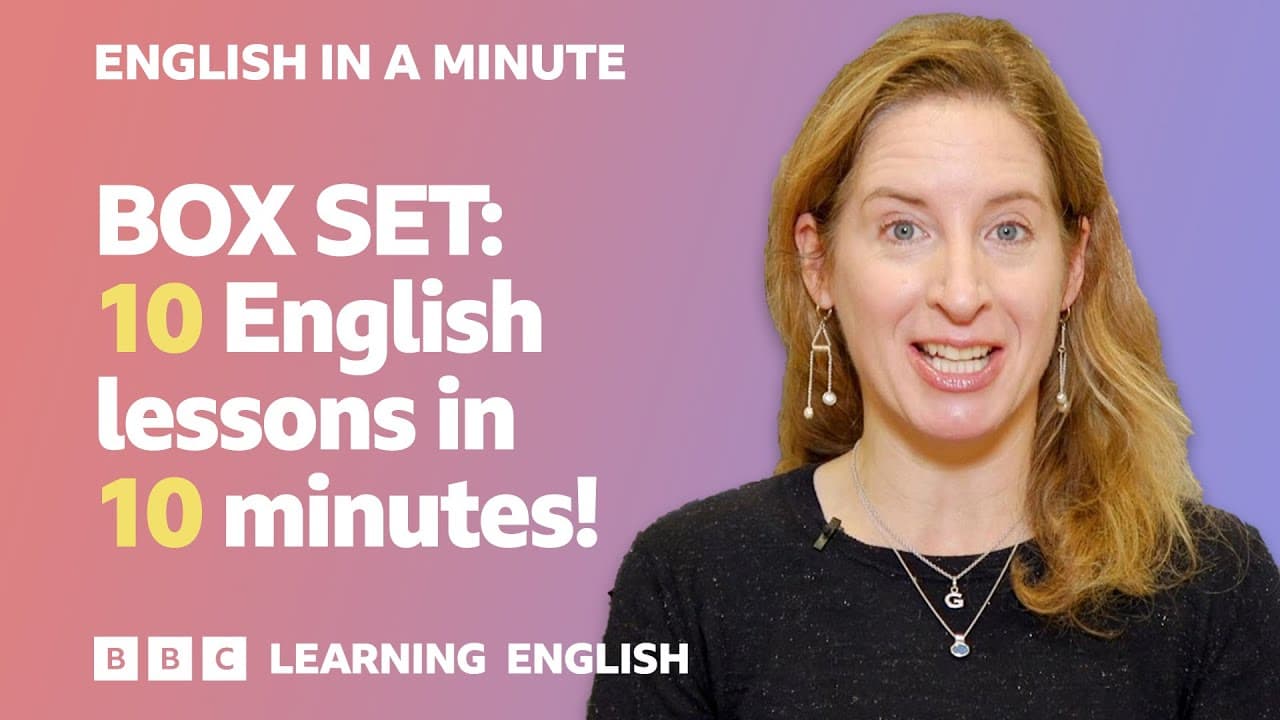
BOX SET: English In A Minute 10 – TEN English lessons in 10 minutes!
TL;DR
Learn essential English grammar and vocabulary in 10 minutes.
Transcript
'every', and 'whole'? They all have similar meanings but are used in different ways. 'All' means the whole amount of something. 100 percent. It is often followed by uncountable nouns or plural nouns. He ate all the sugar. All children love sweets. 'Every' has a similar meaning to 'all' - it means 'each one without exception'. I go to the gym ev... Read More
Key Insights
- The lesson clarifies the usage of 'all', 'every', and 'whole', emphasizing their differences and appropriate contexts.
- It explains the distinction between 'each' and 'every', highlighting their use in referring to individual versus collective entities.
- The word 'through' has multiple meanings, including physical space, time, method, and completion, each used in different contexts.
- The lesson covers how to express wishes using the past tense for present wishes and past perfect for past wishes.
- Infinitives of purpose are used to explain the reason behind actions, with 'to' for verbs and 'for' for nouns.
- Formal apologies can be made using various phrases, with 'afraid' used in a formal context to express regret.
- British slang words like 'gutted', 'knackered', 'skint', and 'loaded' are explained for informal communication.
- The differences between 'on time' and 'in time' are discussed, focusing on schedule adherence versus successful timing.
Install to Summarize YouTube Videos and Get Transcripts
Explore YouTube Video Summarizer or Get YouTube Transcript Extractor
Questions & Answers
Q: What are the differences between 'all', 'every', and 'whole'?
The lesson explains that 'all' refers to the whole amount of something and is often followed by uncountable or plural nouns. 'Every' means each one without exception and is used with singular nouns. 'Whole' indicates the complete amount and is used with uncountable or singular nouns.
Q: How do 'each' and 'every' differ in usage?
In a group, 'each' refers to individual things in turn, while 'every' refers to all things together. 'Each' is used for two or more items, and 'every' is used for three or more. Additionally, 'each' can be a pronoun, whereas 'every' cannot.
Q: What are the common uses of the word 'through'?
The word 'through' can mean from one side to the other (physical space), from start to finish (time), using something (method), or completed (finished). Each meaning is context-dependent, and the lesson provides examples to illustrate these usages.
Q: How should wishes be expressed in English?
To express wishes about the present, use the past tense after 'I wish'. For past wishes, use the past perfect tense. This structure indicates that the wish is imaginary or unreal, helping to convey the desired sentiment effectively.
Q: What is the infinitive of purpose in English grammar?
The infinitive of purpose is used to explain why an action is performed. It involves using 'to' followed by a verb. For example, 'I went home to eat.' When using a noun, 'for' is used instead, such as 'I went home for food.'
Q: How can formal apologies be made in English?
Formal apologies can be made using phrases like 'sorry', 'excuse me', 'pardon me', and 'I sincerely apologize'. The word 'afraid' is also used in formal contexts to express regret. After 'afraid', a full clause or sentence follows to complete the apology.
Q: What are some British slang words mentioned in the lesson?
The lesson introduces British slang words such as 'gutted' (very sad or disappointed), 'knackered' (extremely tired), 'skint' (having little or no money), and 'loaded' (very rich). These words are used informally and add color to everyday conversations.
Q: What is the difference between 'on time' and 'in time'?
'On time' refers to adhering to a schedule or deadline, while 'in time' means not being too late to achieve success. The lesson emphasizes the importance of both terms, noting that sometimes being 'on time' is necessary to be 'in time'.
Summary & Key Takeaways
-
This lesson provides a comprehensive overview of essential English grammar and vocabulary, focusing on words like 'all', 'every', and 'whole'. It clarifies their usage and contexts, helping learners understand subtle differences and improve their language skills.
-
It delves into the use of 'through' and its various meanings, such as physical space, time, and completion. Additionally, the lesson covers expressing wishes and using infinitives of purpose, offering practical examples to illustrate these concepts.
-
The lesson also explores formal apologies, British slang, and the distinctions between 'on time' and 'in time'. These insights aim to enhance learners' understanding of English nuances and improve their communication abilities.
Read in Other Languages (beta)
Share This Summary 📚
Summarize YouTube Videos and Get Video Transcripts with 1-Click
Try YouTube Summary with ChatGPT & Claude or YouTube Transcript Generator
Explore More Summaries from BBC Learning English 📚
Summarize YouTube Videos and Get Video Transcripts with 1-Click
Try YouTube Summary with ChatGPT & Claude or YouTube Transcript Generator