DC series motor | Compound Machine | Types of DC Machines | Lec-23
TL;DR
This session explains series motors, back EMF, and compound machines.
Transcript
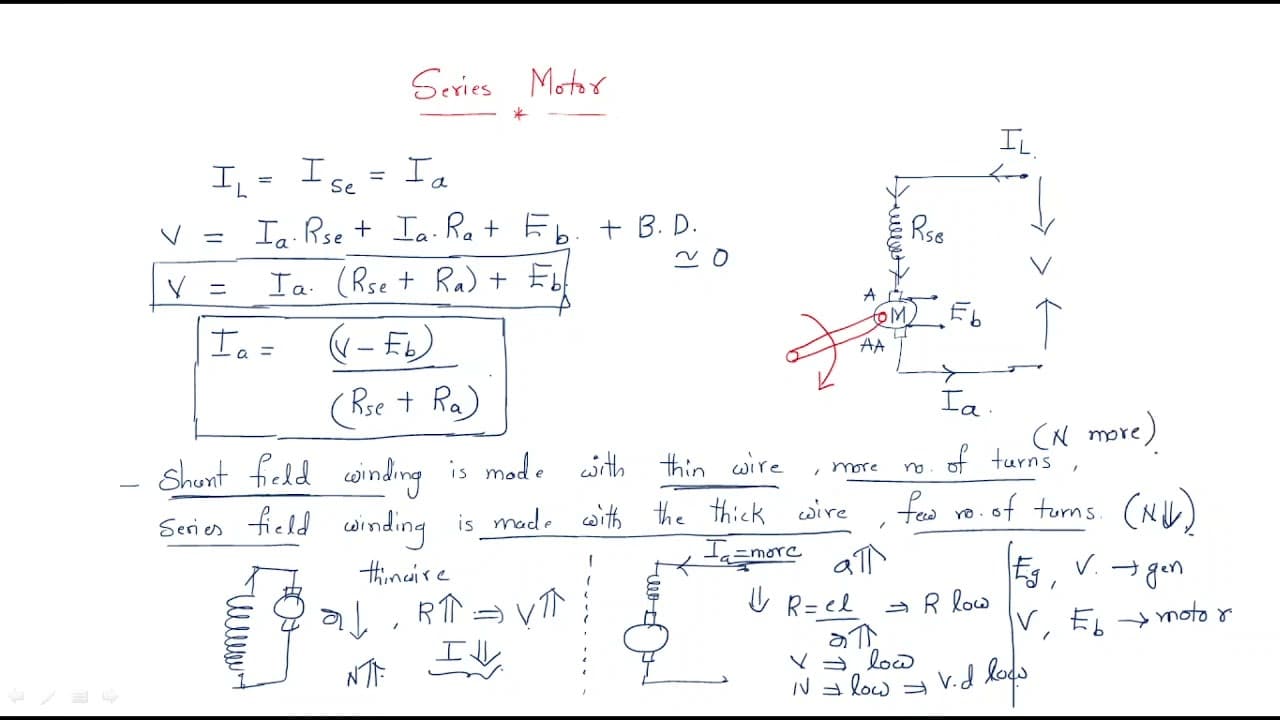
hello everyone in this session we'll discuss about the series motor in the last session we discussed about the series generator so motor and generator already you know the difference here the motor always takes the supply electrical supply will be taken so this is the input supply okay and this is the motor having the two windings two armature term... Read More
Key Insights
- 🥺 Series motors rely on the same current flowing through the load, armature, and field windings, leading to uniform operational characteristics.
- ⚡ The supply voltage in a series motor is influenced by voltage drops across the armature, field windings, and back EMF.
- 😘 Shunt field windings have higher resistance and are designed for low current applications, whereas series windings handle high current with lower resistance.
- 🧑🦼 Understanding the role of wire thickness and resistance in windings is crucial for designing efficient motors.
- ⚾ Compound machines can be classified as cumulative or differential based on how their series and shunt windings are configured.
- 🧑🦼 The performance of series motors can be optimized by managing the load current and its impact on armature and back EMF.
- 🧑🦼 Proper knowledge of series motors and their dynamics is essential for applications requiring variable torque and speed control.
Install to Summarize YouTube Videos and Get Transcripts
Explore YouTube Video Summarizer or Get YouTube Transcript Extractor
Questions & Answers
Q: What is the primary function of a series motor?
A series motor primarily converts electrical energy into mechanical energy using electrical supply as input. When voltage is applied, the motor generates mechanical power which facilitates the rotation of the armature. The unique characteristic of series motors is that the field winding is connected in series with the armature, meaning the same current flows through both.
Q: How does back EMF affect the operation of a series motor?
Back EMF (Electromotive Force) is an essential factor in motor operation, arising from the motor’s rotation. It counteracts the applied voltage, reducing net voltage across the armature. This phenomenon limits the current flowing through the armature and impacts the overall efficiency of the motor. Understanding back EMF is crucial for calculating armature current and designing motor control systems.
Q: What differentiates shunt field windings from series field windings?
Shunt field windings typically utilize thinner wires and have a higher number of turns, resulting in high resistance and lower current flow. In contrast, series field windings use thicker wires with fewer turns, offering lower resistance and allowing for higher current flow. These differences impact voltage drops and resistance in electric motors, influencing their performance characteristics.
Q: Can you explain the difference between cumulative and differential compound machines?
A cumulative compound machine features both shunt and series field windings connected in a manner that their magnetic fields enhance each other, promoting greater torque and stability. Conversely, a differential compound machine has the windings connected so that one field opposes the other, resulting in reduced overall torque and potential instability at varying load conditions.
Summary & Key Takeaways
-
The session discusses series motors, focusing on their operation and the relationship between supply voltage, armature current, and back EMF.
-
Key differences between shunt field and series field windings are highlighted, including wire thickness and resistance characteristics.
-
The presentation also covers the concept of compound machines, distinguishing between cumulative and differential types based on the arrangement of field windings.
Read in Other Languages (beta)
Share This Summary 📚
Summarize YouTube Videos and Get Video Transcripts with 1-Click
Try YouTube Summary with ChatGPT & Claude or YouTube Transcript Generator