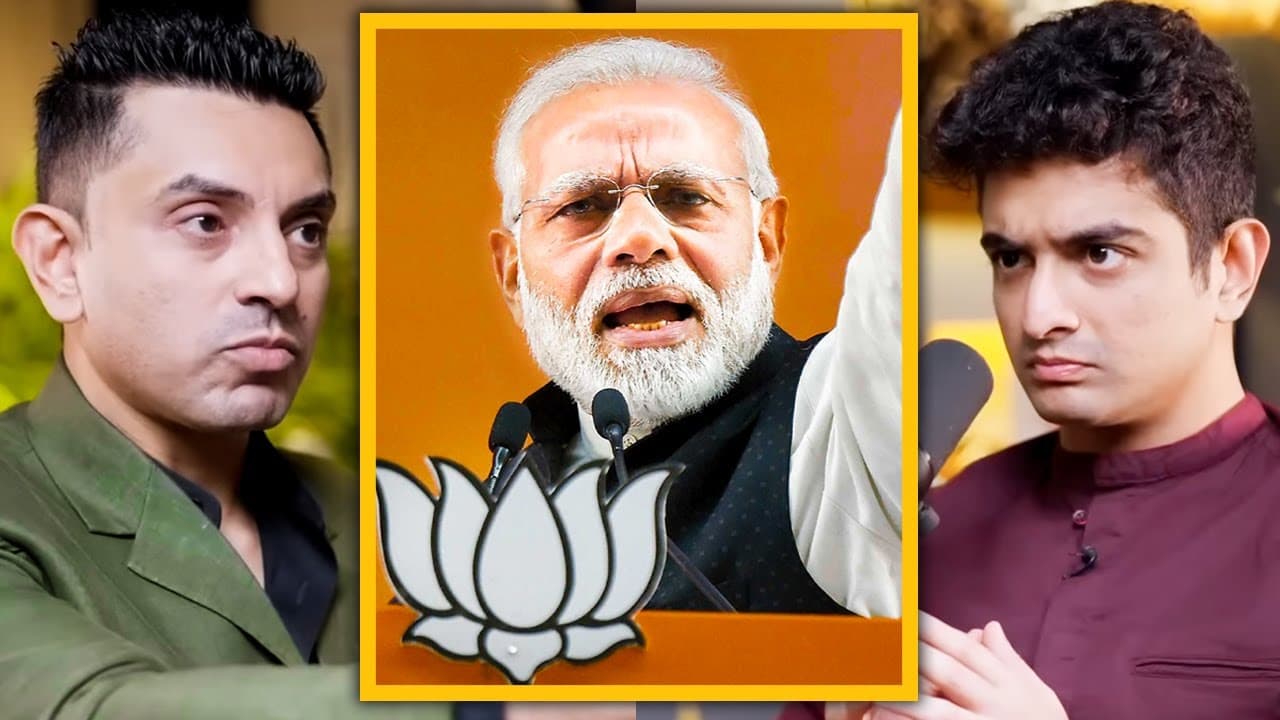
Criticisms Of The Modi Govt - That The Media Will Never Tell You Honestly - Tehseen Poonawalla
TL;DR
The speaker critiques the Indian government's economic policies, arguing they are more leftist than perceived.
Transcript
happiness through Curiosity on DRS clips India there's no right and left let's be very clear Pro and anti-pro there's no right and left in in uh I'm gonna make this as simple for the college people the BJP in my opinion is economically left it's not economically right break that down so many of the bjp's policies economic policies are actually soci... Read More
Key Insights
- 😘 The BJP's economic policies may reflect socialist tendencies despite its right-wing image, leading to more government intervention in markets.
- 🫵 Political strife and polarization are viewed as significant barriers to economic growth and stability in India.
- 🖤 A substantial number of wealthy individuals are relocating or investing abroad due to restrictive business environments and perceived lack of opportunities.
- 👀 Young Indians are increasingly looking for merit-based opportunities that prioritize innovation over government favoritism.
- 🤔 The need for the opposition to articulate specific and forward-thinking policies is critical to engaging young voters disillusioned with traditional politics.
- 🕸️ The government has been criticized for failing to address major sectors like Web 3.0 and artificial intelligence, potentially missing opportunities for global leadership in emerging technologies.
- 🙈 India has seen substantial economic growth, but the full potential remains untapped due to political challenges and inefficient governance.
Install to Summarize YouTube Videos and Get Transcripts
Explore YouTube Video Summarizer or Get YouTube Transcript Extractor
Questions & Answers
Q: What are the main criticisms of the BJP's economic policies according to the speaker?
The speaker criticizes the BJP's economic policies for being more leftist in nature, highlighting government control over essential commodities like oil and rice. The argument is that true capitalism would not allow the government to dictate market prices, indicating a socialist tendency in their governance approach.
Q: How does the speaker view the role of political strife in India's economic growth?
The speaker emphasizes that political strife, specifically the Hindu-Muslim divide fostered by the BJP, has detrimental effects on economic growth. They argue that peace and rule of law are necessary for fostering a conducive environment for economic advancement, and the continued polarization undermines growth.
Q: What are the perceived consequences of government policies on entrepreneurship and business in India?
The speaker suggests that restrictive policies and draconian laws, particularly those enforced by the government, lead to a perception of risk among entrepreneurs. This environment deters investment and innovation, resulting in a migration of talent and resources away from India toward places with more favorable conditions for business.
Q: Why do some wealthy Indians choose to give up their citizenship or invest abroad, according to the discussion?
The speaker notes that many high-net-worth individuals are moving to places like Dubai or giving up their Indian citizenship due to oppressive government policies, lack of opportunities, and a desire for better quality of life. The perception that economic growth is concentrated among a few also drives this trend.
Q: In what ways does the speaker believe Congress could improve its political strategy against the BJP?
The speaker advises Congress to provide a clear vision and specific policies to attract young voters, rather than solely criticizing the BJP. By focusing on innovation, technology, and creating job opportunities, Congress could differentiate itself and appeal to the electorate seeking reform.
Q: What examples does the speaker provide of missed economic opportunities under the current government?
The speaker references the lack of robust policies regarding Web 3.0 and artificial intelligence as areas where India is lagging. They argue that without a cohesive plan for emerging technologies, India risks losing its competitive edge in the global marketplace.
Q: How does the discussion relate to India's status in the global economy?
The speaker acknowledges that while India has seen economic growth and is projected to become the third-largest economy, this progress has not been uniform. They highlight that growth is limited by political polarization and ineffective policies that fail to mobilize the country's potential fully.
Summary & Key Takeaways
-
The speaker argues that the BJP’s economic policies resemble socialist approaches more than true capitalism, as seen in their control over market prices such as rice and oil.
-
Despite India's recent economic growth, the speaker believes the potential for further advancement has been hampered by political strife and polarization, particularly under the current government.
-
The conversation highlights the need for the opposition, particularly Congress, to articulate a clear vision for the future to appeal to younger voters eager for innovation and opportunity.
Read in Other Languages (beta)
Share This Summary 📚
Summarize YouTube Videos and Get Video Transcripts with 1-Click
Try YouTube Summary with ChatGPT & Claude or YouTube Transcript Generator
Explore More Summaries from TRS Clips 📚




Summarize YouTube Videos and Get Video Transcripts with 1-Click
Try YouTube Summary with ChatGPT & Claude or YouTube Transcript Generator