Permutations and Combinations | Colour balls | Vowels together | Aptitude | Part- 22 | Bharath Kumar
TL;DR
This content discusses how to calculate arrangements of letters with vowels always grouped together.
Transcript
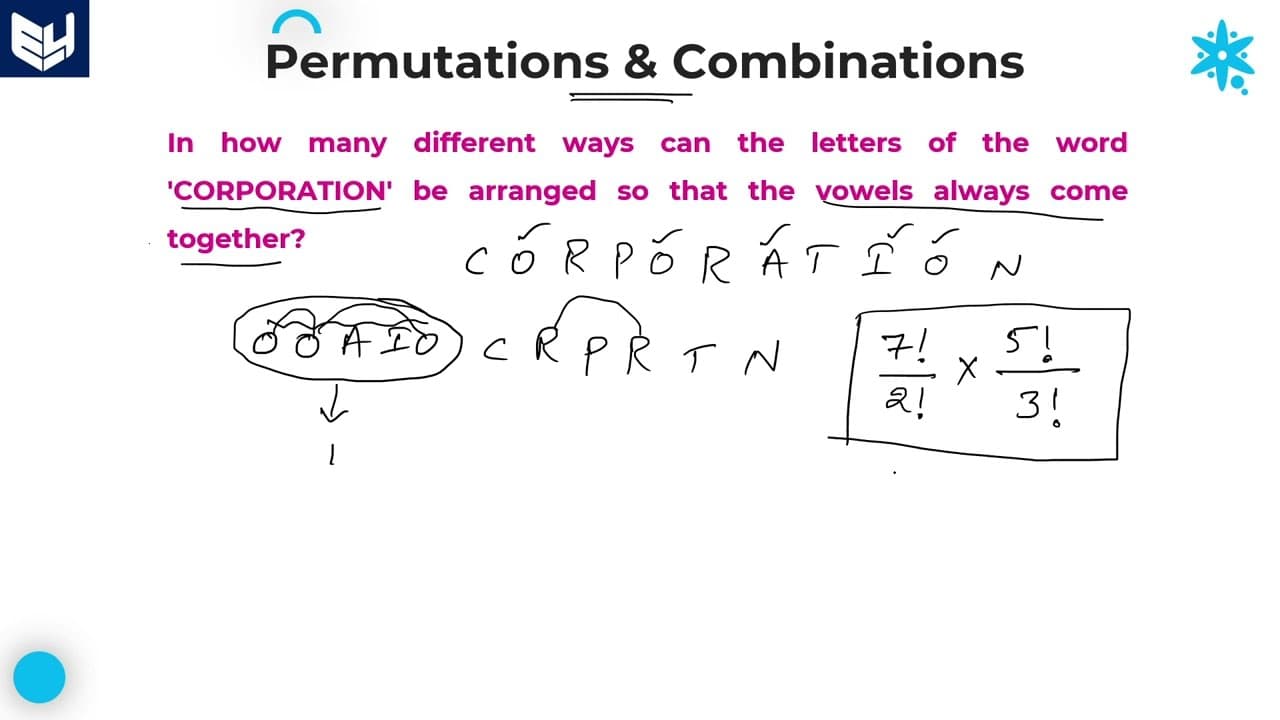
hi everyone welcome to this session in this session i am continuing the problems related to permutations and combinations see the first question see here in how many different ways can the letters of the word corporation be arranged so that vocals always come together here the word which is given as a corporation here the word is given as corporati... Read More
Key Insights
- 💌 Permutation problems often involve conditions like grouping specific letters, which simplifies the calculation.
- 💌 The concept of treating a group of letters as a single entity is essential for managing complex arrangements.
- 💌 Understanding repeated letters is vital as they alter the total count of unique arrangements through division by factorials.
- 🛀 Each example in the content shows a step-by-step approach, reinforcing the process of solving similar problems.
- 🥺 The importance of clearly identifying vowels and consonants in a word can lead to efficient solutions in permutation problems.
- ❓ Calculating arrangements involves detailing both external groupings and their internal arrangements to ensure thorough understanding.
- 🏛️ Mastery of permutations requires practice with various examples to build confidence in using factorial calculations effectively.
Install to Summarize YouTube Videos and Get Transcripts
Explore YouTube Video Summarizer or Get YouTube Transcript Extractor
Questions & Answers
Q: Why is it important to treat vowels as a single entity?
Treating vowels as a single entity simplifies the problem of arrangements while ensuring that they remain together. It allows us to focus first on arranging consonants and then factor in the internal arrangements of the vowels afterward. This approach leads to clearer calculations and accurate results in permutation problems.
Q: How do repeated letters affect the calculation of arrangements?
Repeated letters affect arrangements by decreasing the total unique permutations. For instance, in the word "corporation," the repeated letter 'r' divides the total arrangements by the factorial of the number of times 'r' appears. This ensures we don't overcount identical arrangements that result from swapping identical letters.
Q: Can you explain the process for calculating the arrangements of the word "mathematics"?
First, treat the vowels 'a', 'e', and 'i' as a single entity, then count remaining letters, accounting for any repetitions. The arrangement is calculated using factorials for both the group of consonants and the vowels, adjusting for any letters that repeat. This method yields a precise count of unique arrangements.
Q: What is the role of factorials in calculating arrangements?
Factorials are crucial in calculating arrangements as they represent the total permutations of a set number of items. In permutations with restrictions, such as vowels together, factorials are used to count both the whole set and subsets while adjusting for repetitions, enabling accurate total arrangement counts.
Summary & Key Takeaways
-
The video session explains how to solve permutation problems, particularly focusing on arrangements where vowels must stay together.
-
It illustrates various examples, including the words "corporation," "mathematics," and "hyderabad," breaking down the calculation steps for vowel arrangements.
-
The content emphasizes the importance of accounting for repeated letters when calculating total arrangements, using factorials to derive answers.
Read in Other Languages (beta)
Share This Summary 📚
Summarize YouTube Videos and Get Video Transcripts with 1-Click
Try YouTube Summary with ChatGPT & Claude or YouTube Transcript Generator