Applying Artificial Intelligence: Culture, Change, Comunication (Interview)
TL;DR
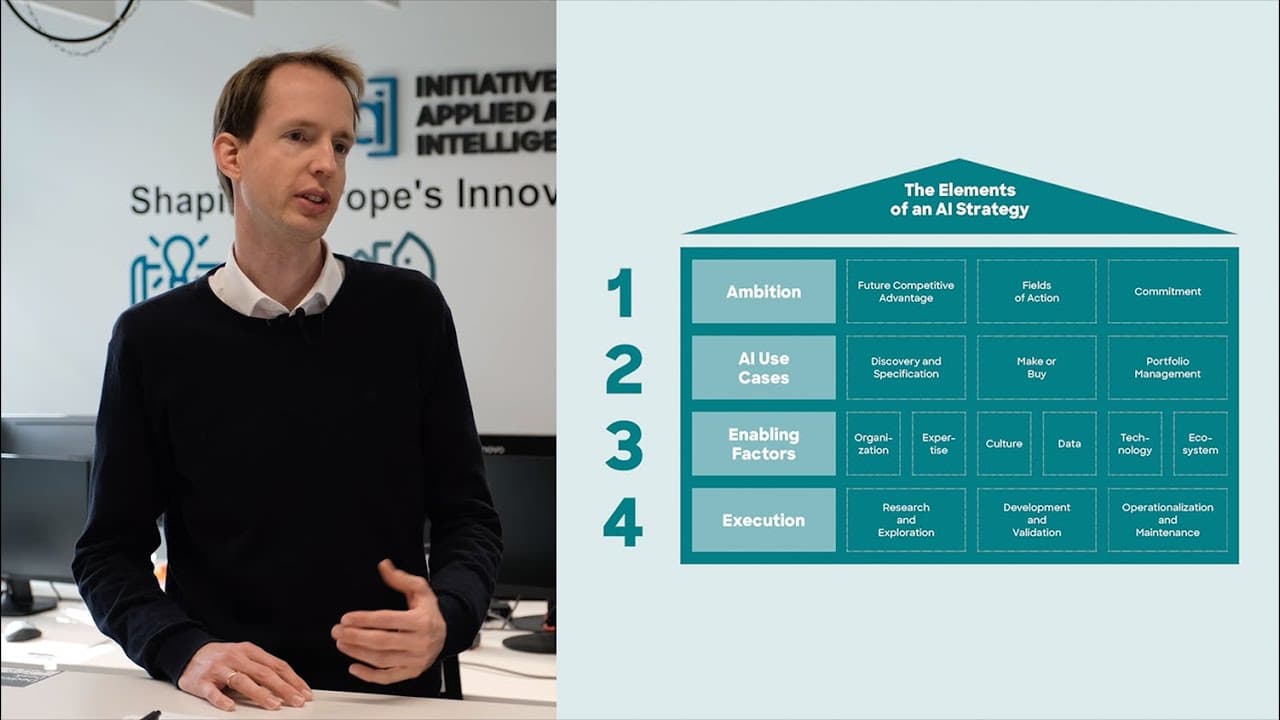
Companies need to think comprehensively about implementing AI, focusing on defining their ambition, finding the right use cases, creating the enabling factors, and executing their use cases, while addressing the challenges of culture and communication.
Transcript
foreign for companies to create value for my eye they need to think about it comprehensively can not only just take the technology and put it on a single processes and to hope that this will create value heads of AI strategy consists of four parts first you need to Define your ambition that's your Northstar like where do you want to go with AI and ... Read More
Key Insights
- 🪡 Companies need to define their AI ambition and implement the necessary changes.
- 😒 Identifying use cases that add value and relate to each other is essential for successful AI implementation.
- 😒 Creating the right environment and executing use cases effectively are often overlooked aspects of AI transformation.
- 💙 AI impacts jobs at scale, both blue-collar and white-collar work.
- 💦 Working with uncertainty in AI predictions requires understanding and decision-making beyond human capabilities.
- 😨 Transparent communication, case studies, and training help address fears and build trust in AI.
- 🤩 Putting humans at the center and empowering the organization are key to overcoming AI implementation challenges.
Install to Summarize YouTube Videos and Get Transcripts
Explore YouTube Video Summarizer or Get YouTube Transcript Extractor
Questions & Answers
Q: What are the four parts of an AI strategy for companies?
The four parts of an AI strategy are defining ambition, identifying use cases, creating enabling factors, and executing use cases. Defining ambition sets the direction, finding use cases adds value and relates to each other, creating enabling factors allows implementation, and executing use cases ensures successful AI implementation.
Q: What are the challenges companies face when implementing AI?
Companies face challenges such as AI impacting jobs at scale, working with uncertainty in predictions, and decision making beyond human capabilities. AI affects all job roles, requires dealing with uncertainty in predictions, and demands trusting the system's predictions based on data.
Q: How can companies overcome the challenges of AI implementation?
Companies can overcome AI implementation challenges by transparently communicating about AI, using case studies and presentations to remove fear, and providing training to develop the necessary skills. Putting humans at the center and empowering the organization through understanding, training, and setting the right directions are crucial.
Q: Why is culture and communication important in AI transformation?
Culture and communication are important in AI transformation because changing the behavior and mindset of employees is challenging. By actively communicating about AI, addressing fears, and providing training, companies can create a culture that embraces AI and effectively implement it.
Summary & Key Takeaways
-
Companies must define their AI ambition and identify necessary changes.
-
Finding the right use cases that add value and how they relate to each other is crucial.
-
Creating the right environment and executing the use cases effectively are important factors for successful AI implementation.
Read in Other Languages (beta)
Share This Summary 📚
Summarize YouTube Videos and Get Video Transcripts with 1-Click
Try YouTube Summary with ChatGPT & Claude or YouTube Transcript Generator
Explore More Summaries from UnternehmerTUM 📚




Summarize YouTube Videos and Get Video Transcripts with 1-Click
Try YouTube Summary with ChatGPT & Claude or YouTube Transcript Generator